

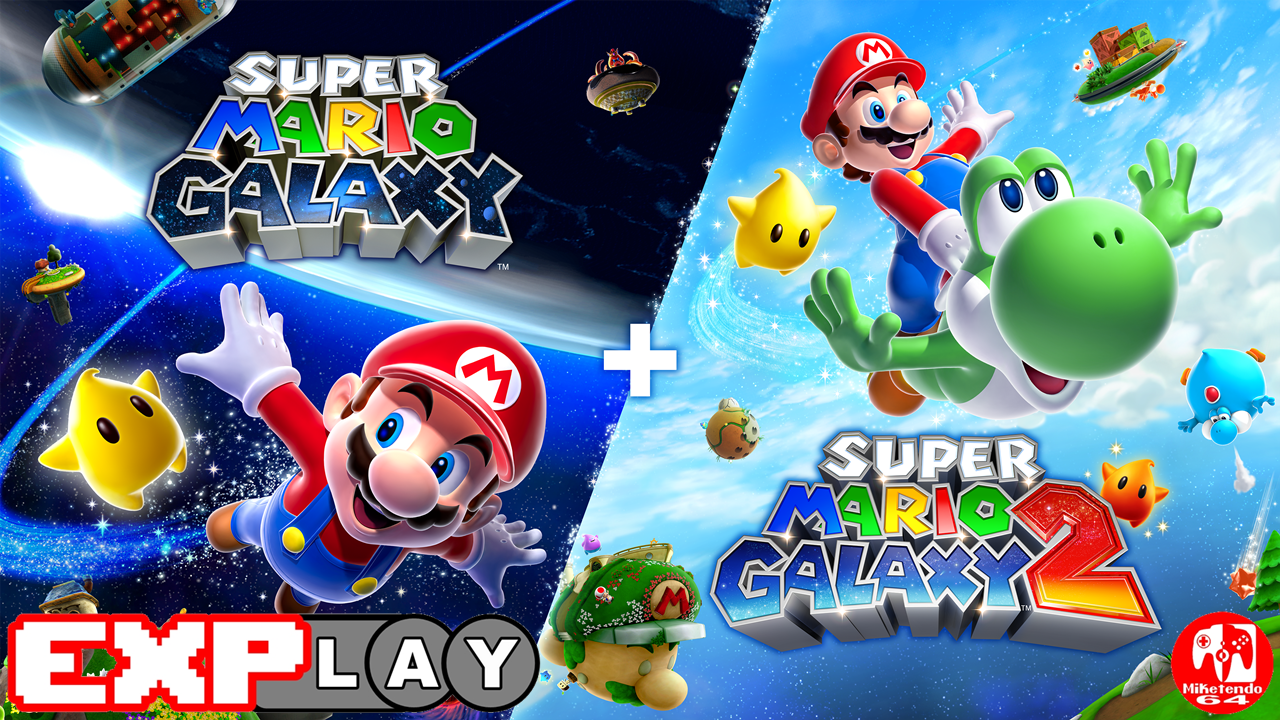
Welcome to EXPlay,(Explain & Play) the review series where we care not for scores but tell it how it is when it comes to every game we get our hands on, whilst also taking the time to include some lengthy gameplay, to give you, the reader, the chance to shape your own impressions and views whilst watching and reading.
In this installment, we’re covering Super Mario Galaxy 1+2 by developer, Nintendo Software Technology.

Super Mario Galaxy + Super Mario Galaxy 2 (Nintendo Switch)
Now, I will just say that I did play both games on the Wii when they first released in 2007 and 2010, respectively. They were truly exceptional titles in their time, and that is a statement I still stand by today. Not only did it take the Super Mario series to new heights in terms of gameplay and themes (I’m in Space, Man!), but the use of motion controls and how the different planetoids had their own gravitational pull that would influence how Mario moved between them was quite the marvel.
For the sake of this review, even though both games can be purchased individually or together in a bundle, I will be reviewing both Super Mario Galaxy and Super Mario Galaxy 2 simultaneously for the most part and shall now refer to both games as Super Mario Galaxy 1+2. However, if I talk about one game in particular, I shall refer to it by its original title. There are some noticeable differences between the Nintendo Switch and Switch 2 versions of both games, which I shall also go into more detail about later in this review.
So, first off, let’s talk story. In Super Mario Galaxy, a special festival is being held in the Mushroom Kingdom. Mario has been invited by Peach to join her for the festival, and on his way to Princess Peach’s Castle, Bowser and his fleet of airships cause chaos and abduct not just Princess Peach, but her entire castle as well. Bowser then takes off into the great expanse of space, leaving Mario behind. Mario is befriended by a celestial being known as a Luma, who takes Mario to meet Mama, the guardian of the stars, who is revealed to be Rosalina. Rosalina offers Mario the opportunity to rescue his loved one, but in order to do so, they will need to reclaim Power Stars from nearby galaxies that have been stolen by Bowser, in order to fuel the Comet Observatory so it can navigate its way to the center of the universe where Bowser is hiding.
In Super Mario Galaxy 2, Bowser is once again up to his Princess kidnapping tricks, and Mario has to navigate the galaxies once more to rescue Princess Peach. This time though, Mario enlists the help of the Lumas and that of Captain Lubba and his planetoid starship that remodels itself on the face of our titular hero. This is pretty much the gist of both games and basically explains why Mario is travelling to different galaxies in the first place. Parallel to the main game, we get to learn more about the Lumas and Rosalina through a storybook. As you progress through either game, new chapters are added to the storybook, and you can read them at any time on board the Comet Observatory or Starship Mario when you are not bopping Goombas or collecting power stars.
Now, on the subject of gameplay, Super Mario Galaxy 1+2 will have players putting their 3D platforming skills to the test as they run, jump and use power-ups through each stage. If you have not played these games before, I shall give you a brief overview. If you have played Super Mario Galaxy and/or Super Mario Galaxy 2, then you can just skip the next few paragraphs. Each stage in (or Galaxy as they are referred to) houses a number of Power Stars for Mario to collect. You can only collect one star per run through each stage, but the title of the star gives you a hint of where you may find it, or if you have to face a boss and defeat them before you can claim the star.
Some stages start off relatively straightforward forward but they do get more and more complex the deeper you get into the game. You can occasionally access branching paths that give you the option to play one galaxy or another, but you will always find yourself playing through both anyway. It’s just a matter of which galaxy you would like to play first.
To help you with collecting stars, you can find power-ups that grant Mario special attributes like the drill, which allows you to burrow into the ground, the bee outfit allows you to fly, the cloud power-up allows you to create temporary cloud platforms, and Spring Mario lets you jump super high, although it can take a little getting used to controlling. There are plenty more power-ups that you can use, but I shall let you discover them on your own.
Power-ups are not the only thing that Mario has at his disposal, as he can also stomp on top of enemies, which will, in turn, grant him coins that can help replenish his health. Mario can also spin attack into enemies to make them dizzy and then give them a kick, making the enemies drop star bits. These star bits have multiple uses, as collecting 50 will grant Mario an extra life, as well as being fed to Lumas to turn them into star-shaped slingshots that will shoot Mario off to newly accessible areas. They also have the added benefit of being used to attack enemies when you hover the cursor over them and press ZR to fire.
So, let’s talk new features and content. Straight off the bat, Super Mario Galaxy 1+2 has received a graphical overhaul with upgraded visuals for both the Nintendo Switch and the Nintendo Switch 2, the latter of which supporting native 4K in TV Mode and 1080p in Handheld via a free update. An assist mode has been added to both games that will start Mario off with a Super Shroom that grants him six health as opposed to the standard three, and he can heal himself by standing still. Should Mario fall into space or towards a black hole, he will simply be returned to the safety of solid ground instead. The storybook in Super Mario Galaxy has a new additional chapter added to it, while an all-new storybook has been added to Super Mario Galaxy 2.
Each game also has its own original soundtrack that can be played from the main menu and totals about 154 songs in total. While you can essentially use your Switch or Switch 2 as a music player to listen to these songs, it isn’t like Super Smash Bros. Ultimate, where you can blacken the screen and still listen to music. If you turn the screen off, the console will simply enter sleep mode and turn the music off. Oh, I should also add that there will be amiibo support with two new amiibo releasing in April 2026, just in time to tie in with the Super Mario Galaxy Movie.
One thing you may be asking is, “Does the Switch 2 version of Super Mario Galaxy 1+2 have mouse controls?” The short answer is yes, but there is a catch. When playing in single player, you can only use the Joy-Con’s or Pro Controller’s gyro controls to move the cursor across the screen. As the original games used the Wiimote’s IR sensors to detect where the cursor would be on the screen, the gyro controls have become the replacement for this due to the lack of a sensor bar with the Nintendo Switch and Switch 2. The catch with this is that Gyro controls are not as precise and are more prone to deviating on screen, so you will be recentering the cursor much more often than you would be with a Wiimote. On the plus side, you can swing the right Joy-Con to do a spin attack, much like you would with the waggle of a Wiimote.
Back to mouse controls, though. These are actually only accessible for the Nintendo Switch 2 when playing in multiplayer and can only be used by the second player, who is displayed on screen as a Luma. Player two can use a Joy-Con 2 as a mouse to move their cursor and fire star bits at enemies. Player 1 does not have this option and can either play with the other Joy-Con 2 horizontally or, alternatively, they can play with a Pro Controller. It does seem a little weird that Super Mario Galaxy 1+2 doesn’t have the option to use mouse controls in single player mode, when it is something that is freely implemented in the likes of Metroid Prime 4: Beyond. I can only imagine that it has something to do with the spin attack being assigned to gyro controls, but surely there could be a workaround that would disengage the spin attack from gyro when the controller is in Mouse Controls mode, and players would have to use the Y button instead, which is used to spin attack as well, anyway.
One important aspect that I should touch upon is some key differences between Super Mario Galaxy and Super Mario Galaxy 2. The first game has a deeper story with more emphasis on exploration as opposed to the second’s focus on enriching gameplay. SMG 1 uses the Comet Observatory as a hub world with different areas granting access to their own galaxies, whereas in Super Mario Galaxy 2 all the galaxies are accessed by a more streamlined and linear map. The second game also includes the likes of Yoshi whom Mario can ride around on, newer power-ups and more galaxies to play through. Luigi is a playable character in both games, but he is only unlockable in Super Mario Galaxy upon 100% completion of the game, whereas in Super Mario Galaxy 2, you can find him and play as him from World 3 or so.
Being able to play Super Mario Galaxy 1+2 on Nintendo Switch 2 has rekindled my love for these games once again. I am truly grateful that I can play these both with updated visuals that make them look even better than ever and the gameplay is still so much fun. It has been an absolute joy to be able to play these games again, even though I had already played and own Super Mario Galaxy as part of Super Mario 3D All-Stars. It just goes to show that I am an absolute sucker that will keep buying the same game over and over again every time Nintendo decide to rerelease it for current systems.
To be honest though, even though Nintendo UK did provide me a code for both Super Mario Galaxy and Super Mario Galaxy 2. I did pick up the game physically as well for Nintendo Switch. Although I do not approve of the $70 markup to buy the game physically or $80 to download both games from the eShop, I am fortunate enough that I have a local video game store that accepts trade-ins towards new releases. This means that by trading in a couple of games that I just don’t play any more, I could acquire Super Mario Galaxy 1+2 without paying any extra. Also, it is worth noting that the likes of Amazon and other online retailers have the physical version available at discount prices to help you save even more money should you want to pick up both of these fantastic Mario titles.
Super Mario Galaxy 1+2 is a brilliant compilation of Mario’s interstellar adventures for Nintendo Switch and Nintendo Switch 2. The astronomical price for these games is quite the letdown and is sure to put a lot of folks off, but let me just say that there are a number of retailers who are sold out on stock because long-time fans know just how great they were and still are. If you happen to own both games already for Wii, then you can always boot up the console and play them there. If you haven’t played Super Mario Galaxy or Super Mario Galaxy 2 before, then now is as good a time as any to experience them for the first time and in 4K too! (for Nintendo Switch 2, of course).
Game Specifications:
Developer: Nintendo Software Technology
Publisher: Nintendo
Platforms: Nintendo Switch, Nintendo Switch 2
Category: Action, Adventure
No. of Players: 1-2 player (Single System)
Release Date: October 2, 2025
Price: $69.99
File Size: 3.7 GB + 2.8 GB
Nintendo.com Listing

Share this:

Discover more from
Subscribe to get the latest posts sent to your email.