

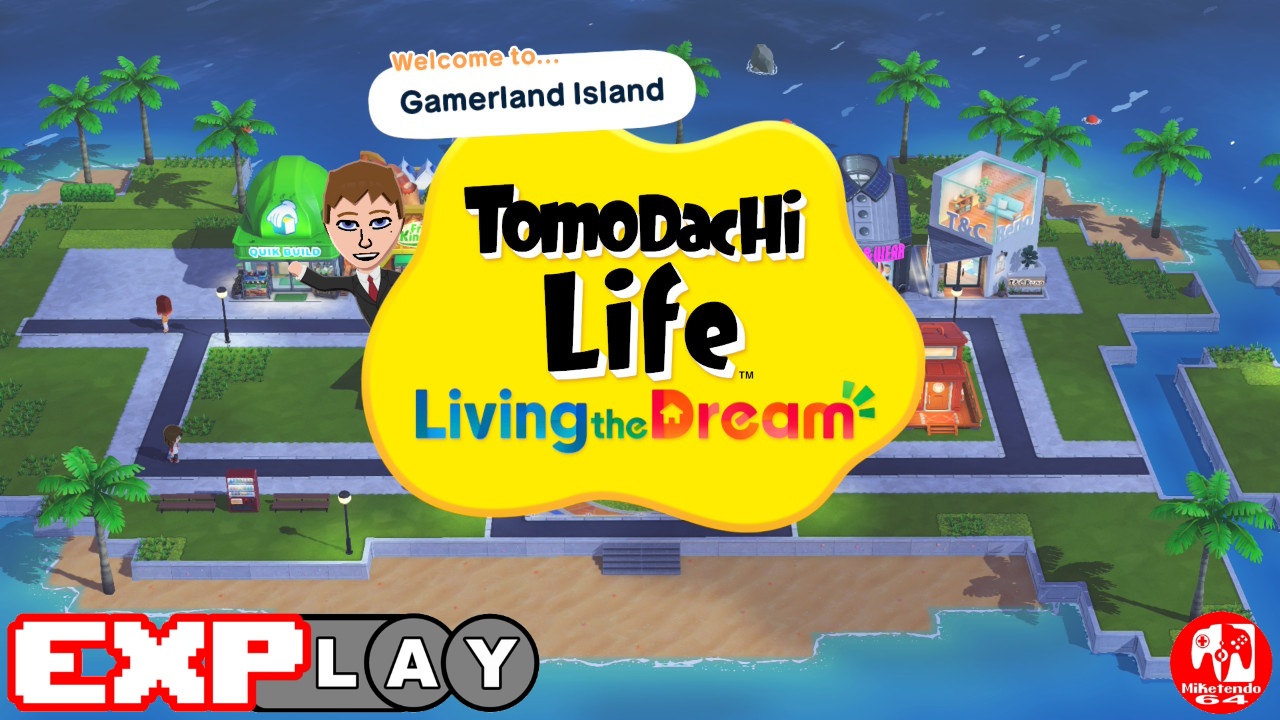
Welcome to EXPlay, (Explain & Play) the review series where we care not for scores, but tell it how it is when it comes to every game we get our hands on, all whilst including some lengthy gameplay, to give you, the reader, the chance to form your own impressions and views while reading and watching.
In this explanatory review, we’re covering Tomodachi Life: Living The Dream by developer Nintendo:

Tomodachi Life Living The Dream (Nintendo Switch)
Hurrah! The Miis have returned once again in Tomodachi Life: Living The Dream. The game has been released on Nintendo Switch and is also compatible with Nintendo Switch 2 as well. It is hard to believe that this game has spent nine years in development, according to a recent Ask the Developer Interview over on the official Nintendo.com website. Still, it’s true, and at long last, we can all partake in the wacky shenanigans once again with our endearing Mii characters.
Tomodachi Life: Living The Dream is a cozy sim game with a wild side. You are put into the role of an island caretaker who must serve the island residents and fulfil their needs. The island residents are made up of Miis that you can create from likenesses of your own friends and families, or perhaps you want to add famous people and characters like Super Mario, Shrek, Jack Black, or Tom Cruise; the limit really is your own imagination.
As you start the game, you will have a deserted island with a few trees, and that’s it. You will then go through a tutorial to help populate the island with Mii characters that you can create from scratch or import from your Nintendo Switch or Switch 2 console. If you are somewhat lacking in the Mii department on your console, but own Miitopia, you can actually export any Miis you have saved in that game to your console and then import them to Tomodachi Life: Living The Dream. Bear in mind, though, that any makeup you have applied to your Miis in Miitopia will not be exported. You will only get the base Mii and the default features you have applied to them.
Once you have created your first Mii character, you will then be asked to input a name (which you can also write out the pronunciation of as well), their date of birth (should you wish to include one), and ultimately some parameters that will form their personality. Once you have confirmed your choices, it is time to place their home on the island and let them start living their best life. You can then go on to add more Mii Characters, who will then have an extra option of whether they are related to anyone else on your island in what capacity (partner of, sibling to, parent of, etc.).
Once you have placed some Miis, it is time to feed them, clothe them, and help them get to know one another to become friends or even fall in love. You can give them topics of interest to talk about that they may share in common, and this is where the fun part begins. There are literally no filters in place, and the Miis will discuss anything and anything your twisted mind can think of. The amount of videos I have seen of Miis in Tomodachi Life: Living The Dream talking about the most unhinged things you can think of cracks me up every time. I won’t reveal examples as I want to keep this family-friendly, but what I will say is that if you can think it, you can write it into this game.
Unfortunately, there is a downside to this level of freedom, and that is not being able to share your screenshots and videos easily on Social Media. Any game that you can record videos or take screenshots of on Nintendo Switch and Switch 2 can be shared directly to the Nintendo Switch Online app on your smart device, where you can download it and then share wherever you want. Tomodachi Life: Living The Dream does not permit you to do this; however, there is a workaround. If you turn your console off completely (not just putting it to sleep), you can remove the Micro SD card and insert it into a PC or a laptop via a Micro SD adapter and transfer the files over that way. It is an inconvenient method, to say the least, but folks will find the means to share their videos and screenshots online anyway to get around the restrictions of direct sharing of anything related to this game.
As you build up the relationships between your Miis and develop your island, you will be able to add new amenities like restaurants, a photo studio, an interior design showroom, and even a Ferris wheel to give your Miis more things to do. You can even level up your Miis and gift them presents and little quirks that make them all the more unique. By doing nice things for your Miis, you will be gifted warm fuzzies that fill up the Wishing Well on the island, which, when full, can grant wishes to add more quirks, prezzies, vacation tours, and decoration items to further improve and develop your island and your Miis ‘ well-being.
One thing that Tomodachi Life: Living The Dream has in abundance is personality. There is very rarely a dull moment, as there is always something silly or amusing happening. You can watch your Miis have a kickabout with one another, have group discussions, fall over, play on See-Saws, fall in love, and so much more. Never have I had such fun just watching these uncanny characters and seeing the shenanigans they get up to.
You aren’t just an observer of what is going on. You also have a very active role in what happens, and your Miis will come to you for advice from time to time and will even play games with you. Such games include but are not limited to Red Light Green Light, Shadow Quiz, No Repeats, and Coin Toss. Winning the minigame will grant you an interesting prize, and losing will give you a consolation prize in the form of toilet roll or tissues, probably to help wipe the tears away from losing. It’s little things like this that give the game so much charm, and knowing that humour can be found in every corner.
Tomodachi Life: Living The Dream is a game I have been longing for ever since Miitomo ended on mobile devices. I have always had an affinity for the Miis since Wii Sports and Wii Play, and I have grown very attached to them. I’m sure a lot of our long-time readers and followers will remember that our feature images on the website would have our Miis in them, as would other images. The MiiFoto mode in Miitomo was largely to thank for that, and when the app was shut down, I haven’t found a game or app that has captured me the same way as that app did. Granted, Tomodachi Life: Living The Dream is not the first title in this series, but I never owned the original game on the 3DS, nor did I own a 3DS for that matter, so for me, the Nintendo Switch title has given me back that joy I had with Miitomo and then some!
2026 has been a pretty good year so far for Cosy Life Sims on Nintendo Switch and Switch 2. We’ve had the Animal Crossing New Horizons – Nintendo Switch 2 Edition and its 3.0 update, Pokémon Pokopia, and now Tomodachi Life: Living The Dream. All have been fantastic to play. ACNH 3.0 was great to get back into for a while, and the new Zelda and Splatoon collaboration items and villagers made it particularly worthwhile for me. Pokémon Pokopia, I could not get enough of and racked up about 100 hours in about a week since it launched, plus what I have now to date. As for Tomodachi Life: Living The Dream, this is the game I have truly fallen in love with and pardon the pun, but I’m not sorry for it; I am truly living the dream with Tomodachi Life: Living The Dream. It is Wacky, Charming, and Hilarious fun that I never want to end.
Game Specifications:
Developers: Nintendo
Publisher: Nintendo
Platform: Nintendo Switch 1|2 (Digital)
Genre: Simulation
No. of Players: 1 (Single System)
Release Date: April 16, 2026
Price: $59.99
File Size: 6.2 GB
Nintendo.com Listing

Share this:

Discover more from
Subscribe to get the latest posts sent to your email.