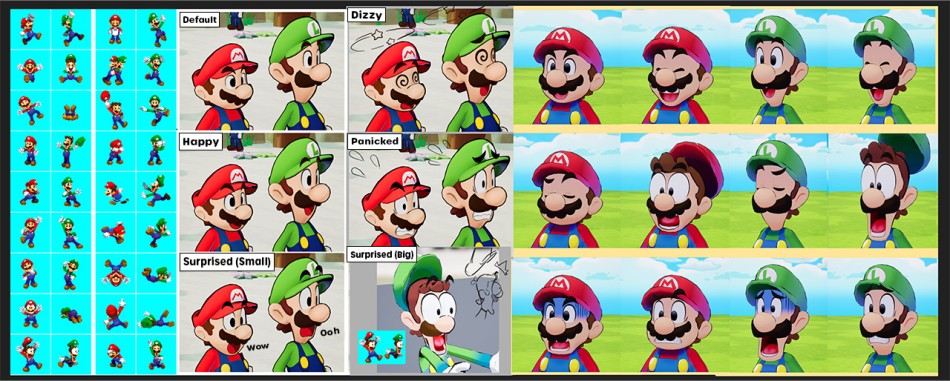
Mario & Luigi | Brothership Devs on Getting the Right Look:
Hitomi Furuta: Our challenge was to develop 3D visuals that would bring out the unique appeal of the Mario & Luigi series and differentiate it from other Mario games. I’m ashamed to say it, but we weren’t conscious of that when development started, which led to us making a huge detour. And in our search for a new Mario & Luigi style, at one point we ended up trying to present an edgier, more rugged Mario instead… (Laughs)
Then we received feedback from Nintendo that we should aim to make the art direction identifiable by fans as belonging to the Mario & Luigi series. After that, we were able to narrow down our focus to how we could combine two things: the appeal of illustrations featuring, for example, solid outlines and bold, black eyes, and the charm of pixel animations depicting the two characters moving around comically in all directions. I think that’s when we finally started to develop an art style that’s unique to this game.
These early concepts certainly do make Mario feel a bit different from the series so far.
Akira Otani: From Nintendo’s perspective reviewing the character designs, they gave the impression of something different that just resembled Mario. So we called for a meeting in order to reassess the direction.
Hitomi Furuta: During the meeting, Nintendo showed us a document describing what defines Mario and Luigi in the Mario & Luigi series. Although we’d enthusiastically pitched this rugged version of Mario, when I considered it from a player’s perspective, I started to worry about whether it really represented the Mario that players would want to play. So, when we got that clear direction from Nintendo, it made perfect sense to us. I think that’s when we realised for the first time, “Ah, this is what we should be aiming for this time in terms of a 3D visual style from Acquire”, and were able to establish the fundamental direction.
Haruyuki Ohashi: We had a strong desire to experiment with new visual styles, but they articulated their vision to us each time in a way that we found convincing.
Akira Otani: Yeah, it’s like we’d unleashed Acquire into the wild…only to go chasing after them again.
While we wanted Acquire to have their own unique style, we also wanted them to preserve what defines Mario. I think it was a period when we were experimenting with how those two things could coexist.
Haruyuki Ohashi: As mentioned earlier, Acquire has hardly ever created games with other companies’ characters, so we didn’t have an established process for this. That was truly a challenge we faced as we kicked off the development of this game. That said, we were able to course correct at the beginning of development by communicating in the way we just described.
Hitomi Furuta: On the artwork side, we struggled with how to embody the characteristics of Mario and Luigi in illustrations, and how to match the expressiveness of the original pixel graphics with 3D models. It’s technically difficult to apply styles that were made possible with pixels to 3D, and we made a lot of challenging requests to the character modelling and 3D motion teams. Also, we were set on incorporating drawn outlines, which is one of the characteristics of the series’ artwork.
From a technical perspective, achieving this in 3D can be CPU-intensive and limits what can be done visually, but we were determined to retain these outlines and made it our priority. Thanks to the perseverance of our character modelling lead, who has a deep passion for the Mario series, and our technical staff, we think that the art came together nicely.
Haruyuki Ohashi: Because we focused on the outlines, we were able to differentiate it from the way Mario is depicted in other action games and realised that we’d established something unique to this game.
Akira Otani: When the announcement trailer was first released in the Nintendo Direct, I saw the excitement from fans that the Mario & Luigi series was back, and I think this reaction can be credited to Acquire’s hard work. Not only were the 3D models brought closer to the style of 2D illustrations, but the animations also closely mirrored the movements from the pixel graphics in past Mario & Luigi games.
Hitomi Furuta: Our 3D motion team studied the series’ pixel graphics in a lot of detail to ensure its appeal would come through. They did a lot of research to depict the movements flawlessly from every angle while preserving the silliness of the pixel graphics. They didn’t just replicate the pixel graphics from previous games, they created a style of animation that’s unique to this game but stays faithful to the Mario & Luigi series.
When it came to Mario’s running animation, we also used Super Mario Odyssey as a reference, studying the feel of the controls closely. The 3D motion and programming teams were constantly tending to the game and kept making adjustments. For example, making it feel more satisfying for players through things like the responsiveness with which Mario’s body tilts when running around corners.
Haruyuki Ohashi: We alternated between working on something and asking Otani-san to try it out.
Hitomi Furuta: While it’s essential to get Mario’s look right, we realised that he’s a character for which the fun and satisfaction you feel through the controller as you’re playing as him are just as important.
In 2015, when rumours of the NX and Zelda U were everywhere, my brother and I started Miketendo64 and we've been running it ever since. As the Editor-in-Chief, I have attended video gaming events in three different countries, been to preview events, and penned more than 4,000 articles to date, ranging from news, to features, reviews, interviews and guides. I love gaming and I love all things Nintendo. I also love Networking, so don't be afaid to reach out.
Email: contact@miketendo64.com / jack.lo@miketendo64.com
Website: https://miketendo64.com/
YouTube channel: https://www.youtube.com/channel/UCyVMO4QgcniAjhLxoyc9n8Q
Websites store cookies to enhance functionality and personalise your experience. You can manage your preferences, but blocking some cookies may impact site performance and services.
Essential cookies enable basic functions and are necessary for the proper function of the website.
Name
Description
Duration
Cookie Preferences
This cookie is used to store the user's cookie consent preferences.
30 days
These cookies are needed for adding comments on this website.
Name
Description
Duration
comment_author
Used to track the user across multiple sessions.
Session
comment_author_email
Used to track the user across multiple sessions.
Session
comment_author_url
Used to track the user across multiple sessions.
Session
Statistics cookies collect information anonymously. This information helps us understand how visitors use our website.
Google Analytics is a powerful tool that tracks and analyzes website traffic for informed marketing decisions.
Used to distinguish new sessions and visits. This cookie is set when the GA.js javascript library is loaded and there is no existing __utmb cookie. The cookie is updated every time data is sent to the Google Analytics server.
30 minutes after last activity
__utmc
Used only with old Urchin versions of Google Analytics and not with GA.js. Was used to distinguish between new sessions and visits at the end of a session.
End of session (browser)
__utmz
Contains information about the traffic source or campaign that directed user to the website. The cookie is set when the GA.js javascript is loaded and updated when data is sent to the Google Anaytics server
6 months after last activity
__utmv
Contains custom information set by the web developer via the _setCustomVar method in Google Analytics. This cookie is updated every time new data is sent to the Google Analytics server.
2 years after last activity
__utmx
Used to determine whether a user is included in an A / B or Multivariate test.
18 months
_ga
ID used to identify users
2 years
_gali
Used by Google Analytics to determine which links on a page are being clicked
30 seconds
_ga_
ID used to identify users
2 years
_gid
ID used to identify users for 24 hours after last activity
24 hours
_gat
Used to monitor number of Google Analytics server requests when using Google Tag Manager
1 minute
_gac_
Contains information related to marketing campaigns of the user. These are shared with Google AdWords / Google Ads when the Google Ads and Google Analytics accounts are linked together.
90 days
__utma
ID used to identify users and sessions
2 years after last activity
__utmt
Used to monitor number of Google Analytics server requests