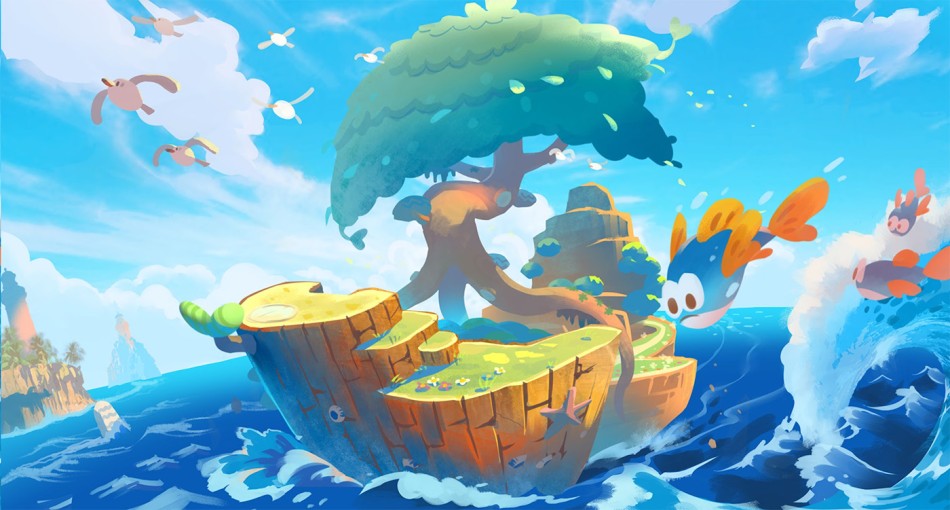
During a new “Ask the Developer” interview with Nintendo, multiple Mario & Luigi: Brothership developers discussed at length, the creation of new characters, choosing to make them less humanoid and more:
Mario & Luigi | Brothership Devs on Creating the Colorful Characters of Concordia:
Hitomo Furuta: It wasn’t exactly smooth sailing. Connie, an original character that appears in this game, was initially designed to look like a human. Afterwards, we settled on the motifs of outlets and electric plugs, and the ideas of an outlet-like face and a plug design that looks like a hat fit right into that world. Eventually, we landed on the current design.
Akira Otani: If other characters looked too human, for example, you may end up with a world where Mario seems superfluous as a protagonist. When creating original characters, it’s important to develop characters and a world that Mario wouldn’t feel out of place in. From that perspective, Acquire has studied the previous games in this series very closely to achieve this. Furuta-san, your efforts came across clearly in the development materials you shared with us. There were a lot of hand-written comments representing your inner voice, such as, “This should work this way… Nope…do it all over”. (Laughs)
Tomoki Fukushima: But because you wrote down everything you were struggling with, it made it easier for us to discuss solutions together.
Hitomi Furuta: Yeah, I guess you’re right. (Laughs) Especially during the initial phase of development, I thought it’d be better to communicate to Nintendo what and how we thought, as well as what we didn’t know, because we were working together for the first time. So I put everything in writing as it came to my mind.
Akira Otani: Speaking of original characters, if we only had Mario and Luigi’s reactions to go on as the story developed, we’d miss out on some detailed information. So that necessitated a partner character for them. That’s how the partner in this new world, Snoutlet, came to be.
Hitomi Furuta: Since the decision for an electric plug as a motif was made early on, we considered various options regarding what form Snoutlet should take, including whether to go for a plug-shaped design.
Haruyuki Ohashi: I was intrigued by one of the ideas that came out of this – a piggy bank-like character whose features could either look like a nose or eyes. Snoutlet is my favourite. (Laughs)
Hitomi Furuta: We first designed Snoutlet so that the eyes were at the top of the head, but while leaving just the eyebrows, we made the nose look like the eyes so it’s fun to guess where the real eyes are.
Tomoki Fukushima: Also, I’ve heard that piggy banks exist in many countries around the world, so this might help Snoutlet’s design be recognisable. And we were glad to see the “Shipshape Island” idea. The moment we saw it, we thought to ourselves, “This is it!”.
Hitomi Furuta: This is the initial concept art of Shipshape Island. We called the first base “the starting island”, and while considering a number of shapes for it, a staff member proposed the idea of an island shaped like a ship. Everyone on the team thought it was a great idea, and we unanimously decided on this design. This shape clearly communicates its functions as a base of operations for their adventure, and from there, various other designs took shape, one after another.
Akira Otani: Since the base is an island, it drifts along the ocean rather than being steered at will. So, it didn’t feel quite right for it to be a real ship. I think that once it became an island shaped like a ship, its appeal really grew.
Haruyuki Ohashi: Because this game is a part of the Mario & Luigi series, there’s no room for gloom with the overall atmosphere. We wanted it to be full of brightness and fun.
Hitomi Furuta: When left to our own devices, we tend to get drawn subconsciously into the heavier directions you find in more serious RPGs. Although we were still getting to grips with the mood in the Mario & Luigi series, we decided on this direction so we wouldn’t forget that it’s a stage for fun, chaotic adventures. This doesn’t only apply to the game’s world, but we learned a lot from Nintendo’s unique design perspective about making things easier to see and understand. The world turned out brighter and easier to play due to the insights we gained.
In 2015, when rumours of the NX and Zelda U were everywhere, my brother and I started Miketendo64 and we've been running it ever since. As the Editor-in-Chief, I have attended video gaming events in three different countries, been to preview events, and penned more than 4,000 articles to date, ranging from news, to features, reviews, interviews and guides. I love gaming and I love all things Nintendo. I also love Networking, so don't be afaid to reach out.
Email: contact@miketendo64.com / jack.lo@miketendo64.com
Website: https://miketendo64.com/
YouTube channel: https://www.youtube.com/channel/UCyVMO4QgcniAjhLxoyc9n8Q
Websites store cookies to enhance functionality and personalise your experience. You can manage your preferences, but blocking some cookies may impact site performance and services.
Essential cookies enable basic functions and are necessary for the proper function of the website.
Name
Description
Duration
Cookie Preferences
This cookie is used to store the user's cookie consent preferences.
30 days
These cookies are needed for adding comments on this website.
Name
Description
Duration
comment_author
Used to track the user across multiple sessions.
Session
comment_author_email
Used to track the user across multiple sessions.
Session
comment_author_url
Used to track the user across multiple sessions.
Session
Statistics cookies collect information anonymously. This information helps us understand how visitors use our website.
Google Analytics is a powerful tool that tracks and analyzes website traffic for informed marketing decisions.
Contains information related to marketing campaigns of the user. These are shared with Google AdWords / Google Ads when the Google Ads and Google Analytics accounts are linked together.
90 days
__utma
ID used to identify users and sessions
2 years after last activity
__utmt
Used to monitor number of Google Analytics server requests
10 minutes
__utmb
Used to distinguish new sessions and visits. This cookie is set when the GA.js javascript library is loaded and there is no existing __utmb cookie. The cookie is updated every time data is sent to the Google Analytics server.
30 minutes after last activity
__utmc
Used only with old Urchin versions of Google Analytics and not with GA.js. Was used to distinguish between new sessions and visits at the end of a session.
End of session (browser)
__utmz
Contains information about the traffic source or campaign that directed user to the website. The cookie is set when the GA.js javascript is loaded and updated when data is sent to the Google Anaytics server
6 months after last activity
__utmv
Contains custom information set by the web developer via the _setCustomVar method in Google Analytics. This cookie is updated every time new data is sent to the Google Analytics server.
2 years after last activity
__utmx
Used to determine whether a user is included in an A / B or Multivariate test.
18 months
_ga
ID used to identify users
2 years
_gali
Used by Google Analytics to determine which links on a page are being clicked
30 seconds
_ga_
ID used to identify users
2 years
_gid
ID used to identify users for 24 hours after last activity
24 hours
_gat
Used to monitor number of Google Analytics server requests when using Google Tag Manager