

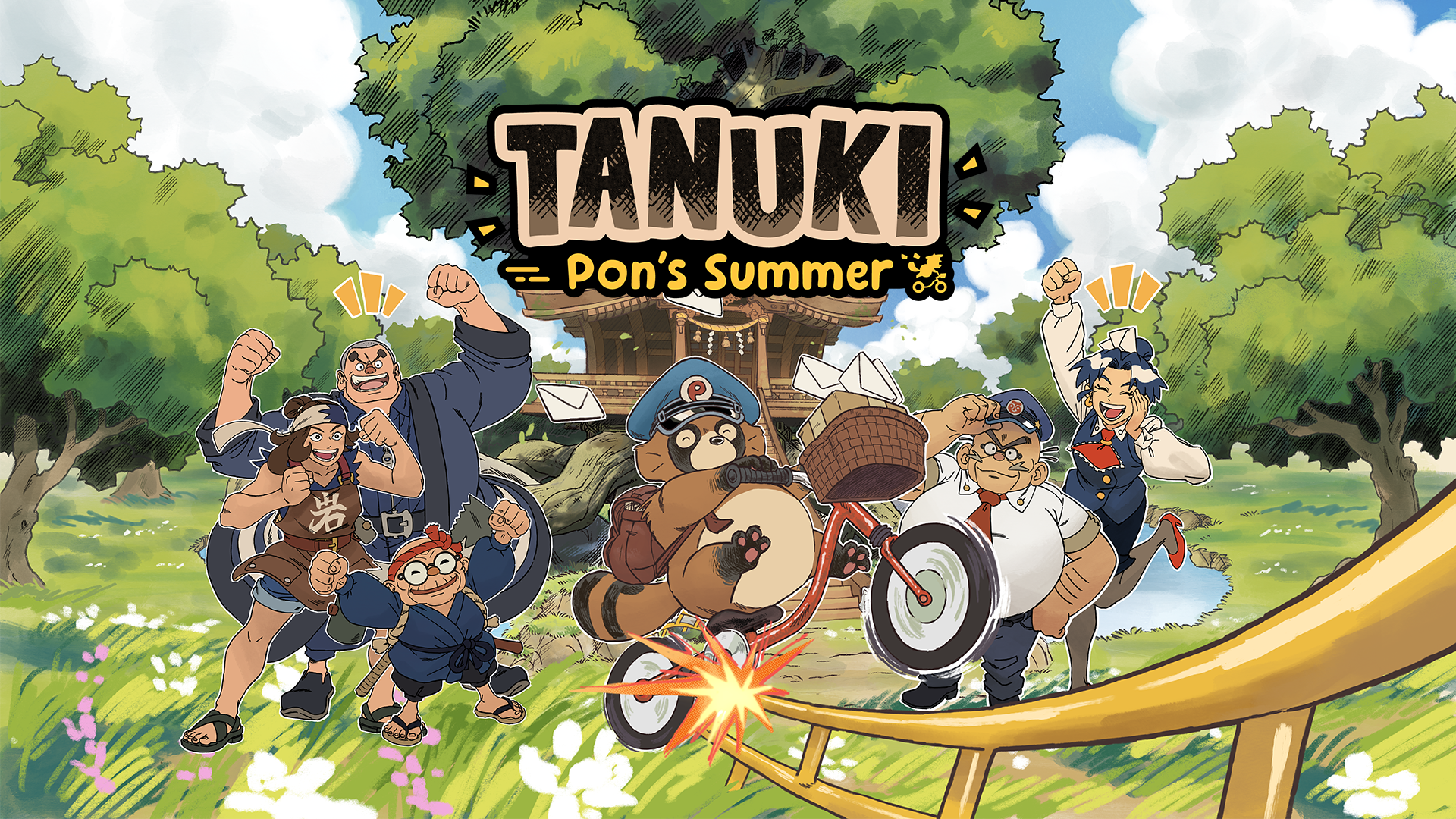
BMX your way into the hearts of the townsfolk!
Showcased during the recent Indie World Showcase (broadcast on October 28, 2026), TANUKI: Pon’s Summer is a bright, BMX-powered life-sim adventure about a well-meaning tanuki trying to restore a shrine before the Great Tanuki Festival arrives. Developed by Kyoto-based studio Denkiworks and published by CRITICAL REFLEX, the game launches on November 10, 2026 for Nintendo Switch, Nintendo Switch 2, PlayStation 5, PlayStation 4, Xbox Series X|S, Xbox One, and PC, with day-one availability on Xbox Game Pass.
We recently had the pleasure of speaking with Liam Edwards, co-founder and game director at Denkiworks, about tanuki folklore, the joy of grinding rails between deliveries, the careful balance of freedom and deadline, and the feeling he hopes players carry when summer finally ends. This is what we learned:
Liam Edwards | One Summer, One Shrine with TANUKI: Pon’s Summer
 How does Japanese tanuki folklore influence Pon’s personality, abilities, and the overall tone of the summer festival arc?
Liam Edwards: We did a lot of research into tanuki mythos, legends and stories. It was a lot of fun! More of Pon’s personality comes from animal-like behavior than it does from tanuki mythos. Tanukis are famously quite mischievous and trickster-like animals, so they get a bad rap haha. But Pon is kind-hearted and determined, though he’s definitely slightly lazy like tanukis of old. A lot of the background elements such as the Shrine’s history and the Great Tanuki God Danzapon, who guides Pon, are all based on some of those legends. Danzapon’s name is a hybrid of one main tanuki mythological character, Danzaburou, with a “Pon” suffix. Small elements such as his ability to summon his BMX out of thin-air are tied to the tanuki legend of transforming objects, as well as his super strength, where he’s able to lift and pull very heavy items that no one else can. There’s some jokes in the game at times about “famous tanuki strength” and such.
How does the post-office job serve as both a gameplay loop and a narrative framing device?
Liam Edwards: The Post Office in a way is a reflection of the Tanuki Shrine. While it wasn’t immediately obvious to me when I came up with the initial concept, we have this historic Shrine with a storied history and it’s sort of falling away to modern times. It’s not visited so often anymore and feels a by-product of a previous time. Then we have the Post Office, which is something we’ve all grown up with – seems very serious and respected, but is also something that… isn’t used so much anymore. In Japan however, the Post Office is still a big fixture of many communities, especially in countryside areas. So, it felt like a strong parallel to the Shrine in a way, matching it to the narrative beats of trying to keep something traditional alive even as times change.
When it came to gameplay, we knew two design things were true: Pon needed money, and Pon needed a reason to cycle around the island. It sounds simple in practice because then the next question is “how does he get money?” – a job, of course. Yeah, but what job would allow him to freely be cycling around the island as part of it? Ah! A courier of sorts? Nice, does it fit with the theme? How can we make this work? A lot of these design issues are then questions you slowly distill down and test until the answer seems to be staring you in the face.
The Post Office would allow the gameplay we want, it would also give Pon a purpose to earn cash and also gives us a great setup to build an island community around. People of all ages use the Post Office, so it gives us a wide character cast of those who maybe remember the Great Tanuki Matsuri and maybe those young enough that they don’t even visit the Shrine. It came together quite nicely in the end, I can’t imagine it being anything other than a Post Office now haha.
What role does BMX movement and sports competition play in making exploration and socializing feel dynamic?
Liam Edwards: BMX is definitely the most fun way to explore the island! While we had quite the story getting to the point where the BMX gameplay is as prominent as it is, we definitely follow the line of “if you’re gonna go from point A to point B as gameplay, we’ve got to make that enjoyable.” Once we added in the ability to grind rails and do backflips early in development it was like an “aha!” moment. If I had to cycle from one place to another to deliver a package, why would I not want to jump around a bit, get distracted and do some tricks? If you could… you would! So we really ran with that idea.
Even now when playtesting the game, in the thousands of hours I’ve done, I always find myself still doing tricks, massive combos and getting distracted jumping off of stuff. While TANUKI can be played without engaging with that system if you so wish, it really is what gives the game its identity and flavor. A lot of people ask “why?” and our answer is always, “why not?” haha.
Can you describe the mix of life-sim activities (delivery, sports, friendship) and how they feed into the shrine-restoration goal?
Liam Edwards: TANUKI: Pon’s Summer is definitely an “experience” type game – we say there’s lots of things to “experience” and they’re based on an open structure. There’s many things to go around the island and do, the types of which we tried to strike a balance between so that it never felt to the player like they’re doing more of one or the other, and each time they meet a new character they would be surprised by what would happen next. Completing each of these activities, meeting characters and completing challenges all feeds back to the player via rewards such as “Shrine Reputation”, which in turn levels up to unlock more decoration items for you to use in your Shrine restoration. All quests reward money alongside so that you’re able to purchase those items, and some deliveries even reward the player with one-off special decorations that can be used!
How did you design the town and its residents so that relationships and activities feel rewarding across a single summer season?
Liam Edwards: We really focused on the idea of it being like a kid’s summer vacation. While Pon has his responsibilities of doing his job, he’s also spending a lot of time being tempted by friends into doing activities and goofing off. While also getting to do what he enjoys most: “BMXing” as much as he wants. It’s that freedom of when you were young, waking up each day of summer vacation being like “What should I do today?”, which sadly becomes lacking when you get older. The residents themselves contribute to that by introducing you to different things that maybe you’d enjoy and make your summer experience a memorable one. They also remind you periodically that all of this will end, like a summer vacation would. Pon has to fix the shrine up and do the Matsuri eventually and, design-wise, we try to push the player into getting to that finish.
From a design perspective, we really wanted to focus on this being a “one-time” thing. A summer you experienced and that will live in your memory forever. So, everything is played once, a character has one main quest each, everything is a list of experiences that stack up so by the end you can say “Wow, I did all these things!” Making it feel like you’re not being asked to repeat something multiple times, or being arbitrarily held back from being able to progress was important.
What challenges arose in balancing free-form cozy play with the time pressure of the festival deadline?
Liam Edwards: Good question and one we spent a lot – if not most! – of our pre-production into production trying to figure out! The reality is we tried everything, from time pressure-type gameplay, Bombers’ Notebook-style stuff from Majora’s Mask, and even letting players replay days if they chose. But, going back to the previous question, we really wanted to make sure that you felt you were progressing. So, while between quests you can spend as much time goofing around as you want, when you’re in a quest you’re locked in to try and finish it.
We also made the slightly controversial decision to end the day immediately after you’ve finished all the quests, which led to a lot of playtesters saying “I want to continue going around the map” – which we totally understood! But the reality is you can do that immediately on the next in-game day anyway, but your progress is one day closer to the finish then… So it’s almost subconscious in progression, without feeling too stressed you’re missing out on anything.
Were there specific real-world summer festivals or slice-of-life inspirations that shaped the world?
Liam Edwards: We’re based in Kyoto, Japan and I’ve lived in Japan for over ten years now. Our co-founder, Arioka-san, is a Kyoto native, so a lot of the stuff in TANUKI is just stuff we’ve naturally absorbed over the years. Every summer there’s various festivals (matsuri) and it’s just a thing that you do… You go to them! So, it became quite easy when we sat down to fill in the details to draw from our real-world experiences here and take specific aspects from them to make our own.
A lot of the game’s environments are also based on real cities here in Japan, especially Kyoto, Sapporo, Beppu and Aomori. But, myself and my two co-founders of the studio, Jan and Arioka, all travelled together around Japan a lot. We drew inspiration from how each had their own vibes and structures. Anything from powerlines, manhole covers, to onsen springs and trees.
How does the dual Switch / Switch 2 release affect presentation or performance goals?
Liam Edwards: At this point, it does affect things quite a bit! We have a lot of power to play with and performance to use with Switch 2, which means we can try to aim for what our PC version of TANUKI would be. However, it doesn’t work straight out of the box like that and our lead engineer, Jan, had to do a lot of great work to get the performance we were determined to get to for the Switch 2 version. Personally I think the Switch 2 version of the game is my favorite!
With the Switch, we started that version ourselves and then we worked closely with a talented porting team called 2Awesome Studio who completed work on that version. They had a very tough task ahead of them and put in a lot – and I mean A LOT – of work to get the Switch version being one we were proud to have as part of TANUKI: Pon’s Summer’s launch. While they’re both different SKUs and different versions that run differently, they’re both great experiences in their own rights and that’s thanks to the team’s hard work.
What kinds of friendships or town events produce the most memorable player moments in testing?
Liam Edwards: It’s hard for me to distinguish a character as their in-game counterpart from the character I was sitting with writing their personality and dialogue. Personally, with fresh eyes, the quest I enjoy most is with either Rei or Mamoru, but there’s also history between Bunta and Taiga that feels good. The characters mean a lot to me because I have been sitting with them for so long, but now they’re in the game they feel distant and like they have their own lives and existence that I’m not a part of now haha. I’m very interested to see what characters and quest stories players are drawn to, or like the best.
What do you hope players feel as summer ends and the Great Tanuki Festival begins?
Liam Edwards: Oh man, joy, some tears, happiness, hope – many of those I hope!
Without spoiling too much, there was a period of about three weeks where, after having played it every day for about a year, I didn’t have tasks needed for me to play. I went back for Switch 2 performance testing and was testing the ending of the game and it got me! I had some tears, so fingers crossed that is someone else’s experience too.
Most of all I hope they feel they enjoyed the experience. There’s no need to come back, once you join Pon for his summer and the summer ends, that’s it, you can both go your separate ways. But in doing so, thinking “Yeah, that was really neat, I’m glad this exists,” and maybe hoping to one day see Pon again in the future would mean we did our jobs and Pon a service.
We’d like to take this moment to extend our sincere thanks to Liam Edwards for taking the time to share such thoughtful and open answers with us. We can not wait to spend a summer with Pon when TANUKI: Pon’s Summer arrives on November 10, 2-26!
About TANUKI: Pon’s Summer:
Taking place over one sweltering summer…
The Tanuki Festival is just a month away, and the shrine is in disrepair. Follow Pon, a well meaning, if a bit lazy Tanuki with a part-time job at the Post Office, as he works to restore the shrine before summer ends. Deliver packages, make friends, and get the shrine ready for the big festival!
Taking place over one sweltering summer…
Deliver packages: Hop on your BMX and deliver letters and packages to the quirky inhabitants of TANUKI’s fictional Japanese island. Packages vary in size, weight, and shape so it’ll be up to you to strategise how you approach each delivery.
Sushi Chef, Sumo Wrestler, Baseball Pro!: As you build up friendship and loyalty with the inhabitants, they’ll ask for help with a range of different activities. Take part to unlock items and rewards that will help with the shrine’s restoration.
The Island Is Your Playground (or Pon’y Hawk!?): Hop on Pon’s BMX and explore the island on two wheels. Launch off ramps, grind along rails, and string together tricks and combos as you discover new paths, radical heights and everything in between.
Restore the shrine to former glory: You’ve been tasked with getting the Tanuki Shrine ready for the Great Tanuki Matsuri at the end of summer! Turn your earnings from deliveries, activities and over 100 BMX challenges into a shrine you’re proud of: build, upgrade and make it your own.
With the Tanuki Festival just around the corner, Pon must restore the shrine to its former glory. Help him earn cash, befriend the local townsfolk, and prep the shrine for the festival of a lifetime.
BMX your way into the hearts of all the townsfolk as a mail delivery Tanuki! You’ve got one month to save up enough to restore the shrine for the Great Tanuki Festival. Deliver packages, compete in sports, make sushi, and much much more in TANUKI!
Share this:

Discover more from
Subscribe to get the latest posts sent to your email.