

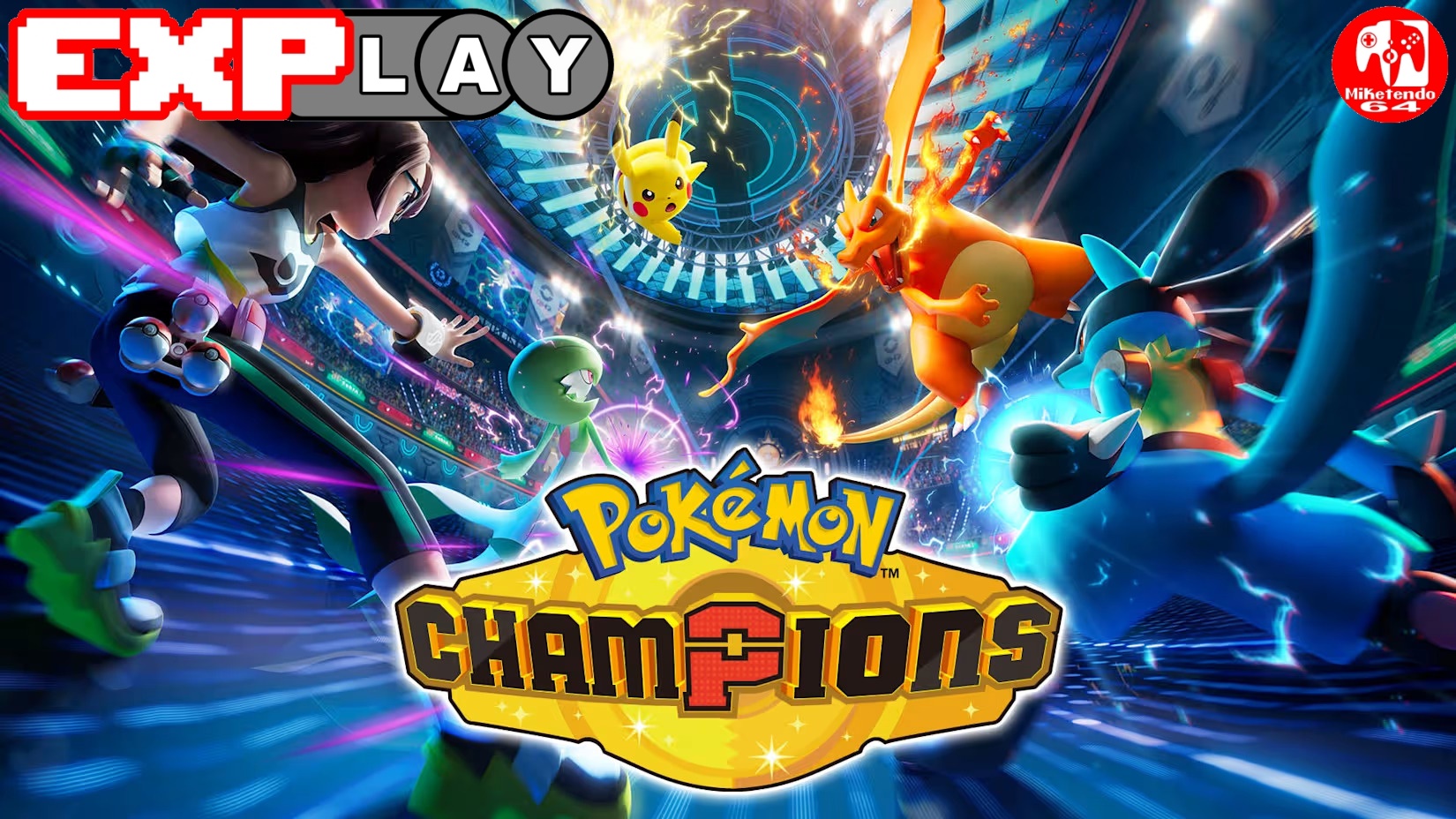
Welcome to EXPlay, (Explain & Play) the review series where we care not for scores, but tell it how it is when it comes to every game we get our hands on, all whilst including some lengthy gameplay, to give you, the reader, the chance to form your own impressions and views while reading and watching.
In this explanatory review, we’re covering Pokémon Champions by developer, The Pokémon Works:

Pokémon Champions (Nintendo Switch)
Developed by The Pokémon Works, while not a mainline series title itself, Pokémon Champions is positioned as the future of VGC for the Pokémon series. After a year of waiting, it was released on April 8, 2026 for Nintendo Switch and Nintendo Switch 2. It is due to release on Android and iOS devices later this year, but it is already off to a rocky start.
From when Pokémon Champions was first revealed during Pokémon Day on February 27, 2025, to the subsequent news drops, fans were led to believe this would be a game with support for multiple battle mechanics, such as Gen 9’s Terastallization, and that by utilising Pokémon HOME, players could finally make use of all the Pokémon stored there and put them to work.
Instead, now that the game is in our hands, Pokémon Champions only supports Mega Evolution, with less than 200 eligible Pokémon that can be transferred into the game — provided you don’t encounter a bug that prevents you from completing the transfer. On top of these transfer limitations, the game launched with a number of bugs, including failed transfers, soft locks during battles, and incorrect Mega Evolution priority. While The Pokémon Works has promised a day-one patch to address many of these issues, it’s disappointing to see such problems at launch. So, without further ado, this is our unbiased Pokémon Champions review.
Due to the two different versions of the game available (free download and the Starter Pack version), along with Premium Battle Pass and Membership options, we will be covering all options, with a focus on both the Nintendo Switch and Nintendo Switch 2 versions. But before we dive into the nitty-gritty, let’s start with the basics.
As the creation of The Pokémon Works, a company founded in 2024 as a collaborative effort by The Pokémon Company and ILCA, with the directive of assisting on the “production of Pokémon games and game-related services,” Pokémon Champions is a cross-platform, turn-based strategy game that requires a permanent internet connection. We can understand why, as all battles require online, but even things like recruiting new Pokémon or simply changing your character’s outfit require an internet connection.
And if you think that’s bad, Pokémon Champions has no single-player campaign whatsoever, which feels really odd when the game adds brand-new characters Caraway and Kojima, yet offers no real way to interact with them outside of brief cutscenes. Many reviewers have compared it unfavourably to Pokémon Stadium, noting that while the core battling is solid, it lacks the personality and single-player charm that made those games memorable. Sure, you can meet Cordy and his granddaughter Tatora, and upon proving yourself worthy in battle, take over Cordy’s gym and start battling your way up the ranks in Frontier City to become a Champion. But aside from the occasional scene with Caraway and Kojima, that’s about it.
Yes, players are free to take on Ranked Battles, starting out as Poké Ball Tier Rank 4 and working their way up to Champion Tier Rank 1. But whether in single battles or double battles, the only people you’ll ever get to battle outside of the game’s tutorial and training are actual players looking to advance their rank and thrash you to the best of their ability. Gameplay-wise, Pokémon Champions is more than just your run-of-the-mill battle simulator. Yes, battles are a big part of its gameplay, but the real depth lies in what happens outside of the battles — in terms of recruitment and training. As this is not your conventional Pokémon game, you do not get Pokémon in a conventional way.
Instead, once per 24 hours, players can head out to Kitt’s ranch to recruit Pokémon for free. When trying to recruit a Pokémon, you will be presented with ten options. Players are free to check the abilities and moves of the Pokémon available, but only one of the ten can be chosen. The majority of the time, the Pokémon will mostly be in regular Poké Balls, but by paying attention to the cutscene that plays before they appear, you can notice different animations.
If something is different, it’s a good sign to pay more attention to the Pokémon that appear, as some can have titles, have a different Poké Ball type, and can straight up be shiny. So, it pays to pay attention before making any selection. And when you do, it’s time to make another decision. Do you spend 0 VP (Victory Points) and temporarily recruit a Pokémon for 7 days, or do you recruit them permanently outright, be it for 2,500 VP or 1 Teammate Ticket?
Both are something you can obtain in-game, with tickets available from missions and the game’s free battle pass, whereas VP is earned for every battle you participate in, regardless of whether you win or lose. Yes, winning gets you more, but losing is rewarded as well, and we can respect that. As for the whole “why would I want to temporarily recruit a Pokémon rather than have them permanently outright?” — this is due to a spacing issue.
While some additional Pokémon Storage spaces can be earned in-game by advancing through the ranks in Ranked Battles, upon starting the free version of the game, you are limited to just 30 Pokémon Storage spaces, which is the same number the free version of Pokémon HOME gives you. But more on HOME in a moment.
By limiting players to 30 spaces, this means you need to be even more selective with what Pokémon you recruit, as unless it’s shiny, there’s no point adding anything to your team if it can’t improve your current strategy or help build your next team.
And on the subject of HOME, not only is there a reported bug occurring for some users during the transfer process, but for anyone with the free version who had hoped they could move Pokémon out of HOME into Pokémon Champions and free up space in HOME, it doesn’t work like that.
The Pokémon still exist in HOME — you just can’t transfer them out into another supported title until they’ve been moved out of Pokémon Champions back into HOME. And when you do move Pokémon into Pokémon Champions, the stats they have at the time are adapted into what the game supports. You can train them and improve them in Pokémon Champions at the cost of VP or Training Tickets, but when moved back into HOME to be EV trained in Pokémon Scarlet or Violet and then brought back to Pokémon Champions, the new stats will not carry over.
This is because Pokémon Champions remembers the Pokémon based on how it was when it first came over to the game and the training you gave it in Pokémon Champions and nothing else. So we recommend not bringing over a Pokémon until you’ve finished training it elsewhere. Also, just because you can get a shiny Pokémon in Pokémon Champions, for anyone who had hoped they would be able to trade it into HOME, you can’t. All Pokémon recruited or gifted in Pokémon Champions stay in Pokémon Champions.
As for the actual training itself, as one of Pokémon Champions’ main gameplay elements outside of battling, this is where you’ll be spending the majority of all VP earned from battles. This is because as long as you have plenty of VP to spend, you are free to change the nature and stats of all the Pokémon you wish to put into a team and use in battle. But this is where things get slightly complicated.
Pokémon levels are not a thing, and all Pokémon stats are instead calculated as if the Pokémon was level 50. Furthermore, IVs (Individual Values) cannot be modified in-game as they are instead calculated as being 31 IVs in all stats. EVs (Effort Values) are replaced by a new stat points system, which can be adapted to a player’s liking at the cost of VP or Training Tickets.
Incidentally, players are free to change a Pokémon’s moves at a price, with some abilities being altered in how they work, such as Intimidate now affecting both opposing Pokémon at the same time rather than one at a time in a double battle, and moves like Beak Blast having 8 PP rather than 16 PP, and Night Slash having 20 PP rather than 15, as Pokémon Champions has changed fixed values of moves to 8, 12, 16, and 20, compared to the previous 5, 10, 15, and 20.
Just keep in mind that Pokémon Champions is not only limited to 186 Pokémon at this time, but the move pool itself isn’t particularly great. There’s some variety, but for now it is somewhat limited.
But if editing a Pokémon feels overly complicated or the thought of trying to build your own team overwhelms you, you can opt to auto-build a squad or replicate a team that someone else is using, just as long as you have all of the necessary Pokémon, items, Mega Stones, and VP to replicate the team. If not, you’re out of luck, but in fairness, Pokémon Champions does a decent job of explaining all of these mechanics at length compared to the main series games and makes competitive battling more welcoming to new players.
So, once your team is built and you’ve paid a little trip to the Frontier Shop to purchase new clothing items, battle poses, and items, it’s time for the real action: battling. Whether you choose to partake in Ranked Battles or settle for private matches with friends or casual matches that won’t affect your rank whatsoever, there are only two types of battles you can face: single and double.
Both allow you to build a team of six Pokémon and equip them with whatever items and Mega Stones you have, but with single battles, you can only take three Pokémon into battle with you, sending one out at a time, whereas double battles let you take four Pokémon into battle and send two out at a time. As for the battles themselves, it’s exactly what you would expect from Pokémon VGC.
Battles are turn-based, with players allowed to take full advantage of stat-boosting moves, weather effects, and every trick in the book to beat their opponent’s Pokémon before their opponent beats theirs. Win or lose, both sides will get VP, but the winner gets more. In the event of a Ranked Battle, win battles to rank up, but lose and risk being knocked down. Just remember your rank does not carry over, so it’s all well and good reaching Master Ball Tier in Double Battles, but if you never bothered with Single Battles, you’ll still be Poké Ball Tier. When each season concludes, all ranks are reverted to Poké Ball Tier Rank 4, but the higher you placed, the better the reward you will be given.
Now, as for visuals and performance, while it is true Pokémon Champions is a good-looking title thanks to explosive animations and 3D visuals, the Switch 2 version of the game can look glorious in 4K — but that’s only if you resort to a bug exploit, as the Switch 2 version has a bug that is preventing it from looking like the glorious title it is meant to be. But once addressed, it should look just as impressive as all the gameplay videos prior to release exhibited it to be. It’s just a shame the game feels sluggish due to being locked at 30 FPS.
But since we’re nitpicking, while we’re a fan of missions, in-game achievements and the game’s quick menu is a positive, the UI screen makes Pokémon Champions look like a mobile game, which makes sense since it is planned for Android and iOS devices. But despite looking like it might support touch-screen controls, the Switch version of Pokémon Champions does not support them at all. It’s not a deal breaker by any means, but it’s a little weird to have the game omit such a feature when future versions of it will rely upon it.
Nevertheless, with the majority of criticism covered, it’s time to cover the paid aspects of Pokémon Champions:
Pokémon Champions + Starter Pack: It’s the exact same game as the free version. The only difference is that it consists of a one-time purchase that comes with a couple of extras. For the price of $6.99 USD, players are given an extra 50 Pokémon Storage spaces, bringing the grand total to 80 before you’ve started ranking up and getting additional storage as tier rank-up rewards:
- Reach Great Ball Tier: +5 Additional Pokémon Storage spaces
- Reach Ultra Ball Tier: +5 Additional Pokémon Storage spaces
- Reach Master Ball Tier: +10 Additional Pokémon Storage spaces
For a player who would rather rely on utilising only Pokémon they’ve acquired through Pokémon Champions than HOME, the Starter Pack is a decent way of giving you more storage options to try and build up a worthwhile competitive collection for any situation.
Incidentally, it also allows players access to the Battle! (Trainer Battle) song which features in Pokémon: Let’s Go, Pikachu! and Let’s Go, Eevee!, and use it when battling. Lastly, the Starter Pack also gives you 30 Teammate Tickets and 50 Training Tickets, with the former being used to permanently recruit Pokémon and the latter to waive VP costs when training your Pokémon. And to be honest, the Training Tickets are worth their weight in gold, since only one ticket is consumed per training session, regardless of how much VP you might have spent otherwise.
Pokémon Champions Membership: Whether you want to pay for one month at a time ($4.99 USD) or opt for an annual subscription ($49.99 USD), membership comes with four main benefits:
- +1,000 Additional Pokémon Storage spaces
- +15 Additional Battle Teams
- Exclusive Missions for more VP Rewards
- Exclusive Battle Songs
Personally, the last one is a cop-out, as Pokémon Champions is rather barebones at the moment, so locking a handful of tracks behind a paywall is just completely unnecessary, especially when only a handful of tracks are currently supported.
Pokémon Champions Premium Battle Pass: Works the same as any other battle pass from any other game. There is a free version and a paid version. Both reward players with rewards upon reaching the required rank, which in Pokémon Champions’ case is pretty easy. There are 50 levels in total, and for every ranked win you’ll level up one level each time, whereas losing two to three times can level you up.
The rewards for the free pass are mostly comprised of lesser rewards like Teammate Tickets, Quick Coupons, and Training Tickets, whereas for the price of $6.99 USD, you gain access to a selection of rewards featuring new Pokémon you can permanently recruit in a Cherish Ball, their associated Mega Stones, and even icons of said Pokémon, which can be used as part of your player profile.
Incidentally, while there are 50 rewards in total, 25 rewards are reserved for the free battle pass and the other 25 are limited to the paid Premium Battle Pass. Freebie rewards are collected every odd-numbered rank, whereas even-numbered rank rewards are paid rewards.
We’re not entirely against the idea of a Premium Battle Pass, but in all honesty, for the players who chose to fork out $49.99 USD for an annual membership, we’re left scratching our heads wondering why the membership couldn’t cover a year of Premium Battle Passes as well? But then we remembered the answer: money. It’s an absolute cash grab that is mostly cosmetic in nature.
Overall, while the free-to-play model is surprisingly generous in some areas, the paid options still feel like they gatekeep meaningful progression and cosmetics. It’s accessible for casual players, but dedicated fans may find themselves pressured to spend if they want the full experience.
In its current state, Pokémon Champions is by no means the champion time we had hoped it to be. Nor is it the perfect Pokémon Stadium successor. From the game we got compared to the one that was first announced last year, if Pokémon Champions was a meal, in its current state it is best described as being a starter. There’s more than enough for you to nibble on and get started, but for the players who do not want to pay a single thing, more will need to be added to the base game to keep fans coming back for more.
We can understand why a game such as Pokémon Champions was chosen to be the face of VGC going forwards, but honestly, we could have done without the paid membership. Prior to Pokémon Champions, VGC has been locked behind a paywall due to main series games always carrying a price tag, and to be honest, maybe it should have stayed that way.
Sure, no one would want to pay the full price of a main series title for Pokémon Champions, but at half the cost, with monthly missions, and less restrictions, that’s a Pokémon Champions game we could all get behind. But here’s a positive we can all get behind: Pokémon Champions is a live service game that both the dev team and The Pokémon Company hope will be around for a long time to come, with more content being periodically added to it.
So, hopefully it is a case of when, rather than if, Pokémon Champions can become the game we all hoped it would be, starting with the update to correct all the bugs the developers recently announced.
UPDATE #1 (June 17, 2026): With Pokémon Champions always planned for mobile devices, mobile gamers’ long-awaited day finally arrived on June 17, 2026, when the game made its debut on Android and iOS alongside Regulation Set M-B.
The mobile version is almost an exact copy of its console counterpart, with the only notable difference being the controls. While the console versions rely on button inputs and controllers, the mobile version uses touch controls in their place.
Pokémon Champions plays smoothly on mobile devices with no major issues. However, for anyone hoping the console version would receive an update to support touch-screen controls in handheld mode, you’re out of luck — no such feature has been added, despite the Nintendo Switch and Nintendo Switch 2 being fully capable of touch-screen input.
Game Specifications:
Developer: The Pokémon Works
Publisher: Nintendo
Platforms: Nintendo Switch (Digital) | Nintendo Switch 2 (Digital)
Genre: Strategy
No. of Players: 1 (Single System) | 2 (Online)
Release Date: April 8, 2026
Price: $00.00
File Size: NSW: 1.9 GB | NS2: 2.1 GB
Nintendo.com Listing

Share this:

Discover more from
Subscribe to get the latest posts sent to your email.