

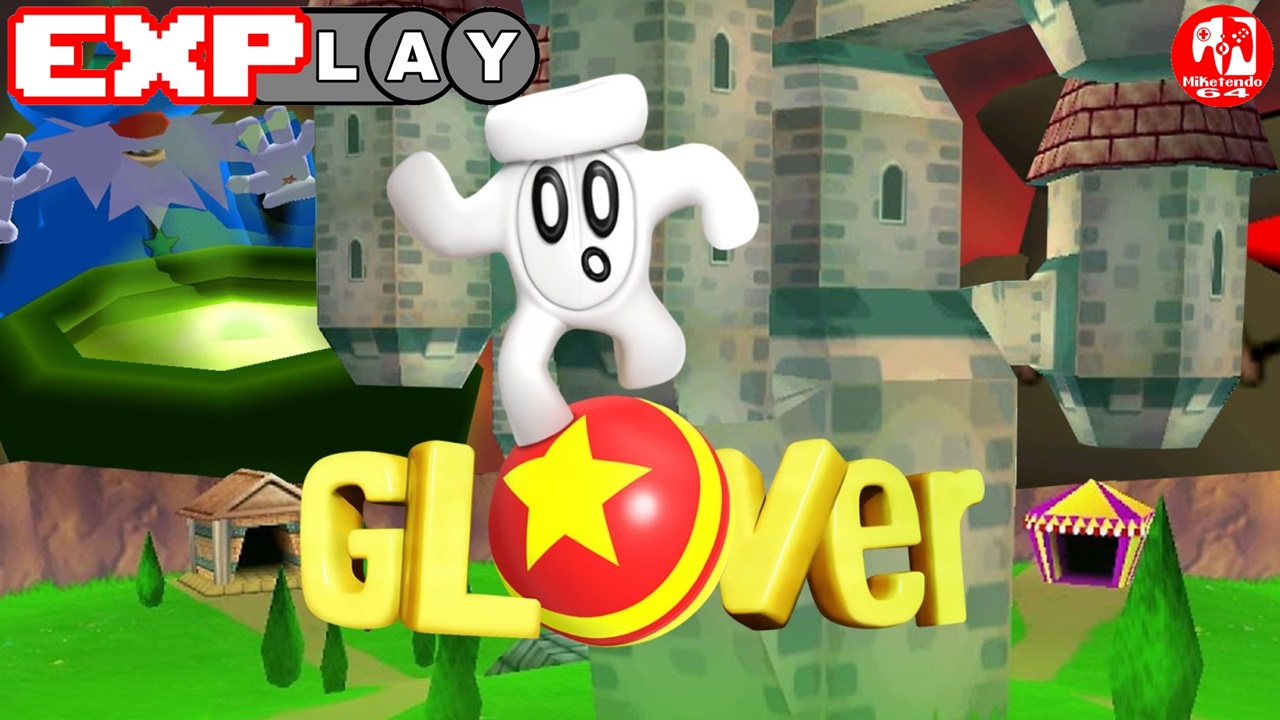
Welcome to EXPlay, (Explain & Play) the review series where we care not for scores but tell it how it is when it comes to every game we get our hands on, whilst also taking the time to include some lengthy gameplay, to give you the reader, the chance to shape your own impressions and views whilst watching and reading. In this installment, we’re covering Glover (Qubyte Classics) by developer Qubyte Interactive.

Glover (Qubyte Classics): (The Explanation)
Ah, Glover. A game that I have not played in decades and one that I did quite enjoy back in the day on my Nintendo 64. Originally released back in 1998 for the N64, Windows and PlayStation, Glover was developed by Interactive Studios and published by Hasbro Intereactive. The N64 and Windows version of the game recieved positive praise but the PlayStation version was not held in such high regard. A sequel was planned but was ultimately scrapped leaving the sentient glove no choice but to be stuffed into the back of a drawer gathering dust for years, until Qubyte Interactive decided to bring it back to life with a release on modern platforms.
The story of Glover (Qubyte Classics) takes place in the Crystal Kingdom where a Wizard was concocting a powerful potion when all of a sudden, a vial is added that causes volatile results. One of his gloves is sent flying out the window and the other falls into the mixture and becomes evil. As for the other glove, this is the game’s protagonist Glover and as he picks himself up off the floor, he sees the crystal orbs that were once on top of the spires or the Crystal Castle falling to the ground. Instinctively, Glover reacts and turns the crystals into inflatable balls which then hit the ground harmlessly and bounce into the doorways to other worlds. It is up to Glover to gather up the balls and return them to the Crystal Castle and restore balance to the kingdom.
For anyone who has not played Glover before, the player is tasked with controlling the sentient glove who must venture to six different worlds and bring back the crystal that is now in ball form, back to the Crystal Castle. Each world is made up of three stages, and a boss stage. There is also a bonus stage though available on Normal Difficulty but it requires the player to collect all the Carib Cards that are scattered throughout each stage. It sounds pretty straightforward in principle but it does have some intersting gameplay mechanics that make this 3D platformer stand out from the others.
When Glover is separated from the ball, he can walk on two fingers, jump, double jump, cartwheel, and fist slam the ground. Upon reuniting with the ball, the controls become a little different. Glover no longer walks but pushes the ball across the floor to move, he can also bounce the ball, throw it, slap it into enemies or targets and even walk along the top of it. When doing the latter, however, I should point out that the controls become reversed and take a little getting used to.
The ball can be transformed into one of four forms: The bouncy ball, bowling ball, ballbearing, and the crystal (its natural state). There is a secret fifth form that turns it into a rubber ball that can be bounced the highest and thrown the furthest but you will need a cheat to unlock it first. As for the other forms, they each have their uses. The bouncy ball can be used to bounce up stairs, float on water and throw at targets but it can be punctured by some enemies and obstacles. The bowling ball is tough, heavy, and can be slapped into enemies and breakable objects. It can’t float or be punctured. The ballbearing is light, easy to maneuver and is magnetic. The crystal is the most fragile and can easily be broken by enemies or by accidentally bouncing or throwing it. On the plus side, it can score double points from Carib Cards so there is that.
There are a couple of features that have been added to the game that allow you to toggle the aspect ratio and the filter. By default, you have 16:9 with a smooth filter, but you can add borders if you prefer to play with 4:3 instead and you can add scan lines, curve, or no filter whatsoever. You also have the option to remap inputs so if there are any control inputs that are not to your liking, you can adjust them to suit your play style.
For the most part, Glover (Qubyte Classics) is a pretty simple game. The visuals may be quite dated and the biggest threat players have to contend with is the camera controls and when the camera won’t swing round when close to a wall and leaves you blind to where your character is on screen. That said, there is some fun to be had here and if you need more of a challenge, there is the inclusion of Time Attack for you to test how quickly you can get through the games stages, and you could try going for all the Carib cards in each stage (good luck finding them all).
As we wrap up this Explain & Play review. Glover (Qubyte Classics) is certainly a welcome blast from the past that gives players something different from the norm, but new players may not appreciate it as well as fans who grew up with it. The game could have done with a remaster to give the visuals the HD touch and smooth out the rough edges to make it appealing for new players whilst having the option to swap to the original visuals for those who want a more nostalgic experience. With that in mind, it is tough to wholeheartedly recommend Glover (QuByte Classics), but we would certainly hope that some people will look past its flaws and give it a try anyway.
Game Specifications:
Developer: Qubyte Interactive
Publisher: Qubyte Interactive
Platform: Nintendo Switch (eShop)
Category: Platformer, Adventure, Action, Other
No. of Players: 1 player (Single System)
Release Date: February 27, 2025 (EU & NA)
Price: $19.99
File Size: 225 MB
Nintendo.com Listing

Share this:

Discover more from
Subscribe to get the latest posts sent to your email.