

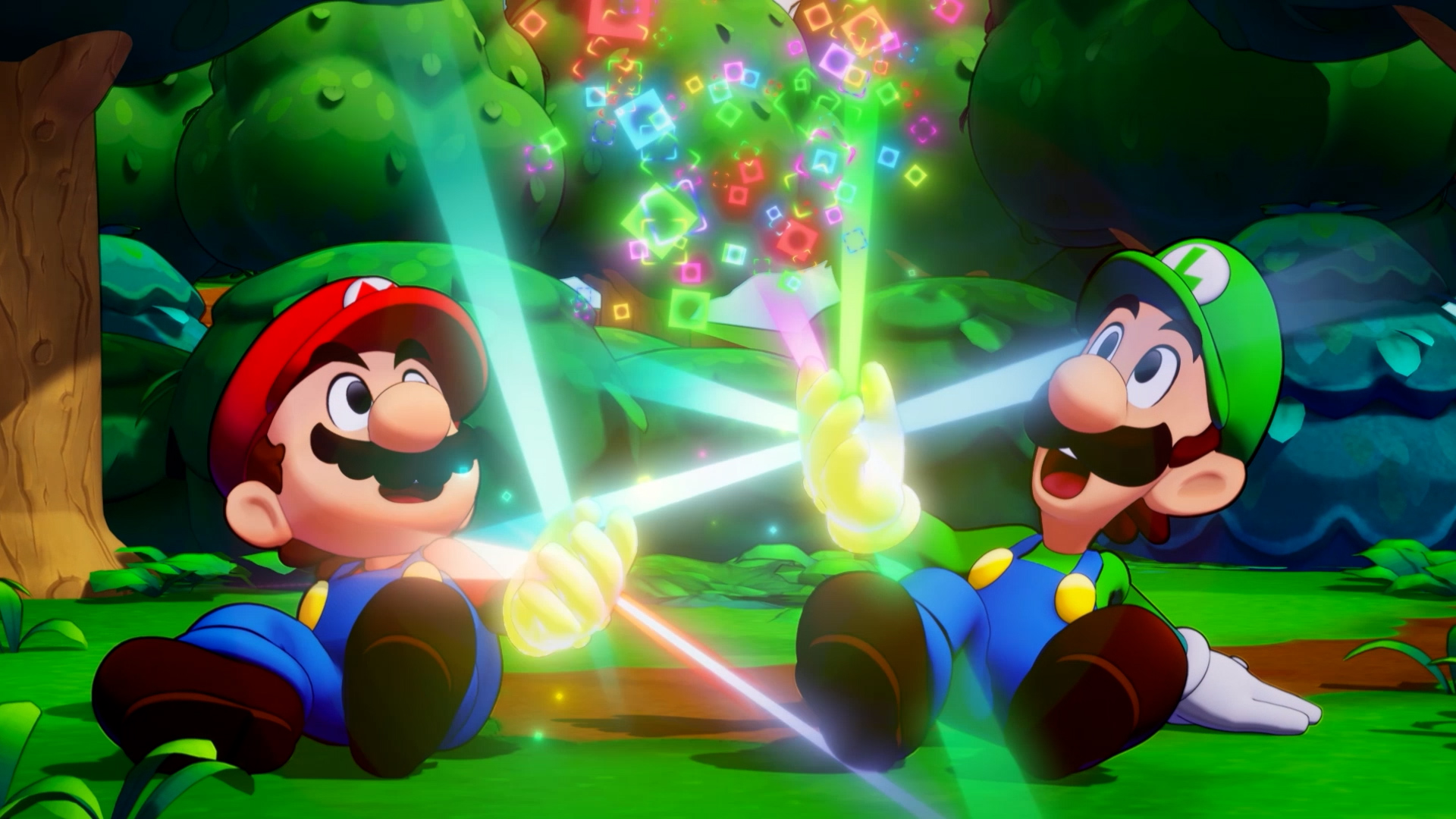
During a new “Ask the Developer” interview with Nintendo, multiple Mario & Luigi: Brothership developers all weighed in on the gameplay of Brothership and how connection influenced the game’s direction:
Mario & Luigi | Brothership Devs on Connection & Gameplay:
Tomoki Fukushima: As for what would become the core gameplay, Acquire’s initial idea was really good, so we started by having them prototype it. Here’s what was written in the proposal: “A Mario story that’s uniquely yours. Living and adventuring on drifting islands”.
Haruyuki Ohashi: I thought drifting islands sounded fun. You discover an island, have an adventure, befriend the people there… I thought it would be fun to connect more and more islands together and increase the number of allies you could go on an adventure with.
Akira Otani: I have to admit, it was a good idea. Nobody came up with such an idea when we were brainstorming at Nintendo. Gameplay where you connect different islands isn’t something you’d come up with normally. (Laughs)
Haruyuki Ohashi: However, it took us quite some time to capture that previously-mentioned “Mario & Luigi-like” feeling, so the testing for this new element took a back seat… As we discussed how to make this drifting island gameplay fun, it ended up being a while before we could present concrete ideas to Nintendo, and I think that might have worried them.
Akira Otani: To be honest, I was getting anxious. Fukushima-san and I were wondering when Acquire would be ready to share their ideas with us. (Laughs)
Tomoki Fukushima: However, Ohashi-san is the type of person who thinks hard and gives one answer once he’s satisfied, so we trusted him in that respect. That said, we did have a lot of internal strategy meetings to discuss how long we could wait. (Laughs)
Haruyuki Ohashi: In this game, Shipshape Island serves as the base of operations for Mario and his friends’ adventure. You drift around the ocean on this island, approaching various other islands and having adventures. But it took a while to complete the game mechanics for this, such as how to have the island travel around this huge ocean.
Tomoki Fukushima: The gameplay and story direction are usually decided in a short period of time at the start of development and the details are ironed out from there. But that took longer than expected. Meanwhile, we were working on the battles and actions you can take while exploring without certain things being final. For example, Shipshape Island’s drifting system, or the game’s scale, such as the number of islands and their themes. It was a bit like chasing rainbows, and it was a lot of work.
Akira Otani: Also, there was a big difference in the way both companies go about developing games. In previous games in the series, we always created the gameplay first and then came up with a plot that would bring that gameplay to life, so the director led all of the progress. But Acquire’s approach to making games was to have the director, Ohashi-san, think about the drifting islands gameplay, while separately from that and in parallel, have an external story writing company come up with the story… However, because it’s an RPG, the story and gameplay must work together in unison in order to make any progress.
Haruyuki Ohashi: The story writing company also struggled to capture that “Mario & Luigi-like” feeling. They couldn’t come up with a fitting story.
Remember when we were thinking about the plot together and we decided on themes for each sea? The first sea would be “family”, the second “friends”, and so on.
Tomoki Fukushima: You’re right, that’s when various elements started falling into place with the theme of “connection”. The gameplay is about connecting islands, but there are also the connections that exist between the people living on those islands.
Haruyuki Ohashi: This was around the time that drifting islands were implemented in the game. We started to see how you connected people with each other too as part of the story, and “connection” was gradually established as a theme for this game.
Hitomi Furuta: At the time, we thought that fusing together different islands would be a huge undertaking on the system side, requiring a massive amount of data, and therefore might not be possible. So we switched our approach and pivoted towards connecting them with a rope or something similar. We began coming up with lots of different ideas for what rope-like things could be used to connect islands.
One idea was that inserting an electric plug into a socket would create a rope-like connection with electricity running through it, which would cause something good to happen. And with good things happening leading to bonds being formed between people, the idea of “plugging in” mitigated the challenges we faced on both the game mechanic and story fronts. …I think that discovery was the turning point.
Tomoki Fukushima: As soon as familiar and easy-to-visualise motifs, like electric plugs and cables, were decided on, everyone’s understanding aligned, and the process of coming up with ideas for the game that matched the setting became smoother.
Akira Otani: Before it was a plug, it was a rainbow, wasn’t it? (Laughs)
Hitomi Furuta: A rainbow bridge, in fact. At first, we connected the islands with bridges. I’m glad we could pivot to something that fit the game better.
Akira Otani: In the Mario & Luigi series, we always combine gameplay with the game’s overall theme in a straightforward way so the game doesn’t appear too complicated. Also, since it’s a Mario game, we made efforts to ensure the story was clear and understandable. This game’s themes are “connection” and “bonds”, with the gameplay of connecting the drifting Shipshape Island with other islands and the story of forming bonds between people. Of course, we needed to find a way to communicate these themes clearly to the player.
For the full interview, why not click here to check out Ask the Developer Vol. 15, Mario & Luigi: Brothership – Chapter 3:
Ask the Developer | Mario & Luigi Brothership (Participating Developers)
- Akira Otani | Entertainment Planning & Development Division, Co-Production Group (Producer)
- Tomoki Fukushima | Entertainment Planning & Development Division, Co-Production Group (Associate Producer)
- Haruyuki Ohashi | Director, Acquire Corp.
- Hitomi Furuta | Designer, Acquire Corp. (Art Director)
Share this:

Discover more from
Subscribe to get the latest posts sent to your email.