

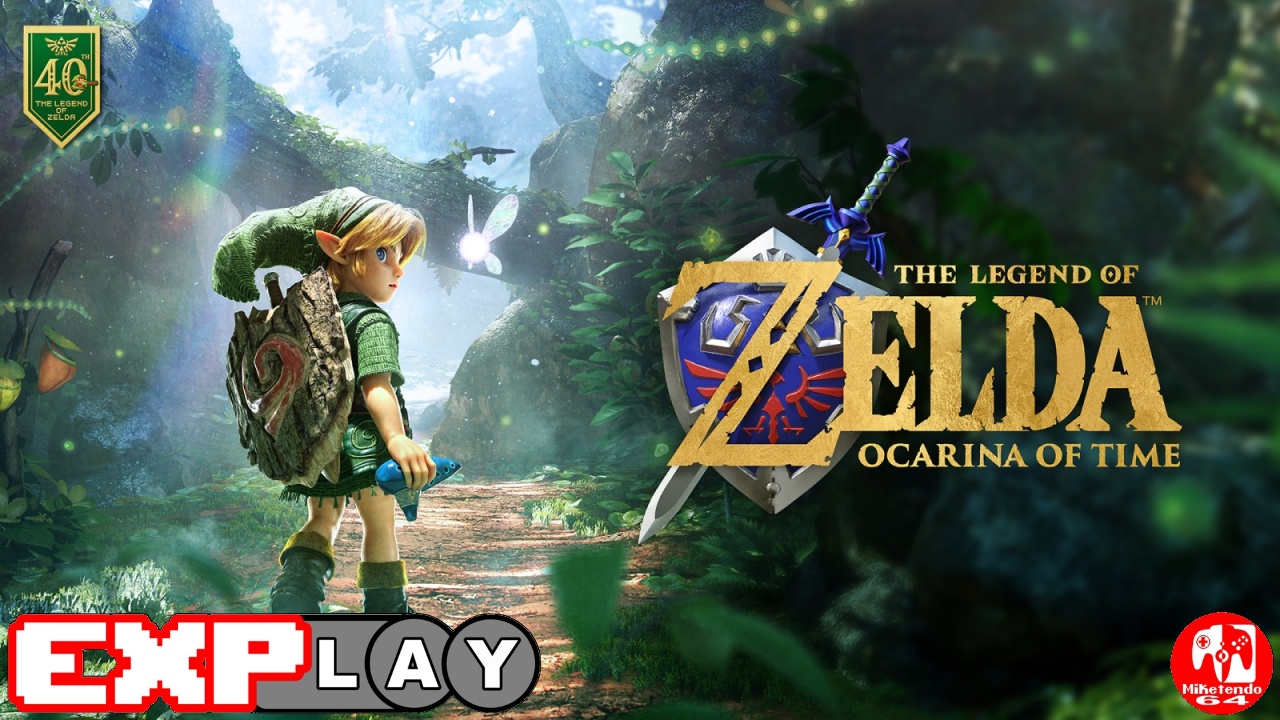
Welcome to EXPlay (Explain & Play) — the review series where we don’t care for scores. Instead, we tell it how it is with every game we get our hands on, while including lengthy gameplay so you, the reader, can form your own impressions and views while reading and watching.
In this explanatory review, we’re covering The Legend of Zelda: Ocarina of Time by developer Nintendo:

The Legend of Zelda: Ocarina of Time (Nintendo Switch 2)
Art Thou Ready? These three words have been etched into my soul ever since I embarked on an adventure of a lifetime in The Legend of Zelda: Ocarina of Time on the Nintendo 64 back in the late 90s. My first experience with the game was at a neighbour’s house. He was wandering through Goron City as Adult Link, and I was in awe of the game’s scale and how revolutionary it was at the time. I was much younger than he was, but my neighbour let me try it for a little while, and I was hooked immediately. So much so that I begged my parents to buy me the game for Christmas. When Christmas came round, there it was under the tree. It was the best Christmas ever for me. I spent so many hours losing myself in Hyrule, fighting formidable foes and terrifying bosses. To say that The Legend of Zelda: Ocarina of Time had imprinted itself on me would be an understatement. I lived and breathed the game, and it was my first step into a decades-long love affair with The Legend of Zelda series that I still cherish to this day.
Now, 28 years from that fateful day I became a Zelda fan, a remake of this iconic game is now playable on Nintendo Switch 2. I could not have been more excited when it was revealed, and now I have the opportunity to experience the game I have highly regarded all these years with some of the most stunning visuals I have ever seen in a modern video game. Granted, there has been a remake of The Legend of Zelda: Ocarina of Time on the Nintendo 3DS previously, but I never played it despite owning a copy (I never owned a 3DS; I just had the game as part of my Zelda collection). However, I had no excuses this time, as I do own a Switch 2 and was really eager to dive into the game once again and see if it still holds the same charm and wonderment as the N64 original.
Okay, so let’s begin with story; if you are a die-hard fan of the original game, feel free to skip a few paragraphs. If you are new to this game or would like a refresher, please read on. The Legend of Zelda: Ocarina of Time follows our hero Link on an epic quest as he travels through time to save Hyrule. From leaving the safety and tranquility of Kokiri Forest as a young boy to meet with Princess Zelda, Link finds himself undertaking plenty of trials and tribulations. He must go into the belly of the beast of Lord Jabu Jabu to rescue Princess Ruto of the Zora, save the Gorons from being eaten by the Fire-Breathing Dragon Volvagia, and overcome the darkness as a dead chill fills the air in the Shadow Temple, all in the hopes of garnering enough strength to defeat the evil Ganondorf.
Upon meeting Zelda, Link is first charged by the princess to find all three Spiritual Stones that will open the door inside the Temple of Time. By opening the door, they could then lift the Blade of Evil’s Bane out of its pedestal (aka the Master Sword) so they could traverse into the Sacred Realm. It is here that a divine artifact known as the Triforce can be found. Zelda wishes to find it so that she can keep it away from Ganondorf. Little did they know that their attempts to do so would only facilitate Ganondorf’s entry into the Sacred Realm to claim the Triforce for his own. As Link lifts the Master Sword, he becomes trapped and falls into a deep slumber while Ganondorf enters the Sacred Realm and takes the Triforce.
When Link awakens, he finds himself in the future. Seven years had passed, and he was no longer a child but a young adult. He is met by Rauru, the Sage of Light, who informs Link of the current state of affairs and what he must do to stop Ganondorf. Now strong enough to wield the Master Sword, Link sets off once again to find the sages who will lend him their power that will finally end Ganondorf’s reign once and for all.
In the original The Legend of Zelda: Ocarina of Time, the story was told through cutscenes that had text-read dialogue. Nothing was spoken, barring a few sounds like grunts, oohing, and aahing due to memory limitations on the old software and hardware. The Switch 2 version has made all the main cutscenes fully voiced and even thrown in a few new voiced cutscenes to further deepen the game’s story and its characters. It was such a relief for me to hear fully audible characters, though I was somewhat surprised by the voice direction of some characters. I suppose I had become accustomed to Patricia Summersett’s portrayal of Zelda that I was thrown back a little by Young Zelda sounding far less regal in Ocarina of Time. I still think Erica Mendez did a pretty good job as the character; I just wasn’t expecting it. As for other characters, like Saria, Navi, Darunia, Ruto, Impa, Ganondorf, and the Great Deku Tree, they sounded exactly what I had imagined they would sound like, and everyone did quite a bang-up job of portraying each character.
Okay, that’s story done with; let’s get down to gameplay. The Legend of Zelda: Ocarina of Time plays almost exactly like the original game, but with some very noticeable differences. First and foremost, Link can actually jump at the press of a button this time around. Some people might find this weird, but this was not a feature in the original game, and Link would automatically jump platforms if he had momentum. The combat and “Z-Targeting” are generally the same; Link can swing his sword or whatever weapon he is holding and can fire projectiles like arrows (Adult Link) or Deku seeds (Young Link). In the original, there was actually a separate button for Link to raise his shield. I am rather grateful that he does it automatically this time around, as I lost many a heart for not reacting fast enough to block in the N64 version.
The sub-weapons and items are no longer assigned to three separate buttons, but just one. Instead, you can scroll through the weapons by holding L or R and then moving the left joystick to select the item in question. This is a feature that was introduced with Breath of the Wild and has seemed to stick around in Tears of the Kingdom and Echoes of Wisdom. I don’t dislike the feature, but I did prefer having quick access to multiple items at once; though, granted, one slot was almost always reserved for the Ocarina, so I was only really fighting over two slots. Speaking of which, the Ocarina actually has its own button and is reserved for the left button on the D-Pad. It is actually quite handy having it there and is much more accessible when you need to play a song quickly, like the Sun Song (if you know, you know).
Another important detail I should add about the Ocarina is that it is compatible with the Nintendo Switch 2’s built-in microphone. You can now hum the tunes you learn in-game, or even play real-life instruments. The game will instantly recognize the song and play it on screen. It is such a game changer for me to do that, especially when I keep looking for the non-existent C-buttons to play the songs, only to remember that some buttons have been reassigned to the L and R shoulder buttons. Now, I just hum the songs and hey presto! I am warping away to Lake Hylia or being greeted by my trusty steed Epona.
Regarding content, The Legend of Zelda: Ocarina of Time on Nintendo Switch 2 is very much a 1:1 remake. All the main quests and side quests are the same, but there are a couple of notable changes. You can obtain an additional empty bottle to store things in, and some of the placements for items like Heart Pieces and Gold Skulltulas have been moved. The topography has also changed in a good number of places, like Kokiri Forest, Kakariko Village, and Hyrule Castle Town. For example, in Hyrule Castle Town, the Treasure Chest Mini-game shop has moved from the town center down an alleyway. There are plenty of minor changes like this all over Hyrule, and it does make things feel different whilst remaining remarkably familiar at the same time.
Another welcome change is that you can also wear masks as an adult now. In the N64 version, only Young Link could wear Masks, but in the remake, Adult Link can as well. I personally applaud this addition, as all too often I would encounter a Sheikah Stone as Adult Link only to not be able to converse with it due to not being able to wear a particular mask. Only to go back in time as Young Link and forget where the Sheikah Stone was. Now, it will no longer be an issue, result! The inclusion of new masks that you can unlock with the upcoming Young Link and Young Zelda amiibo is definitely a quirky idea that only Nintendo can come up with. You can only have one of these masks in the game at any one time, but you can scan these amiibo as many times as you want in the same day.
I really could keep going about The Legend of Zelda: Ocarina of Time, but at some point I do need to wrap up this review. So, let’s get down to brass tacks. I was always going to be biased about this game as the original was my first and most favourite Zelda game of all time. That said, I knew that this remake had a lot to live up to, and it would really need to deliver if it was to convince me and many other Ocarina of Time fans. I am ecstatic to say that it did indeed deliver, and on all counts. The world of Hyrule has never looked so good. The way the grass and the flowers in Hyrule Field sway in the wind, and the details in the character models and the environments have been reworked to make this game look the absolute best it can be. I cannot express enough how good the designs of Link’s Tunic are. The fact that the Kokiri Tunic actually looks like it was woven with leaves just shows how much attention to detail Nintendo has put into making The Legend of Zelda: Ocarina of Time on Nintendo Switch 2.
It is also hard to believe that one of the MOST iconic things about The Legend of Zelda: Ocarina of Time has reached new heights of perfection. The soundtrack has always been one of the most memorable of all Zelda games that I have ever played. A lot of Zelda games have heavily featured music, and many of them are instantly recognizable, most of all Ocarina of Time. To think that Koji Kondo and his team could make such incredible music back then and, on top of it, improve it even more for this remake is simply astounding. The music itself is just as important as the gameplay when it comes to Ocarina of Time and truly goes hand in hand.
As much as I have absolutely adored my time playing The Legend of Zelda: Ocarina of Time, there are a couple of snags I would like to address. The first is that the game has definitely been made easier. This is great for first-time players who may not have played a Zelda game before, but long-time fans have been left somewhat disappointed that this game has been “dumbed down” so that more people can experience it. I have certainly noticed that it has been very easy for me to play, and I was hoping that there would be a Master Quest mode included that would have offered a more challenging difficulty with remixed dungeons. This is not the case; however, it is rumoured that Master Quest Mode could be coming in a possible Paid DLC sometime in the near future.
Coming to a close, if ever there were a “System Seller” for the Nintendo Switch 2 that would convince you to buy it for one game in question, this is it. I say that with all sincerity. Not just because I loved the original and I want to see this do well, but because The Legend of Zelda: Ocarina of Time is actually doing well commercially. In just four days since its launch, it sold well over 5.2 million copies worldwide and is considered the fastest-selling game on the Switch 2, and the second most sold game on the system behind Mario Kart World.
To wrap up, if you were ever on the fence about playing a Zelda game, The Legend of Zelda: Ocarina of Time on the Nintendo Switch 2 is the best way to dip your toe in its waters. It is a traditional Zelda experience with modern visuals and controls, and serves as a great stepping stone without worrying too much about the deep lore that the series has been expanded upon over the years. The gameplay is fun without feeling repetitive. The story is engaging, with its endearing cast that with many having deep character developments. Most importantly, you will not want to stop playing from the moment you boot up the game until the credits roll. I am having an utter blast with this game. To me, it is like coming home from a long journey and being exactly how I remembered it when I first played it all those years ago. In short, The Legend of Zelda: Ocarina of Time is a true masterpiece that respects nostalgia whilst being accessible for new players to experience and enjoy!
Game Specifications:
Developers: Nintendo
Publisher: Nintendo
Platform: Nintendo Switch 2 (Digital/Physical)
Genre: Adventure, Action
No. of Players: 1 (Single System)
Release Date: November 5, 2026
Price: $59.99
Nintendo.com Listing

Share this:

Discover more from
Subscribe to get the latest posts sent to your email.