

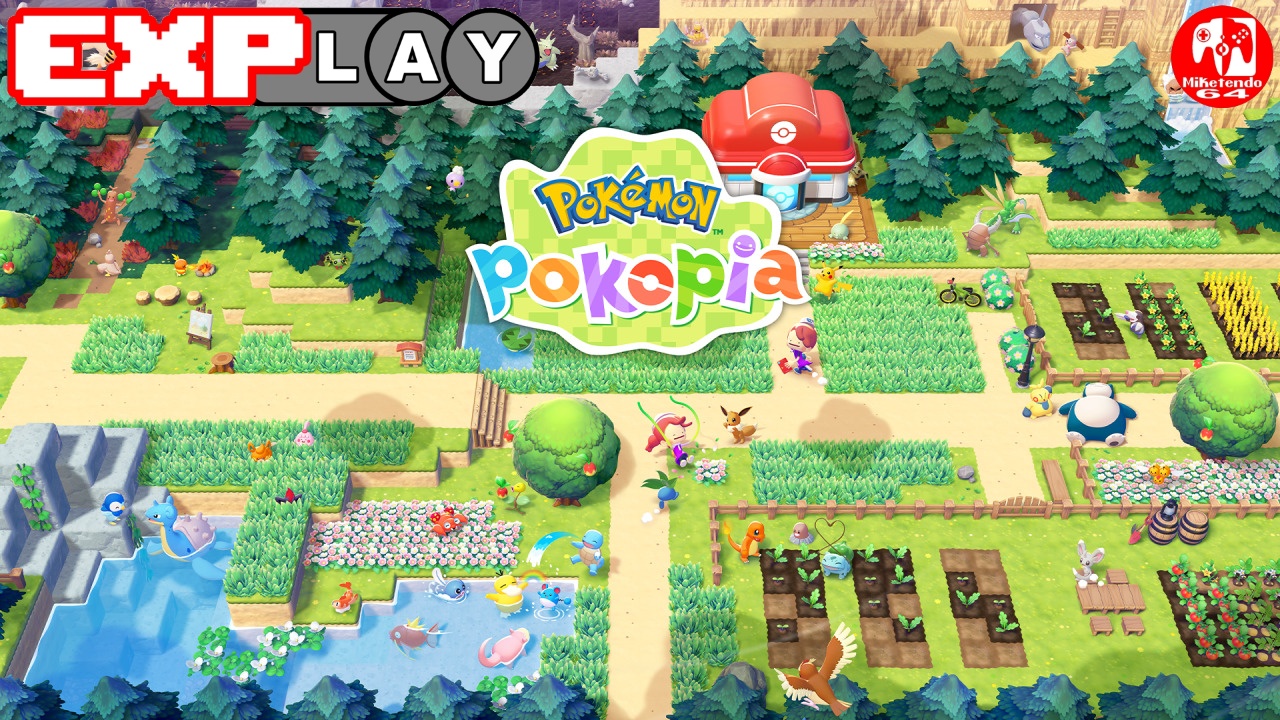
Welcome to EXPlay (Explain & Play) — the review series where we don’t care for scores. Instead, we tell it how it is with every game we get our hands on, while including lengthy gameplay so you, the reader, can form your own impressions and views while reading and watching.
In this explanatory review, we’re covering Pokémon Pokopia by joint developers, GAME FREAK and Omega Force:

Pokémon Pokopia (Nintendo Switch 2)
Co-developed by GAME FREAK and Koei Tecmo’s Omega Force, Pokémon Pokopia launched on March 5, 2026, as a Nintendo Switch 2 exclusive — and it’s one gorgeous-looking title you absolutely don’t want to miss.
Originally envisioned as a spiritual successor to the Pokémon: Let’s Go games, Pokémon Pokopia is a cosy life sim that hooks you immediately with its premise: you play as an adorable Ditto who assumes the form of a human trainer. Sure, you can build habitats, befriend Pokémon, and slowly recreate Kanto one revitalised area at a time — but the lore beneath the charming visuals is surprisingly dark. A cataclysmic event drove humanity from the planet, leaving their Poké Pals behind while they fled to the stars. Scattered notes reveal what really happened — and to the surprise of many, just how central Team Rocket was to it all. (No spoilers here, though — if you want the full deep dive, you’ll have to play.)
Story-wise, Pokémon Pokopia is about a Ditto with a can-do attitude who can do almost anything. After breaking free from your Poké Ball and meeting Professor Tangrowth, you’re led into the open Withered Wasteland and encounter a Squirtle in desperate need of water. Using Ditto’s transforming ability, you learn Water Gun, revive the Squirtle, and begin restoring the dry grass. Professor Tangrowth then guides you through a few tutorial tasks until you reach a dilapidated Pokémon Center. The building is a wreck, but the outside PC still works. Rebuilding it will take time, Pokémon, and materials.
That’s where the core loop begins: create habitats using natural items (leafage for grass patches) or crafted objects (benches, punching bags), luring in Pokémon like Hitmonchan. Each habitat differs, so different Pokémon appear. Rarity is tracked with a three-star system: one-star (Common) appear quickly, while two- and three-star (Rare/Very Rare) take much longer. Weather, time of day, and location all play a role too.
Withered Wasteland is just the first area — it connects to four others. Palette Town, accessible via the Cycling Road west of Withered Wasteland, stands apart from the main story. It’s a free-build zone across three islands where you can place anything you want, discover rare items, and experiment with build kits. For players who want to speed through the story, here’s the path: each area has ruins and a broken Pokémon Center. Raise the environment level by creating habitats, befriending Pokémon, and housing them to boost comfort. Once you hit the required level, buy a building kit to restore the Pokémon Center. It takes a day to complete, then a few requests drive the story forward — some featuring mythical or legendary Pokémon encounters.
After finishing the main objectives in all four story areas, Ditto’s trainer rank increases, and you can pass through gates to new zones. But the real endgame is raising each environment to at least level five to unlock the Team Initiation Challenge — nine steps that must be completed to see credits. Does humanity return? Does Kanto get repopulated? We’re not spoiling that.
What we will say is that beating the game is just the beginning — Ditto’s work is never finished. There are ten environment levels total, and every rank-up unlocks new items and recipes via the PC. But here’s the catch: what can be given can be taken away. Remove a Pokémon’s home to build something else, and their comfort drops — which can lower the environment level and lock away new items/recipes until you rank back up.
Building is the heart of Pokémon Pokopia. There are countless recipes for crafting, cooking, and creating — but world-building is the real draw. With 300 Pokémon to befriend (before variants like Peakychu, both Shellos forms, etc.), plus in-game events adding lines like Hoppip, there’s also an event Pokédex alongside the main one. There’s a Habitat Dex too, tracking every habitat you’ve built or discovered hints for.
The customisation is endless: change item colours, patterns, and layouts — your imagination is the only limit. Personally, I could’ve rushed the story much faster. I didn’t have to spend so much time in Palette Town and Withered Wasteland — but I did, and I don’t regret a single second. At 90+ hours and counting, there’s still so much left: every habitat, every Pokémon, every CD, fossil, and Mysterious Slate. Pokémon Pokopia has become an absolute obsession. The moment I turn it off, I’m already thinking about what to do next. It’s full of feel-good moments and has reconnected me to a childhood sense of happiness and positivity.
Gameplay outside building is incredibly versatile. As Ditto, you learn moves from Pokémon — Water Gun, Leafage, Rock Smash, Rototiller, Jump, Camouflage — and special skills like Waterfall to climb falls. Some Pokémon encourage you to transform: surf as Lapras, roll as Graveler, glide as Dragonite. For anything Ditto can’t do, your Poké Pals step in.
Each befriended Pokémon has a unique ability: Charmander lights fires, Bulbasaur speeds plant growth, electric types power vending machines and street lights, Scyther chops logs, fire types bake Squishy Clay into bricks, Trubbish recycles waste into paper. They also have personalities, unique dialogues when paired, and can help find items or lost Pokémon. Lost Bellsprout? Open the Pokédex, search, and ask around — some point the way, Charizard flies you over, Abra teleports you.
With humanity gone, Pokémon aren’t fighting — they’re helping each other. They’re working as a community to bring humans back, and with Ditto leading, they prove they’re capable of far more than we ever imagined. So if you’re ready to give up your social life and accept that Pokémon Pokopia is a Game-Key Card title only, prepare yourself for the greatest Pokémon spin-off to date. You’ll spend hundreds of hours building your perfect Pokémon utopia — with events, new Pokémon, and Dream Islands to plunder. Whether playing solo or online via Link Play, this is the only Pokémon game you need to celebrate the 30th anniversary.
UPDATE #1 (August 5, 2026): Not only was August 5, 2026 the day that Part 1 of Pokémon Pokopia’s Expansion Pass released, bringing with it a wave of new content, but the accompanying version 2.0.0 update also delivered an extensive list of changes worth getting excited about.
For instance, a new move has been added in the form of Dive. With Dive, Ditto can now put a bubble around its head and explore freely underwater. Buildings can be erected underwater, and the game’s storage system has been improved with the addition of the new Portal Pod, which can be used at any time to access any item stored in a Portal Pod.
New items also include a safe, a dynamic Ditto print, two new emotes, and five new hair colours. One of the greatest quality-of-life tweaks implemented is the ability to move items in bulk between any storage box and the item bag. Players can also choose to store only items that have already been stored in a given storage box — a change that will make organising inventory far easier going forward.
Players can now delete items placed inside garbage bins, and fine-tune depth placement when positioning doors, windows, and similar objects. More items can now be painted, a motion-sickness reduction option has been added for the cameras, and a new setting allows movement while the move wheel is open.
Another major improvement: if a Pokémon’s habitat is accidentally destroyed by removing one item, returning the item or rebuilding the habitat nearby will cause the Pokémon to move back in, saving players from having to track down a newly homeless Pokémon. Pokémon now also respond more quickly when furniture is removed or replaced. Any Pokémon currently being searched for in another town can now be travelled to directly when returning home.
Pokémon that have been taught an emote will now respond when they see you use the same one. Relics can be appraised in batches of up to 10 at a time, crafting materials in the storage box next to the workbench are consumed first, and the power generator limit has been expanded from 64 to 128.
The number of different photos that can be displayed in one town has been raised from 10 to 40. Smearguru can learn patterns from any photos stored in references, released stored water now automatically adjusts to nearby water levels, and more treasure can be discovered when dowsing on Dream Islands.
And believe it or not, we’re still not done. Other changes include:
- Leafage can now be used on farm soil to revert it back to a soil block
- Surf and Waterfall activate more smoothly
- Strength can be used underwater
- Surf can be activated on land
- Rollout can destroy objects such as large boulders
- Pokémon can follow you while using Surf, Glide, Rollout, and Magnet Rise
Additionally, while transformed and using Rollout, players can now inhale and interact with their item bag. An “All” tab has been added to both the Pokédex and Habitat Dex pages. Items can be placed on top of square plants, the Hide-and-Seek game can be cancelled midway, both the Tidal Bell and Clear Bell can now be triggered by laser sensors and switches, certain roof items can block water, and nearly 30 bugs and glitches have been fixed.
In short, version 2.0.0 is a sizeable update. Even without the Bubbly Basin content, it provides Pokémon Pokopia with so many worthwhile fixes and quality-of-life adjustments that the base game has evolved into something greater than it already was — and we’re here for it.
For our full thoughts on the Bubbly Basin DLC, that’s a separate review, which you can check out right here.
Game Specifications:
Developers: GAME FREAK, Omega Force
Publisher: Nintendo
Platform: Nintendo Switch 2 (Digital)
Genre: Simulation
No. of Players: 1 (Single System) | 2 – 4 (Local Wireless) | 1 – 4 (Online)
Release Date: March 5, 2026
Price: $69.99
File Size: 6.2 GB
Nintendo.com Listing

[REVIEW] Pokémon Pokopia Expansion Pass Part 1: Bubbly Basin (DLC You Can Dive Into) | NINTENDO SWITCH 2
Share this:

Discover more from
Subscribe to get the latest posts sent to your email.