

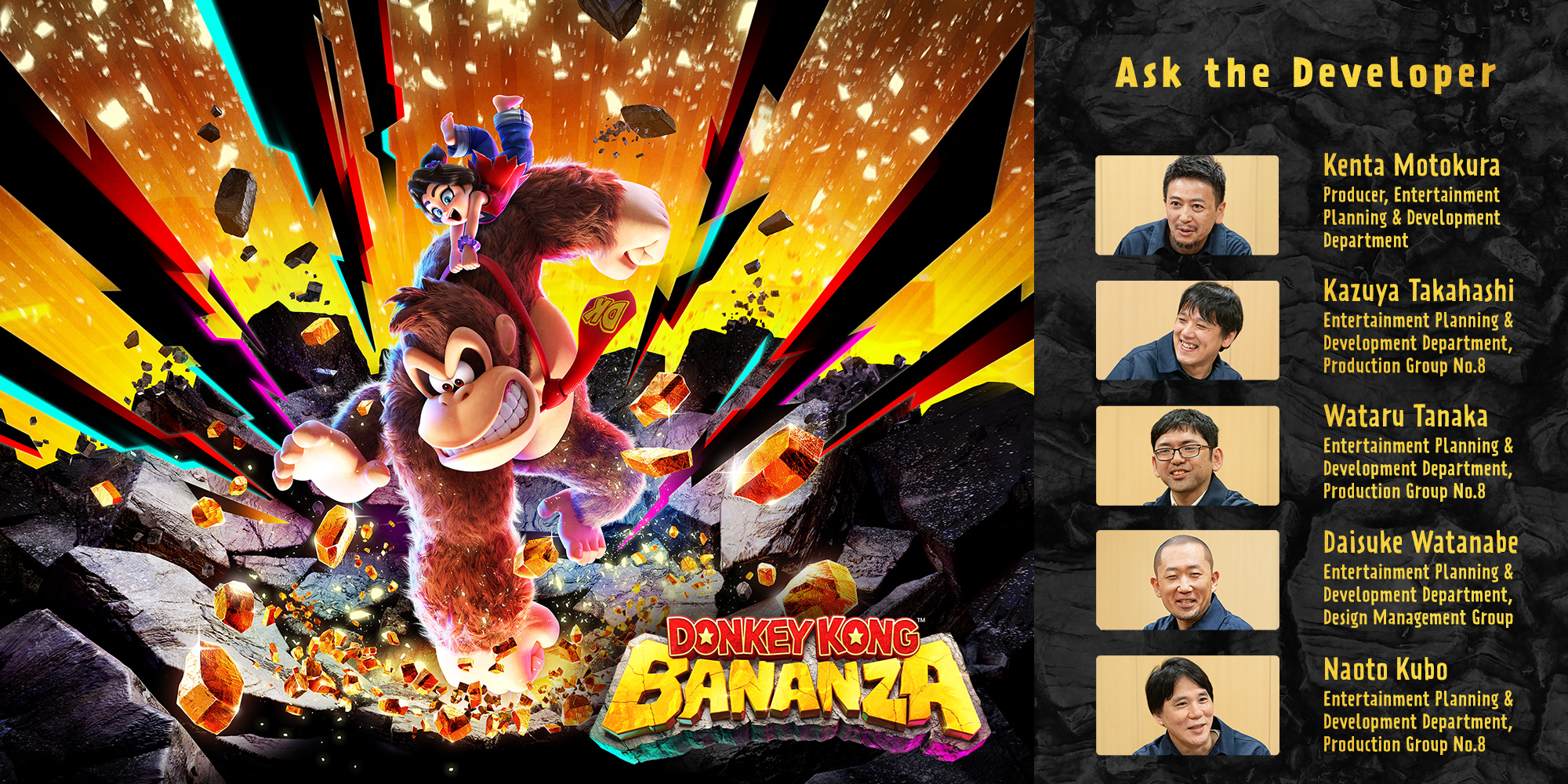
Asked and Answered with the Devs behind Donkey Kong Banaza.
With just mere days to go before the release of Donkey Kong Bananza for the Nintendo Switch 2, Nintendo has released a brand-new three-part interview with five of the developers behind the upcoming game. For everything asked and answered during the 19th instalment of Ask the Developer, here is every answer provided, but first,, it’s time to introduce the developers who took part:
- Kenta Motokura (Producer, Entertainment Planning & Development Department)
- Kazuya Takahashi (Entertainment Planning & Development Department Group No.8)
- Wataru Tanaka (Entertainment Planning & Development Department Group No.8)
- Daisuke Watanabe (Entertainment Planning & Development Department Group No.8)
- Noato Kubo (Entertainment Planning & Development Department Group No.8)
Chapter 1: Chain of destruction

Nintendo: First, can you introduce yourselves?
Kenta Motokura, Kazuya Takahashi, Wataru Tanaka, Daisuke Watanabe, Noato Kubo, Entertainment Planning & Development Department Group No.8
Kenta Motokura: Hello, I’m Kenta Motokura, the producer for Donkey Kong Bananza. Until now, I’ve mostly been involved in the development of 3D Mario games, having directed Super Mario 3D World and Super Mario Odyssey. In terms of Donkey Kong games, I worked on the character designs for Donkey Kong Jungle Beat. As the producer for Donkey Kong Bananza, I crafted the game’s concept and set the direction for the overall structure and player controls.
Kazuya Takahashi: Hello, I’m Kazuya Takahashi, one of the directors for this game. I joined Nintendo in 2020, but before that, I worked on a broad spectrum of games, including open-world RPGs and arcade games. For this game, I gave direction on the game design and worked on the level design, cut scenes, and text creation.
Wataru Tanaka: Hello, I’m Wataru Tanaka, another of the game’s directors. I’ve been involved in the development of several 3D Mario games since Super Mario Galaxy 2. For Super Mario Odyssey, I implemented player controls and directed the core system of action elements. As the programming director for Donkey Kong Bananza, I mostly provided direction on the processing performance and utilisation of system functions for Nintendo Switch 2, as well as enemy behavior.
Daisuke Watanabe: Hello, I’m Daisuke Watanabe, the art director. I was in charge of character design in the Super Mario Galaxy series and joined Super Mario 3D World as the design lead. I oversaw Donkey Kong Bananza’s overall art direction.
Naoto Kubo: Hi, I’m Naoto Kubo, the sound director. I’ve previously composed music for Super Mario Maker and led the overall sound development for Super Mario Odyssey. As the sound director for Donkey Kong Bananza, I co-ordinated overall sound development and controlled quality. I also composed some of the game’s music myself.
Nintendo: Thank you. It sounds like staff members who’ve previously worked on 3D Mario games, in particular Super Mario Odyssey, were central to Donkey Kong Bananza’s development. But how is it that the 3D Mario development team ended up creating a new game in the Donkey Kong series?
Kenta Motokura: Development began when Koizumi-san approached our team and said, “With an eye to expanding the Donkey Kong franchise further, I’d like the team that’s been working on 3D Mario games to create a 3D Donkey Kong game”. The Donkey Kong series started with an arcade game created by Miyamoto-san. It featured a lot of things that were innovative for arcade games at the time, such as narrative-based gameplay and stage composition with varied design. Later on, we had success with the Donkey Kong Country series developed with Rare Ltd., and I think those titles also represented a significant innovation as Super NES games with unique visuals. So this time around, tasked with developing a Donkey Kong game ourselves, we decided we were going to aim for another big innovation.
We’d built up a lot of expertise in gameplay development for 3D action games through our work on 3D Mario games, including Super Mario Odyssey, but we needed to dive deeper into the fundamental question of “What is Donkey Kong?”. So, our first step was to seek out Miyamoto-san and Koizumi-san.

Nintendo: And were you able to find out what Donkey Kong means to them?
Kenta Motokura: Miyamoto-san, who was also involved in the development of the Donkey Kong games created by Rare Ltd. and Retro Studios, Inc., put great emphasis on Donkey Kong’s moves, such as Hand Slaps and blowing on things.
Hearing that made me realise the wide range of moves Donkey Kong has at his disposal, and that there’s potential to expand them even further. Koizumi-san, who was involved in both Super Mario Odyssey and Donkey Kong Jungle Beat, highlighted Donkey Kong’s massive arms as something that sets him apart from Mario. I felt that Koizumi-san put emphasis on Donkey Kong’s strength, like delivering mighty punches or lifting heavy objects.
Nintendo: I have the impression that the Donkey Kong series brings something new to the table with each instalment. Where does this title fit in?
Kenta Motokura: Well now… In a long-running series, novelty and continuity are both important, but we wanted this title to fully convey the appeal of Donkey Kong as a character. Meanwhile, we thought that by creating something new, leveraging our experience developing 3D Mario games, we’d have the opportunity to create two separate branches – 2D Donkey Kong and 3D Donkey Kong – just as we did with Mario games. So, keeping in mind that this game will come to symbolise 3D Donkey Kong, and with the theme of bringing Donkey Kong’s strengths and new actions to the forefront, we thought the concept of “destruction” would be a good fit..
Nintendo: So you aimed to develop a game that would leverage the unique aspects of Donkey Kong as a character. Speaking of which, Donkey Kong’s character design has been given a makeover, right?
Daisuke Watanabe: That was a hot topic of discussion. People’s impressions of Donkey Kong actually vary quite significantly from person to person. Donkey Kong began life in the arcades as Mario’s nemesis, but since then he’s had many guises depending on the game, be that a cool, rugged king of the jungle or a lovable goofball. So, rather than just giving him a simple design update, we strove for a design that would get to the core of what makes Donkey Kong who he is, bringing out his unique characteristics and appeal.
Kenta Motokura: We also interviewed people who’d drawn illustrations of Donkey Kong from way back to preserve the image of Donkey Kong in the mind of his creator, Miyamoto-san.
Daisuke Watanabe: We got no shortage of advice. From general guidance regarding his body frame and unique facial expressions, right down to the smallest detail, like how his pointy hairdo is essential…but you can’t make it too long. (Laughs)
Everyone: (Laughs)
Kenta Motokura: Because the series has been played for such a long time, we pursued the “identity” of Donkey Kong himself in various aspects.
Daisuke Watanabe: Also, as we were testing out various moves with a temporary character model in the early phases of development, it became apparent how much bigger Donkey Kong is than Mario, giving him a considerable on-screen presence. This meant we could properly showcase a wide range of facial expressions, and by combining them with powerful moves, we felt we could create something new in terms of game feel, too.
Kenta Motokura: When controlling a character in a 3D world, the player often sees them from behind, so we were also conscious of how Donkey Kong would look from the back while he’s moving. The back view of Donkey Kong just looks like a mass of brown fur, which would make for a monotonous visual if we simply rendered him in 3D. That inspired us to make some creative adjustments to his outfit, such as giving him britches and suspenders. We also made his fur look rich and thick. Outside of this game, Donkey Kong has recently appeared in The Super Mario Bros. Movie released in 2023 and in Mario Kart World, but there’s a basic character design which provided the foundation for those versions of Donkey Kong. That basic Donkey Kong design has been completely revamped. While overhauling the design, we returned to where it had all started. We took Miyamoto-san’s original Donkey Kong as the basis, adding design elements from Donkey Kong Bananza here and there.
Nintendo: Does that mean that all of the recent Donkey Kong designs, including those from the movie and Mario Kart World, have their roots in the original one created by Miyamoto-san, with elements of Donkey Kong from Donkey Kong Bananza added to it?
Kenta Motokura: That’s correct. Donkey Kong Bananza sparked the creation of a design which I think better conveys the new Donkey Kong.

Nintendo: His thick fur stands out compared to the previous design, making him look wilder. And yet, at first glance, his various facial expressions also give the impression that he’s a comical and charming character. That said, I saw he can alter his appearance in this game by transforming.
Kazuya Takahashi: Smashing lots of terrain and collecting gold fills up the Bananergy gauge, allowing Donkey Kong to perform Bananza transformations, in which he powers up by transforming into different animal forms. This idea emerged while we were searching for Donkey Kong’s ability change. We were discussing how it might be fun if, once he transforms into a powerful Kong Bananza, he could deal out destruction in different ways, not just with regular punches, but with charge punches, piercing punches and the like. In Mario’s case, he progresses through the game by powering up and becoming bigger or using special abilities, but in this game, Donkey Kong can transform anywhere by harnessing the power of Bananza transformation. Being able to transform anywhere lets him chain together his destruction, which is the concept of this game. We thought that this chain of destruction would be compelling as an action game. And so it became one of the key gameplay elements we focused on in this title.
Chapter 2: Voxel technology

Nintendo: The concept of destruction is central to this game. How did the team go about exploring and implementing it?
Wataru Tanaka: Actually, the programming team had already been researching smashing mechanics even before development began.
Nintendo: So it wasn’t that the concept of destruction came first, and then you built a mechanic around it?
Wataru Tanaka: No. Shortly after Super Mario Odyssey was released, we started running technical experiments with the idea of, “What kind of game do you get if everything in the environment is destructible?”.
Kenta Motokura: We even tried sticking arms on a Goomba.
Watura Tanaka: That’s right, we did. (Laughs) In Super Mario Odyssey, there’s a boss called Knucklotec who attacks Mario with giant hands. The programmer who created him tried attaching those arms to a Goomba as an experiment. The Goomba could smash terrain, tear off pieces to use as weapons, and throw them.
Those actions felt surprisingly satisfying, and we got a sense that this destruction-based gameplay could be a compelling core mechanic.
Kenta Motokura: The results of our tests showed that destruction-based gameplay could work, and it was a good match for Donkey Kong’s enormous strength. We felt that the concept and the core gameplay had clicked into place.
Nintendo: So your efforts to define a new Donkey Kong aligned with the smashing mechanics you’d been exploring at the same time.
Kenta Motokura: That’s right. But truth be told, that was just the first step in a long journey. (Laughs) We did a ton of testing. We wanted to incorporate actions like tearing off part of the terrain and swinging it, resulting in further destruction, like smashing something to reveal a new path. At the core, we wanted to create a game where the player’s actions trigger reactions, and that continuous interaction keeps moving the gameplay forward.
Wataru Tanaka: We decided pretty early on that if we were serious about pursuing that kind of gameplay, we should use voxel technology.
Nintendo: Voxel technology? What exactly is that?
Wataru Tanaka: Let’s start with pixel art, which I think most people are familiar with. Pixel art is made up of lots of tiny squares arranged on a flat surface, and by varying the colours of those squares, they combine to form a single image. While each square in a two-dimensional image is called a pixel, when the same idea is extended into three dimensions, each cube is called a voxel. It’s hard to put into words, so we created this diagram to clearly explain it to the development team since it’s such an important element in this game.
Kenta Motokura: Since our team’s been creating 3D action games for a long time, we thought that combining what we did in 3D Mario games with voxel-based destruction would naturally lead to a completely new kind of gameplay.
Kazuya Takahashi: Everything in this game is made out of voxels, including the terrain and the enemies. And it’s the voxel-based terrain that enables the core gameplay feature where you can destroy virtually everything in sight.
Wataru Tanaka: But once we’d decided to go all in with voxels, I instinctively knew it was going to be difficult. That’s because the development environment for voxel-based games wasn’t readily available to everyone on our team. So first we needed to consider how to go about creating the voxels themselves.
Nintendo: I see. You referred to voxels as cubes, but the terrain and enemies in this game don’t look especially cube-like, do they?
Wataru Tanaka: Voxels are really just part of the internal structure, so we focused on making sure players wouldn’t notice them while playing. The biggest reason we chose voxels was their flexibility, as they let us define the appearance and material of each part of the terrain individually. It’s not just that the terrain is destructible – it also has various different properties. Take sand, for example. It’s soft, sticks to walls when thrown, and is hard to climb because you tend to slip. There are also visual differences, such as desert sand being yellowish and shoreside sand being whiter in colour. The development team collectively referred to different substances, such as white sand, red soil, and grey rock, as “materials”. Each has its own unique physical properties and appearance. Each voxel in the game is assigned one of these materials.
Daisuke Watanabe: Put simply, placing voxels with the soil material generates terrain made of soil. Adding voxels with the grass material on top of that then turns it into terrain with grass growing over soil. Terrain created in this way can be destroyed on a voxel-by-voxel basis.
Kazuya Takahashi: Typically in game development, 3D levels are created by first building polygon models and then applying textures to each of them. But for this game, as soon as we had our voxel modelling tools, things became much more convenient. We could freely combine voxels and materials to build terrain and then test it out immediately in-game. This let us quickly experiment and iterate when building Layers. That’s one of the great things about voxel technology, I think. Though it must have been an absolute nightmare for the programmers building the tools. (Laughs) Thanks to the creation of this toolset, we were able to craft Layers that feel truly unique to this game, with terrain that features a rich variety of visual styles and physical properties, along with underground areas and fully destructible environments, down to the smallest detail.
Nintendo: I see. Hearing you talk about it, I can really see how this technology is a perfect match for gameplay built around the concept of destruction. By the way, was this the first time your team incorporated voxel technology?
Kenta Motokura: Actually, we also used voxel technology in Super Mario Odyssey to make the terrain interactive. For example, the cheese rocks in Luncheon Kingdom, or the snow you can plow through in Snow Kingdom.
That said, in Super Mario Odyssey, we started using voxels midway through development, so the areas where we could apply them were limited. But the trial and error we went through back then directly led to what we were able to do in Donkey Kong Bananza.

Nintendo: Speaking of what’s changed since Super Mario Odyssey, Donkey Kong Bananza is being released as a Nintendo Switch 2 game. Given the development timeline, was it planned as a Switch 2 game from the beginning?
Kenta Motokura: We originally began developing Donkey Kong Bananza on Nintendo Switch, but we ran into some challenges. I think it was around 2021 when we started to think about moving development to Switch 2.
Daisuke Watanabe: We first looked into how we could upgrade what we’d originally built for Switch to take advantage of Switch 2. One of the most obvious improvements was that we could place far more objects in the environment than before. Being able to place more objects in the terrain didn’t just enhance the game’s visual richness. More importantly, it increased the amount of things players could destroy, which amplified the exhilaration of being able to demolish anything and everything. That went hand in hand with the game’s core concept of destruction. It convinced us that this game would be even more fun if we developed it for Switch 2.
Wataru Tanaka: From a programmer’s perspective, voxel technology is well-suited for creating gameplay centred around destruction. However, it also uses a lot of system memory, and we faced the challenge of Switch not having enough to support everything we wanted to do. I’ll explain with some simple arithmetic. If you’re asked to double the size of a 1 × 1 pixel image in both width and height, you end up with a 2 × 2 image, which means four times as many pixels. But when you do the same with voxels, you’ve got width and height, but also depth to contend with. So, doubling all three dimensions gives you 2 × 2 × 2, or eight times the data. It may sound simple to just “double something”, but the reality is that memory usage, voxel density, and all kinds of processes end up gobbling up eight times the resources. It was clear that the memory available on Switch would struggle to handle that load, and we felt that manifesting the huge volume of terrain that we did in this game might have been unachievable on that platform. With the move to Switch 2, we gained not only more memory but also greater processing capacity. That gave us the freedom to incorporate gameplay ideas we’d previously abandoned because they were too demanding. When we got down to trying it, we discovered that not only could it handle the heavy processing requirements, but it also ran at 60 fps. Things we’d given up on, like explosions flinging large objects or causing them to collapse, were now possible. Designers could also place as many objects as they wanted. There were so many moments when we thought to ourselves, “Now we can really do this”.
Daisuke Watanabe: As well as running at a smooth 60 fps, the core gameplay of smashing got way more satisfying. The physics of smashing involve lots of things all happening at once. Donkey Kong throws a punch, the terrain and objects break apart, and visual effects show debris flying outward. All of that is packed into a single moment. At 30 fps, we couldn’t fully capture everything that happens in that instant. But at 60 fps, we saw that sense of destruction coming through much more clearly. We thought to ourselves, “Now we’ve got something seriously satisfying!”. Not only did Switch 2 enable the game to run well, it unlocked the game’s full potential – no, it made the game possible.
Nintendo: I see. So the way everything’s expressed in that brief moment really has a strong impact on the gameplay experience.
Daisuke Watanabe: We talked about voxel technology earlier, and I think for most people, the term “voxel game” brings to mind visuals made of stacked cubes. That’s exactly why we as designers aimed to create rich and dense visuals that don’t look like voxels at all – something that players will see and think, “Wait, you can destroy this?”. We believed that by creating dense visuals with a sense of realism that weren’t obviously made of voxels, players would be genuinely surprised when they realised the environment was destructible. That surprise would make the sense of destruction all the more convincing and satisfying. This wasn’t something the designers could handle on their own. We worked closely with the programmers, running test after test to figure things out together. Since voxel technology has yet to be fully explored, we had to figure things out as we went along, experimenting with both the mechanics and the design.
Wataru Tanaka: Right. The technology that enables voxel-based shapes to appear smooth already existed, but we figured that if we were going to do it right, we should push the visuals to have a strong sense of realism. Of course, actually getting that to work took an obscene amount of effort from both the designers and the programmers. (Laughs)
Daisuke Watanabe: Since destruction is such a central concept in the game, we had to pay attention not just to how things looked, but also to the physical properties of the terrain itself.
Nintendo: By physical properties, you mean the “materials” you mentioned earlier, right?
Daisuke Watanabe: Exactly. We focused not just on the surface of the terrain, but also what lies beneath it once it breaks. We designed the terrain so that when it’s destroyed or carved out, its appearance and physical properties change in ways that make the sense of destruction feel more convincing.
Wataru Tanaka: For example, if you strip away the grass, it exposes the soil underneath. If you strike a rock, cracks begin to form. And if you dig near water, the ground gradually darkens as moisture seeps in.
We carefully defined the effects each material produces when it breaks, refining every detail to make the destruction feel as realistic and convincing as possible.
Noato Kubo: We also poured a lot of effort into the sound effects to make the sense of destruction feel satisfying and responsive. It wasn’t just about using loud or dramatic sounds. For instance, players will hear the sound of basic materials like rocks breaking thousands of times during play. So we aimed for sounds that are pleasant to the ears without being tiring or repetitive. To that end, we recorded sound effects by hand, capturing the textures of materials like rock and sand. Recording everyday sounds like this is often referred to as Foley. We recorded lots of variations so the sound would vary depending on how the material was destroyed, instead of always sounding the same. We also added subtle randomness through programming and fine-tuned the sounds to make sure they weren’t too loud or high-pitched. Meanwhile, for special objects that show up later in the game, we emphasised fun and flashy sounds. We hope players will find them satisfying. We recorded all kinds of material sounds using Foley techniques, including those of fruits. There’s even a dedicated sound for hitting a watermelon. It was about more than just making it sound hard or soft. When players hit it, we wanted it to sound delicious! (Laughs)
Nintendo: I’m curious to know how a delicious watermelon sounds. (Laughs)
Kenta Motokura: We put a lot of thought into the sound and visual effects, and into making the destruction feel satisfying. I think players will realise the fun of smashing things the moment they start playing. It’s a simple, intuitive kind of fun that even newcomers to action games will appreciate. Compared to Super Mario Odyssey, I think the game’s core appeal and sense of exhilaration can be felt more immediately.
Kazuya Takahashi: This game isn’t just about smashing things. Continuity is another important concept we focused on. For example, there’s a move called the Hand Slap, where Donkey Kong slams the ground. That move also acts like a sonar, revealing objects buried nearby. You might spot something glowing on the other side of a wall, and when you break through the wall and dig up the fossil buried there, you might then come upon a hidden area beyond that, leading to even more discoveries.
When creating Layers, we went beyond surface level design. We crafted them with continuity in mind, so that breaking one thing would naturally lead to the next.
Nintendo: The sense of continuity that comes from breaking things really feels unique to this game. But if players can destroy almost anything, wasn’t it a challenge to design levels that don’t fall apart?

Kazuya Takahashi: It certainly was, and that’s exactly why they needed so much thought put into them. The Layers are fun, even if you just play through them normally, but we designed them so that even if the destruction causes their structure to collapse, it’s all part of the fun. In most games, level design is a bit like designing a course. You’ve got a main route you want players to follow, and you build paths to guide them along it. But in this game, even those paths can be destroyed. For example, the “correct” way to get a golden banana – aka Banandium Gem – might be to use the Bananza transformations to smash through a concrete wall. But if you instead dig a tunnel and sneak around to grab it from behind, that’s equally viable. Designing levels with that kind of flexibility in mind was a huge challenge, but I think the ability to be crafty like that is part of what makes this game so fun.
Noato Kubo: It must’ve been rather tough, designing all those hidden underground areas.
Daisuke Watanabe: The levels in this game are really expansive, both vertically and horizontally, so we talked about how we could ensure players wouldn’t get lost.
Kenta Motokura: In 3D Mario games, the goal is often placed up high. But since digging and breaking things are the main actions in this game, the player naturally moves downward instead. We kept tweaking the design, using various mechanisms and the terrain to gently guide the player, balancing the exhilaration of destroying everything with the satisfaction you get when you complete a Layer.
Chapter 3: Sparking interactions

Nintendo: Earlier, you mentioned how the player keeps heading deeper underground. I’ve noticed that each of the Underground World’s Layers has its own distinct environment. How did you go about creating those different environments?
Kazuya Takahashi: We started by giving each Layer its own theme, then we came up with unique gameplay ideas using voxels. We also considered the materials we talked about earlier. We asked ourselves questions like, “What if there was a Layer made of ice or lava?”. And since it’s possible to ride chunks of stone you’ve torn off like a skateboard, we thought it would be fun to create a Layer with rolling hills that would really entice you to do that. For each of these Layers, we started by thinking about the kind of gameplay we wanted to create.
Daisuke Watanabe: We wanted players to experience a sense of surprise each time they reached a new Layer. So, while figuring out the gameplay, we also thought about each area’s colour scheme, unique features, and so on. We made sure each Layer felt distinct, and looked at the world’s overall balance to develop the concept art.
Nintendo: Some of the concept art hearkens back to the original Donkey Kong, with vibes of Brooklyn, New York. How did those designs come about?
Kenta Motokura: In Miyamoto-san’s mind, Donkey Kong’s world always felt like New York City. When we asked him early on, “What is Donkey Kong?” he explained that the steel beams and ladders in the original Donkey Kong game were inspired by the neon lights of New York City. Even the star in the “O” of the logo was inspired by the American aesthetic.
I think the original Donkey Kong game lies somewhere in between the wildness of Donkey Kong Country, and something more urban.
Daisuke Watanabe: Our goal was to make the Underground World feel like an entirely separate civilisation to that of the surface and to cram it full of variety. We felt compelled to create a fresh new world for Donkey Kong, so instead of sticking to what past games in the series had done, we made sure each Layer had its own unique world and flavour. That said, we did draw inspiration from Miyamoto-san’s original vision of Donkey Kong. By weaving neon colours into the visuals as a key element, we aimed to create something fresh while still evoking the feel of the original arcade game. By the way, the pink and light-blue neon tones were inspired by the colours of the ladders and steel beams in the original game.
Noato Kubo: We also composed music that adds to this experience. When a player reaches a new Layer, the music helps to draw them in and sets the tone for the world they’ve just entered. This game is all about destruction, but since players can spend long periods of time exploring the same Layer, having only fast-paced music that relentlessly pushes them to take action would end up being exhausting. To strike the right balance, we used percussion to inject some groove but made sure the music also adds to each Layer’s unique atmosphere.
Nintendo: I got the chance to browse though some of the development materials. It looks like you really mapped out how the mood and intensity of the music shift throughout the game.
Noato Kubo: That’s right. The way the story’s tension builds and the liveliness of each Layer really impact the sense of enjoyment. So we carefully considered the overall musical balance. We might build up excitement in one Layer, then shift to something more serious and dreamlike in the next. That wide range of musical expression may be one of the game’s defining characteristics. In past Donkey Kong games too, although the music was mostly built around a cheerful, jungle vibe, it also featured tracks that were deeply enchanting or mysterious. I think that sense of musical variety is something we’ve carried over into this game.
Nintendo: On the flip side, having the flexibility to make it so varied can lead to choice paralysis. During your trial-and-error process of exploring what music worked, did you ever consider leveraging music from previous games in the series?
Noato Kubo: The series has a lot of recognisable background music, so of course, Donkey Kong Bananza has arrangements of those sprinkled throughout, too. However, it’s also a completely new Donkey Kong game, so we momentarily set aside the fact that it’s part of a series and took up the challenge of composing new tracks from scratch. At the same time, Donkey Kong’s new transformation mechanic was added, which meant we had to create tracks that would play while he’s in his transformed state. That’s when one of the designers came up with this sketch of a zebra as one of his transformations.

Nintendo: Wow, this is…quite something.
Noato Kubo: And they declared, “Donkey Kong will transform into this!”. (Laughs) The mere sight of this sketch was enough to shock me, but actually seeing it programmed into action, I thought to myself, “Well, since we’ve gone this far, we might as well also transform the music that plays once Donkey Kong has transformed”. Changing the music that plays is actually quite a big deal. Even in Mario games, we don’t go that far unless it’s a major transformation, like getting a Super Star and turning invincible. But since Donkey Kong only transforms for a limited time and it has such a big impact on the gameplay, we decided to go all out with transforming the music. We envisioned a track that would give you the urge to sprint as soon as you heard it, and then the image of a zebra galloping passionately to Latin or Spanish-style music popped into my head. I mean, not that Latin music has anything to do with zebras, but still… (Laughs)
Everyone: (Laughs)
Nintendo: Who would’ve imagined this zebra sparking such a complete shift in the music?
Noato Kubo: I know, right? And then, just as we were thinking, “Oh, that transitioned quite nicely. This might be rather interesting”, Motokura-san comes along and says…
Wataru Tanaka: So that was when it happened.
Kenta Motokura: Right, and I said, “Maybe we can add Pauline?”. (Laughs)
Everyone: (Laughs)
Kenta Motokura: Originally, we were discussing whether to have Pauline in the game as a character that players could relate to. But at the time, we weren’t able to incorporate Pauline into a gameplay feature unique to this title. However, now that the transformation mechanic had started to take shape, we thought we could create something new by tying Pauline’s singing to the Bananza transformations. So I asked Kubo-san, “Would you care to write an animal song for Pauline to sing?”.
Noato Kubo: Not just one. He requested one for each and every Bananza transformation. (Laughs) But I thought I might as well go full swing, so I added vocals to the Latin and Spanish-style music. Even though it was the same base track, the response I got from the team was completely different, much more positive. It made a strong impression on me. That really cemented my sense of how powerful the human voice is.
Kenta Motokura: When I made that request, Kubo-san, I wasn’t leaving until I’d heard a “yes” from you. (Laughs) We had the same situation for Super Mario Odyssey, didn’t we?
So, it was only decided later in development that Pauline would appear in the game?
Kenta Motokura: It was after we’d created the destruction gameplay to a certain extent. In the story, Donkey Kong is motivated by his love of bananas, but we wanted to have something else that players could relate to. By featuring Pauline, we thought we could create an experience where players are a part of Pauline’s growth and the growth of Donkey Kong, adventuring alongside her. The best part was that it gave us the chance to incorporate various gameplay features using the power of song, such as breaking seals or showing the route to a destination.
Kazuya Takahashi: Because she’s a human character, she can take on the role of explaining things. And since she opens up about her feelings when she visits the Underground World for the first time, players can empathise with her, giving them the feeling that they’re with her on the adventure.
Daisuke Watanabe: I think the story is also entertaining, and Pauline’s presence played a big role in that. If Donkey Kong were on his own, we could never have included as many talking scenes.
Kazuya Takahashi: Donkey Kong and his friends, as well as their enemies, the Void Company minions, are all headed for the Planet Core in the hopes of having their wishes granted. Although they all have the same goal of heading underground, their motivations differ. Donkey Kong is just out for bananas, Pauline wants to return home to the surface, while the Void Company seeks to hog the wealth for themselves. I think the fact that their enemies are also Kongs is another thing that distinguishes Donkey Kong Bananza.
Kenta Motokura: As a side note, if you use GameShare or share your Joy-Con 2 controllers, player one controls Donkey Kong, while player two controls Pauline. Pauline can attack their enemies with vocal blasts. Since the game’s on Nintendo Switch 2, player 2 can also use Joy-Con 2 mouse controls when playing as Pauline, so I hope you’ll give that a try.
Wataru Tanaka: You can wreak havoc with her singing voice alone, so I think you can have fun just smashing things. If you keep on destroying things, you’ll eventually hit upon treasure chests with maps of Banandium Gems and fossils. It’s a unique co-op experience, so I hope even those who are new to video games will feel comfortable to give it a try.
Nintendo: Thank you. I’m curious to see Pauline in action, and I’m relieved to hear you can also enjoy the game in a way that isn’t too taxing on the brain. Finally, could each of you say a few words to everyone who’ll be playing this game?
Noato Kubo: In this game, you progress by smashing all kinds of things. Your surroundings change constantly, so we worked hard to create sounds that reflect that change. We measured the sizes of areas such as open spaces and caves, and adjusted the volume and reverberation accordingly. Even for the background music, we split each song into multiple tracks and adjusted the balance according to Donkey Kong’s surroundings and the size of the area. I think it’s an audio experience unique to games that use voxel technology, so I hope players will listen out for those details too as they play.
Daisuke Watanabe: I think Donkey Kong is fun to play in this game, with his rich facial expressions and exciting moves. I’d love for players to experience it for themselves. Also, the Underground World where this game takes place is a bit different from previous games in the series. It’s a beautiful yet strange world, and I hope players will enjoy it to the fullest as they journey together with Donkey Kong and his friends. Oh, and smash everything in their paths, naturally. (Laughs)
Wataru Tanaka: I think the gameplay mechanic that lets you destroy everything, right down to enemies and NPCs (non-player characters), stands out as being unique to Donkey Kong Bananza. Not only are things destructible, but the presence of materials expands the gameplay experience even further, with some things being hard and impossible to break with his bare hands, or thorny, et cetera. It would be great if players were also on the lookout for actions based on materials, like tearing off part of an enemy that’s made of explosives and using it to destroy other stuff.

Kazuya Takahashi: There’s a lot of leeway in terms of progression in this game. For example, locations or parts of the story you can skip without suffering any consequences. When the game progresses in a way we hadn’t intended, we call it a “sequence break” in development terminology. Typically in game development, restrictions are put in place to prevent this from happening, but since this game is all about destruction, we wanted people to play freely. Truth be told, restrictions make things a lot easier for us developers. (Laughs) But please do experiment.
Kenta Motokura: I think the strength of video games in general is the player’s ability to spark interactions. In previous 3D Mario games, too, we created gameplay based on those kinds of interactions. But I think we were able to take that to a whole new level in Donkey Kong Bananza. We devoted ourselves to creating a game that feels instinctive to play, no matter how many times you’ve played it. We developed this title with great care and an awareness that Nintendo wouldn’t be where it is today, if not for the original Donkey Kong game. As well as building on the series so far, Donkey Kong as a character continues to explore the unknown, in movies, theme parks and other new experiences. We took on a bunch of new challenges with Donkey Kong Bananza, and it’s shaped up to be a game that we’re proud to present to the world, so please do give it a try! We’ll strive to keep on delivering a Donkey Kong game that’s fun for everyone.
Nintendo: I look forward to digging into the story, in which the new Donkey Kong, alongside Pauline, of course, wreaks glorious destruction on the terrain and enemies. Thank you very much.
End of Interview
Are you looking forwards to the release of Donkey Kong Bananza for the Nintendo Switch 2 on July 17, 2025? Let us know!
Share this:

Discover more from
Subscribe to get the latest posts sent to your email.