

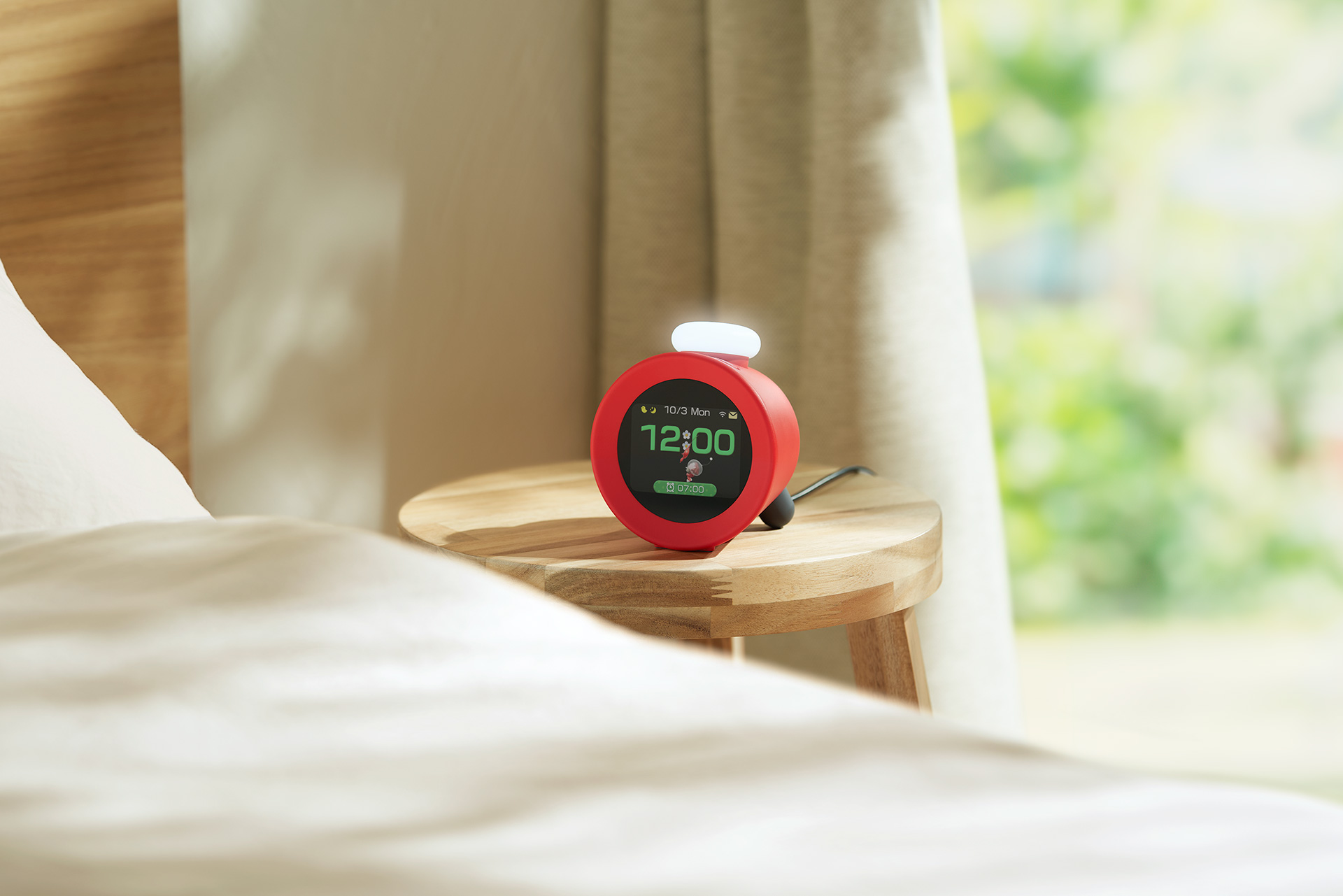
Just in case it wasn’t enough for Nintendo to shadow drop Nintendo Sound Clock: Alarmo on us, they also saw fit to ensure Alarmo was the latest project to be covered during their “Ask the Developer” interview series. Across four chapters, Producer Yosuke Tamori and Director, Tetsuya Akama were asked many questions, and now it is time to hear their answers.
When talking about their involvement with Alarmo, Tamori and Akama revealed how they had to work from scratch and why it became an alarm clock:
Nintendo Sound Clock | Alarmo Devs on How Alarmo Became an Alarm Clock:
Yosuke Tamori: One of our in-house projects was to research motion sensor technology. As this sensor maintains privacy since it doesn’t use a camera, we had an idea for how it could be highly suitable for use in the bedroom, so we decided to kick off a new project to see what we could do with it.
Tetsuya Akama: It’s generally known as a “radio wave sensor”. To put it very simply, it uses the reflection of radio waves to measure the distance from and speed of an object. Self-driving cars, drones, and robots are equipped with sensors like these to help avoid collisions. The key feature is that it can recognise very subtle movements, and unlike cameras, it doesn’t need to film videos, so privacy is better protected compared to cameras. Since it uses radio waves, it can be used in dark rooms. It can also detect movements even if there are obstacles, as long as the radio waves can pass through.
Yosuke Tamori: This sensor can detect the movement of a person in bed even when they’re covered with a duvet, and it doesn’t need to use images or video like a camera. Due to those characteristics, we’d been discussing internally for some time that a motion sensor could also be suitable for use in a private space, such as a bedroom.
We knew that the theme was to support people during their sleep, and we were looking for a way to achieve this. However, it was only after a lot of technical trial and error and building many prototypes that we decided to focus on alarm clocks.
The motion sensor used in this device detects a sleeper’s movements, and there are certain body movements that they make just before waking up. From an early stage, we thought that if we could get this sensor to detect the timing of these movements, people could use it to help themselves wake up feeling refreshed. But it was technologically quite difficult for the sensor to detect those movements accurately enough back then, so we continued experimenting for a while.
Then, our programmers found a way to use the sensor effectively, and there was a point when its responsiveness improved dramatically. They developed a system that detects approximately where a person is on a bed based on the distance and angle measured by the sensor. This made it possible for the sensor to capture the moment a person gets in or out of bed more accurately. It was at this time that we started discussing the possibility of developing an alarm clock that automatically stops as soon as a person gets out of bed.
Tetsuya Akama: From the early days of the project, we considered implementing a feature to wake yourself up, such as an alarm that stops around 10 seconds after you get out of bed or when you move your body. Although those were all useful features, we weren’t sure if they’d be enjoyable or satisfying, unfortunately. Back then, there were no game characters appearing on the screen. The time remaining until the alarm turns off was simply displayed on an on-screen bar, so you had to look at the screen to see the time remaining. Also, it would take a while for the alarm to stop even after you got out of bed. So, there were many challenges.
Then, as programmers made technical improvements, such as the enhanced sensor accuracy mentioned earlier, we started coming up with more and more ideas to make it fun and responsive. These included sound effects that go up in pitch when you move your body, or a fanfare that plays the moment you get out of bed. It was around this time that we finally began to feel that we could create a new product in the form of an alarm clock.
Yosuke Tamori: When creating hardware from scratch, as long as you can establish the technology that supports your idea, the functions you can implement are, in a sense, unlimited, so you can do all sorts of things. We even tried to detect whether a person is starting to sit up in bed to determine if they’re awake.
Tetsuya Akama: Yeah, we tried things like detecting arm movements, dividing the bed’s area into left and right to detect the direction you roll over, and making the alarm stoppable by stretching. Basically, we kept making various prototypes. During the trial-and-error process, the knowledge and expertise of the staff who were involved in the early stages of motion sensor development were very useful. For example, we took advantage of ideas such as “stopping a device without touching it” and “reacting to body movements” in the final product.
Yosuke Tamori: We were so fixated on the idea of not touching the device that there was a time when we challenged ourselves to make the user interface, such as setting the alarm time and music, controllable with hand gestures. Gesture controls made things a bit cumbersome, so we nipped that in the bud.
For the full interview, why not click here to check out Ask the Developer Vol. 14, Nintendo Sound Clock: Alarmo – Chapter 1:
Ask the Developer | Nintendo Sound Clock: Alarmo (Participating Developers)
- Yosuke Tamori | Entertainment Planning & Development Division, Production Group No.4 (Producer)
- Tetsuya Akama | Technology Development Department, Technology Development Group No.1 (Director)
