

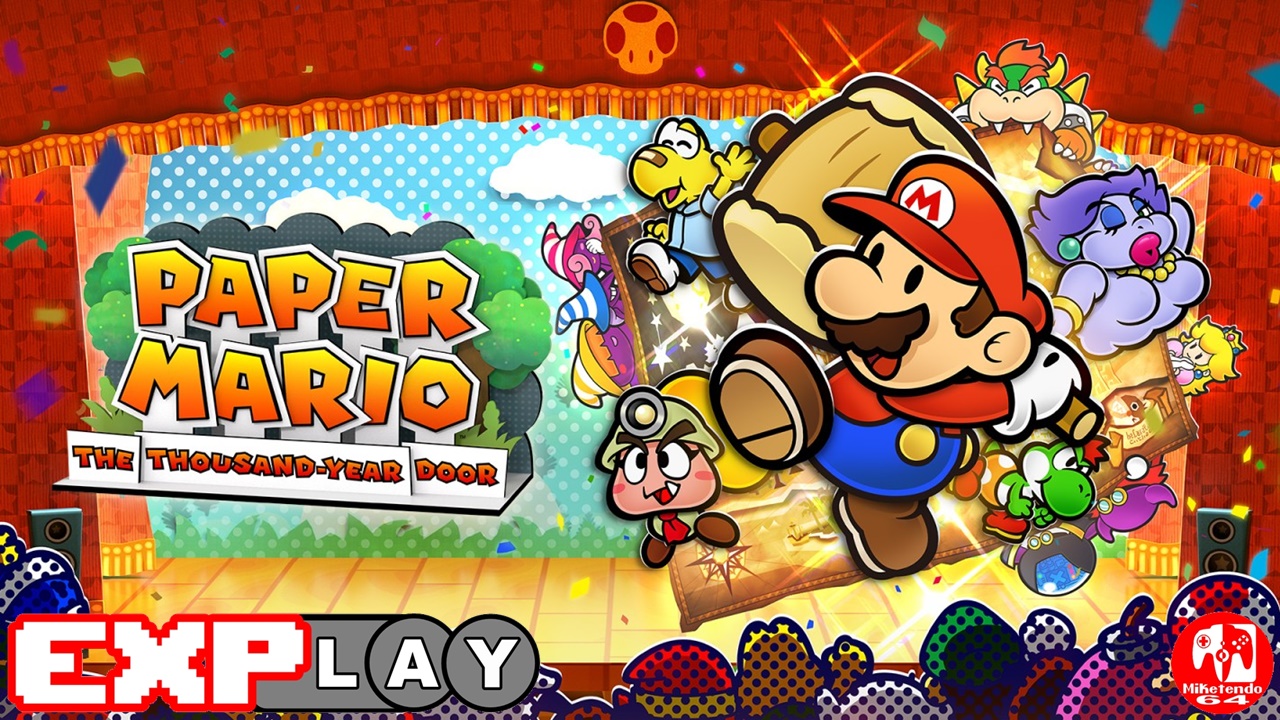
Welcome to EXPlay, (Explain & Play) the review series where we care not for scores but tell it how it is when it comes to every game we get our hands on, whilst also taking the time to include some lengthy gameplay, to give you the reader, the chance to shape your own impressions and views whilst watching and reading.
In this explanatory review, we’re covering Paper Mario: The Thousand-Year Door by developer Intelligent Systems:
Paper Mario: The Thousand-Year Door: (The Explanation)
Paper Mario: The Thousand-Year Door has for years been revered as “The Best” Paper Mario game in existence. First released on the Nintendo Gamecube in 2004, the game was praised by both critics and fans alike for its story development, gameplay, and humour.
I never played the original Gamecube game and have long wanted too but getting a hold of a couple in this day an age would mean a visit to a back alley surgeon so you could sell your kidneys. Fortunately, after years of fans continously pleading to Nintendo to port the game to modern consoles, The House of Mario have listened and not only ported the game to Nintendo Switch but gave it an overhaul as well to add new features and revamp older ones to appeal to new and veteran players alike.
For the purpose of this EXPlay, our target audience is not for those who have played Paper Mario: The Thousand-Year Door already but for those who missed out on playing it the first time around. Those who have played this game originally would have undoubtedly picked up it up on day one as they don’t need any further convincing about how good The Thousand-Year Door is, they already know.
So, for anyone still reading this who has never played Paper Mario: The Thousand-Year Door before, the game follows the titular hero Mario on a paper-crafted adventure around the Mushroom Kingdom. Princess Peach finds herself in the nefarious Rogueport, a coastal town full of shady characters and a tragic history. A hooded merchant coerces Peach into opening a box that can only be opened by someone who is pure of heart.
We are then taken to Mario’s house, with Luigi collecting the mail and reading a letter from Princess Peach to Mario. The letter informs Mario that Princess Peach received a strange map that was in the box and that she is try to find the treasure that the map was hinting at. She then invites Mario to join her on her treasure hunting adventure but when Mario arrives at Rogueport, the Princess is nowhere to be seen and he soon learns that Peach has been kidnapped but not by Bowser this time. Instead it is another nefarious villian with plans of claiming the treasure for his own and use it to conquer the world.
As you can imagine, Mario sets of to rescue the princess once again and he is not alone as a group of colorful characters join him on his adventure. There is Goombella the Goomba, Koops the Koopa, Vivian the Shadow, Madame Flurrie, Admiral Bobbery, and more. Each character brings something to the table with their unique abilities like Goombella’s Tattle ability to read enemies’ stats and traits. Koops can launch his shell, and Vivian can hide Mario in the shadows to avoid being hit.
In Paper Mario: The Thousand-Year Door, Mario and his companions will travel around the Mushroom Kingdom searching for Crystal Stars that can be used to open the Thousand-Year Door and access the treasure sealed behind it. It won’t be plain sailing though as Mario will need to rely on his trusty hammer, jumping skills and the strength of his allies to take on their adversaries who stand in their way. Goombas, Koopas, Piranha Plants, Iron Clefts, are just some examples of enemies that you will fight against.
If you have played Paper Mario 64 natively on a Nintendo 64 or via NSO, Paper Mario: The Thousand-Year Door takes what that game did as its foundation and builds upon it. It uses 2D sprites for its characters that move around in 3D environments. Battles with enemies takes the form of turn-based combat on a theatre stage with an audience of onlookers. Players are given the option to attack, use items, apply tactics, or administer special skills.
When attacking enemies, Mario and his companions each take a turn to make a move. Although Mario can have a party of seven partners, only one can accompany Mario in battle at any one time but you may change between partners which, will cost a turn (you can apply a special badge to quick swap your partner which won’t cost you a turn but we will talk more about badges in a bit). Both Mario and his partners have a standard move as well stronger moves that require Flower Power (FP for short) in order to use them. You only have so much FP so you will have to micromanage how you use it to some degree to get the most out of your attacks.
All attacks do a set amount of damage but you can do more if you successfully follow the control prompts for each attack like pressing the A button just before stomping on an enemy or releasing ZR as soon as the red icon lights up. On the flip side, when enemies attack you, you can block attacks to minimize the damage by guarding at the right moment. There is also a Superguard option that requires split-second reflexes that if done right, will waver all damage and even inflict damage back to the attacking enemy. As is typical of most RPG’s, the battle ends when either all enemies have lost their Hit Points (HP), or your party has. The latter obviously meaning game over and having to restart from your previous save point.
Winning battles, however, will earn you star points (these serve as the game’s XP), which upon reaching 100, will allow Mario to level up and choose which stat, you would like to upgrade; HP, FP or BP (Badge Points). Unlike most games that increase the amount of XP needed each time to level up, Paper Mario: The Thousand-Year Door is fixed at 100 for every level up. The trade off is that as you get stronger, weaker enemies will reward you less Star Points or not at all depending on your level. I should point out that your partners don’t level up alongside Mario but you can increase their rank but finding and using Shine Sprites that are scattered throughout the world.
Now, in regards to badges, which I have mentioned once or twice already, these can provide Mario and his partners with some handy advantages in battle like stronger attacks, stat boosts, as well as cosmetic and audible changes. Badges require BP in order to use them so the more BP you have, the more badges you can equip. Some Badges for new attacks only require 1 or 2 BP whereas increase to attack or defense stats can require 6 BP. Badges can really change up how you play the game and can make things easier as well as more difficult, depending on your particular play style.
Items have a number of effects, both active and passive that can help swing battles to your favour. Mushrooms help recover health, Fire Flowers inflict fire damage at foes, Sleepy Sheep send enemies into a slumber, etc. As for Specials, these also have their own effects and require Star Power in order to use them. Some can deal damage to enemies and even one-shot them if the command prompts are followed successfully. Other Specials can be used to recover HP and HP.
You can earn Star Power by performing successful commands and appealing to the audience. Sometimes, the audience may throw items or objects onto the stage or even come up onto the stage to interact with the props. These props can fall down on top of you or your enemies, dealing small amounts of damage unless you guard effectively.
With all that said, we are still at just the tip of the iceberg when it comes to Paper Mario: The Thousand-Year Door. There is a whole world to explore that is broken up into eight different regions, a huge array of interesting characters with colorful personalities with some of them having requests requiring Mario’s expertise to resolve them, and there are are special traversal abilities the Mario can learn that can turn him into a plane, a boat, or even a tube to reach certain areas he would otherwise be unable to reach in is normal form.
I should also add that Mario is also not the only playable character either as both Princess Peach and King Bowser also have their roles to play with their own side stories. The segments with Peach and Bowser are quite short and serve mainly to develop the story and provide a brief respite from the game’s typical gameplay.
I could go on for hours about Paper Mario: The Thousand-Year Door but it is time to wrap up this EXPlay as I really have gone on for far longer than I would have liked. To summarise, to say that I thoroughly enjoyed Paper Mario: The Thousand-Year Door would be an understatement. I have always enjoyed the Paper Mario games and whilst I wasn’t a fan of Super Paper Mario for its change of gameplay direction and have never played Sticker Star, I can understand why so many fans hold The Thousand-Year Door in such high esteem. It is worth it all and so much more. The Gameplay is peak, the characters are charming, the music is fantastic (by that I do mean the original Gamecube soundtrack, of course. The Switch version’s music is pretty good as well but the OG OST is top!).
As much as people may think that the current lineup of first party games seems like filler content to tide us over until the inevitable next console reveal, Paper Mario: The Thousand Year has always been considered a top tier game on Gamecube and its presence on Switch gives so many players a new opportunity play this beautifully paper-crafted adventure.


Paper Mario: The Thousand-Year Door: (The Gameplay)
Game Specifications:
Developer: Intelligent Systems
Publisher: Nintendo
Platform: Nintendo Switch (eShop)
Category: Role-Playing, Adventure
No. of Players: 1 (Single System)
Release Date: May 23, 2024
Price: $59.99
File Size: 5.1 GB
Nintendo.com Listing

Share this:

Discover more from
Subscribe to get the latest posts sent to your email.