

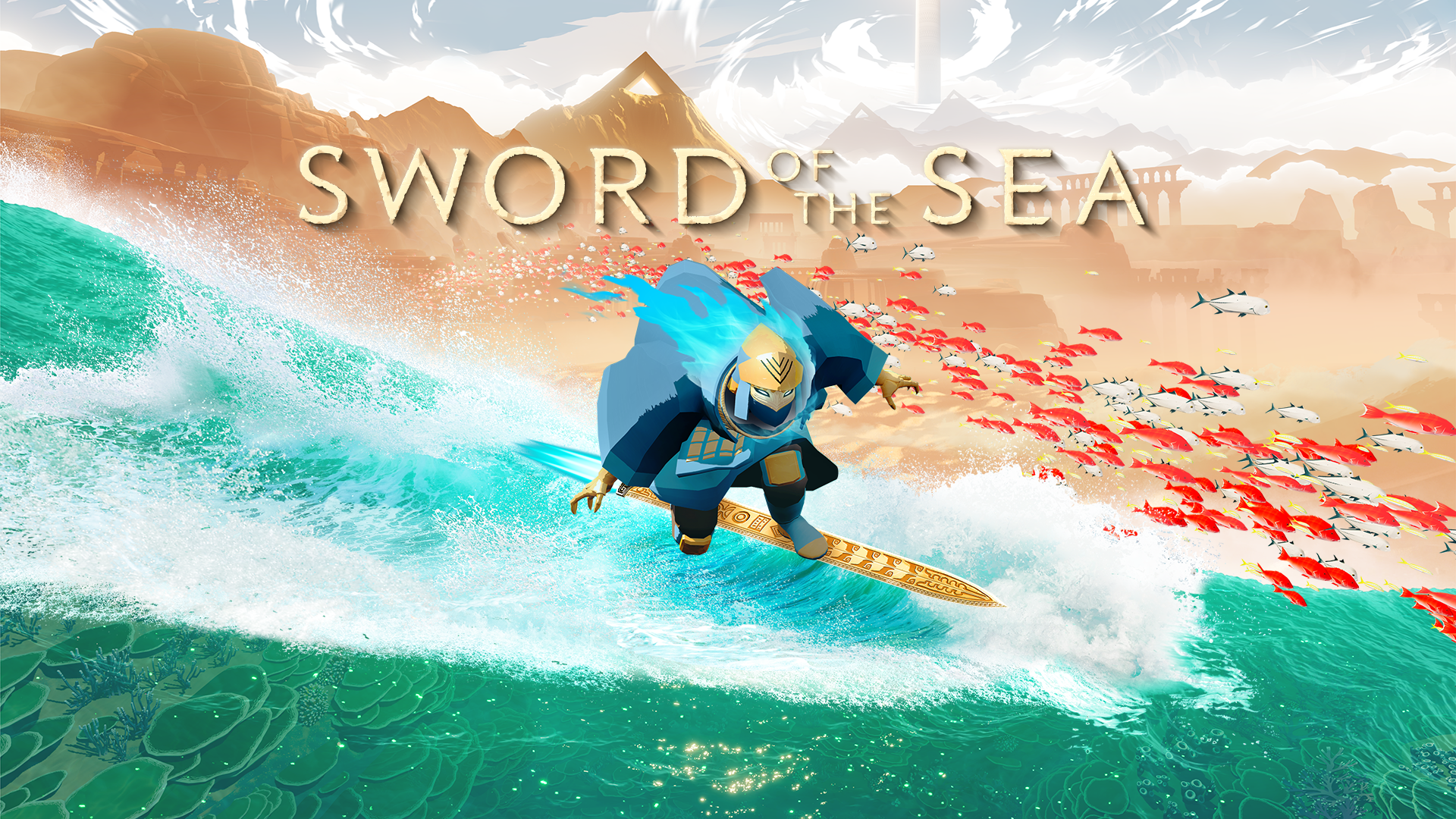
Movement as meditation.
Showcased during the recent Indie World Showcase (broadcast on October 28, 2026), Sword of the Sea is an atmospheric surfing adventure from Giant Squid, the studio behind ABZÛ and The Pathless. Directed by Matt Nava (art director of Journey), the game invites players to ride a mystical Hoversword across waves of sand and water on a quest to restore a lost ocean. It launched on Nintendo Switch 2 and Xbox Series X|S on October 29, 2026, following its earlier release on PlayStation 5 and PC.
We recently had the pleasure of speaking with Matt Nava about the evolution of the studio’s movement systems, the inspiration behind the Necropolis, the Grammy-winning soundtrack, and the lasting feeling he hopes players take with them once the ocean is restored. This is what we learned:
Matt Nava | Restoring the Ocean with Sword of the Sea

Looking back at Giant Squid’s catalog, where does Sword of the Sea sit in the studio’s creative evolution?
Matt Nava: Sword of the Sea really is the culmination of everything that Giant Squid has done and that I have personally learned as a game designer and artist. You can see elements have their roots in all our games, and even in Journey, which I art directed. There’s water, there’s sand, there’s fluid movement, and a mysterious world. It’s immediately satisfying to control, but beneath the surface there’s a lot of meaning to find.
How does the Hoversword movement system build on or diverge from the fluid traversal in ABZÛ and The Pathless?
Matt Nava: Every time I ship a game, I learn a bit more about what I’m trying to communicate as a game designer and artist. In Sword of the Sea, I see a connection to ABZÛ and The Pathless with the idea of movement becoming a flowing dance. We have expanded the idea and given players more expression than ever before. We also have experimented with totally new things – like a hidden combo system that is constantly tallying points as you play to display a final score at the end. This creates a whole new dimension of replayability that is very fresh and exciting.
Can you describe the process of blending skate/snowboard/surf inspirations into a cohesive, meditative feel?
Matt Nava: I drew inspiration from my own experience as a snowboarder. When you ride down the slope, you move incredibly fast. It’s the closest thing you can do to being everywhere at once on the mountain, which lets you understand and experience its totality in a completely different way. I wanted the movement in Sword of the Sea to give the player this experience, and that was our guiding light.
How does the game balance high-speed thrills with the quieter, restorative tone the studio is known for?
Matt Nava: What I have found is that movement can itself be a meditation. When you play Sword of the Sea, you get into a flow state where you forget you are holding a controller, and you just synchronize with the waves. I often found myself just surfing, jumping, and fluidly pulling off tricks for hours when I was working on the game. I think that the high-speed thrills are most powerful when you can reach tranquillity through them.
What inspired the Necropolis setting and the quest to restore a lost ocean?
Matt Nava: We live in a world full of beauty but also full of pointless strife and suffering. I imagined a world where all wars have been fought to their conclusion, and all has been lost. What does a warrior like the Wraith do in that scenario? The only way forward is to see the world in a new way. They must recontextualize their power – a sword that used to cut things apart finds a way to bring the world back together.
How does the soundtrack by Austin Wintory interact with the shifting environments and player speed?
Matt Nava: Austin is a fantastic collaborator who was close to the development process from the start. The music he wrote mirrors not just your location but the player’s story itself. So as you explore, it advances, but it never backtracks, even if you do. And because players may spend very different amounts of time in various areas, the music evolves over time as well. We peel back layers as you search a zone for secrets, which keeps the music from ever becoming repetitive or fatiguing. I’m incredibly happy about how it turned out. And the music won a Grammy!
What challenges arose in bringing the sand-and-water wave physics to Nintendo Switch 2?
Matt Nava: At the core of Sword of the Sea is a dynamic wave surface that shifts and evolves dynamically. You collide with that surface every frame, creating a data processing load that most games with static terrain never have to handle. It challenged us to make the scene render as fast as possible to make sure that it ran smoothly in the Nintendo Switch 2’s docked and handheld modes. Almost every single 3D model was updated with more levels of detail, faster material logic, and more. This includes the hundreds of fish species that animate and react to each other in real time. It was a massive undertaking, but everything just feels right. The Giant Squid team did a fantastic job.
What does the Nintendo Switch 2 version offer in terms of performance or presentation refinements?
Matt Nava: Giant Squid, the original development team, got to polish and optimize the experience as we updated it for Nintendo Switch 2. We took advantage of the great hardware to implement and refine fantastic haptic rumble effects. We refined and improved many graphical effects and scenes. We got smooth performance in docked and handheld modes, and got many bug fixes in to make the experience really great. Sword of the Sea is a great fit for the Nintendo Switch 2, and I’m super excited for Nintendo fans to finally be able to play it.
Are there any specific hidden paths or environmental storytelling moments you’re especially proud of?
Matt Nava: There’s the game you play on the first run, and then there’s an entirely new experience in New Game Plus, which unlocks a boost power. We discovered tons of new lines that take advantage of huge leaps you can do. Speedrunners have found even more than we did. They are hidden in plain sight, but you don’t realize it until you really master the movement. That’s something I’m proud of in the level design.
What do you hope players feel after they finish restoring the ocean?
Matt Nava: We build a space and an experience where the player can learn something about themselves. In many ways, the game can be a mirror that allows you to see your own life reflected in a new light. So I hope that when a player restores the ocean, the beauty washes over them. But also that they find in this metaphor a parallel to something in their life, and take the time to appreciate the fragile and beautiful things that surround us. They are worth fighting for.
We’d like to take this moment to extend our sincere thanks to Matt Nava for taking the time to answer our questions!
About Sword of the Sea:
Surf across surreal undulating landscapes on a quest to unveil a lost ocean.
Surf across magnificent waves of sand and glistening waters on an epic quest to restore a lost ocean in Sword of the Sea.
From the visionary artist behind ABZÛ, The Pathless, and Journey – Sword of the Sea is an atmospheric surfing adventure with highspeed Hoversword movement inspired by skateboarding and snowboarding.
Awesome Surfing and Tricks: Carve your way forward on the ancient and powerful Hoversword, which moves like a snowboard, skateboard, and surfboard all in one. Build momentum to reach top speed and catch big air off the crests of giant waves. Pull off radical flips, spins, and grab tricks with ease as you shred halfpipes, ramps, and wall rides. It’s the perfect balance of exhilarating action and fluid, meditative movement.
A Mysterious and Visually Stunning World of Waves: Explore a world where the land flows in constant waves. From massive tides to the smallest ripples, the shifting sea of dunes is incredibly detailed and beautifully rendered. Surf across sandy deserts, glacial mountains, and many more undulating environments full of secrets in this incredible adventure.
A Spiritual Journey to Unveil the Sea: You are the Wraith – resurrected in the desolate Necropolis on a quest to unveil the ancient sea buried beneath the land. Discover the remnants of a lost culture hidden in sinking tombs and skatepark-like ruins as you search for purpose. Transform sandy dunes into glittering, emerald waters and witness magical sealife return in huge, breathtaking shoals. Feel the spiritual magic of surfing as you connect with nature and restore life – but beware, there is also darkness lurking under the waves.
A Legacy of Art, Design, and Music Continues: Developed by the renowned indie team Giant Squid, Sword of the Sea features the unique artistic design of creative director Matt Nava and beautiful music composed by Austin Wintory. Long time creative partners, their works together include beloved indie games ABZÛ, The Pathless, and the legendary, award-winning game Journey.
Share this:

Discover more from
Subscribe to get the latest posts sent to your email.