

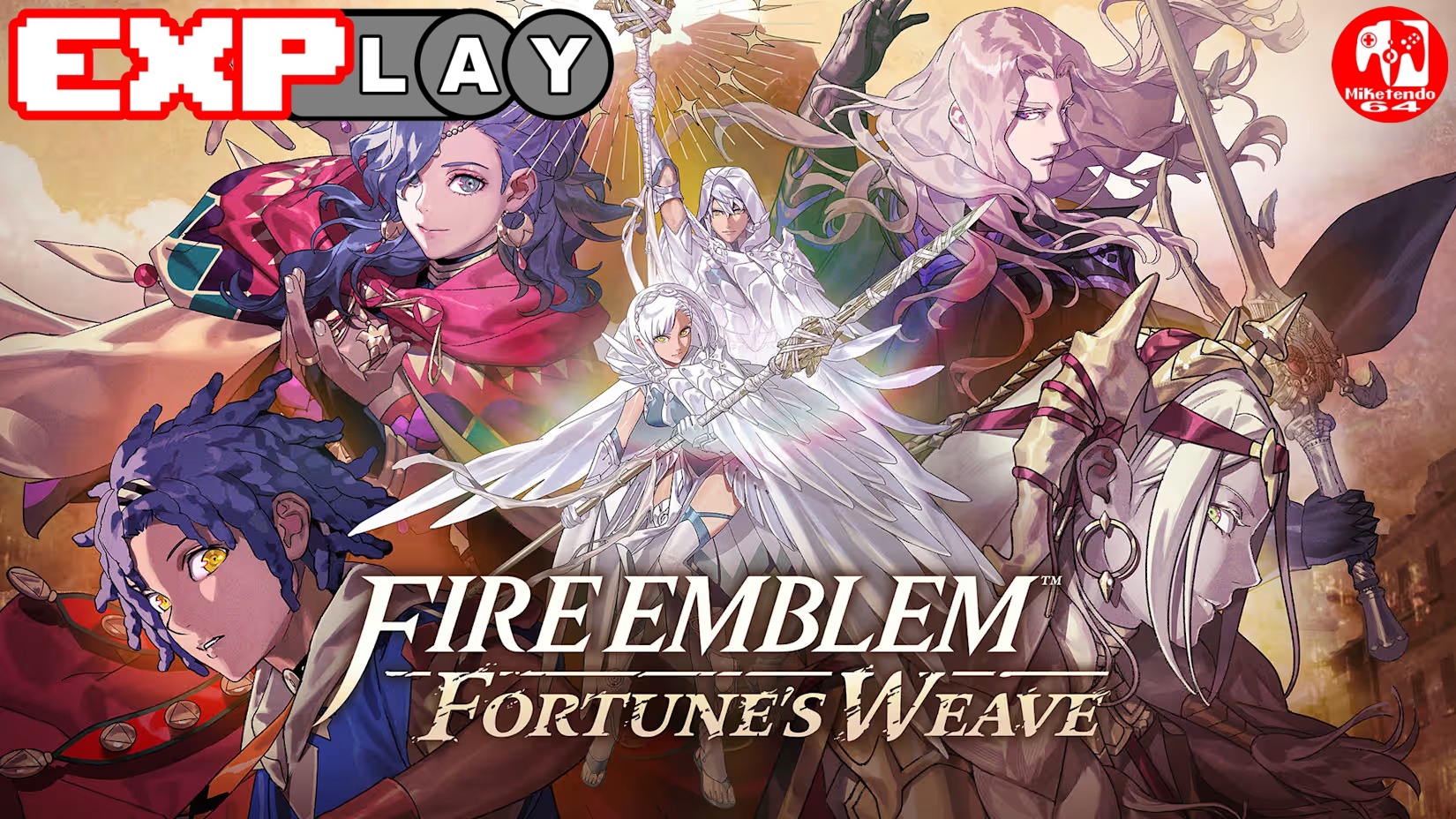
Welcome to EXPlay (Explain & Play) — the review series where we don’t care for scores. Instead, we tell it how it is with every game we get our hands on, while including lengthy gameplay so you, the reader, can form your own impressions and views while reading and watching.
In this explanatory review, we’re covering Fire Emblem: Fortune’s Weave by developer, Intelligent Systems:

Fire Emblem: Fortune’s Weave (Nintendo Switch 2)
Developed by Intelligent Systems and published by Nintendo, Fire Emblem: Fortune’s Weave is the eighteenth entry in the long-standing Fire Emblem series. As one of the most ambitious and densely layered titles yet, this is one of the most emotionally resonant strategy RPGs you could play. Released on September 17, 2026, this Nintendo Switch 2 exclusive is just waiting to be discovered.
Taking place in the same world first seen in 2019’s Fire Emblem: Three Houses, a few centuries later, the game deliberately avoids being a retread of Fódlan. Where that earlier entry gave us an academy, three houses and a war that fractured a continent, Fortune’s Weave shifts the focus to the continent of Dagda, south of Fódlan. This time we get a gladiatorial empire, four fully realised protagonists, time travel, a ruined future, and a narrative structure that genuinely feels like it is weaving something larger than any single path. In all honesty, the game is absolutely massive in both size and content. The fact the developers even considered more paths is borderline insane. We can only thank the development team for their restraint, because without that particular cut it would likely be next year before anyone came close to finishing it.
The story of Fire Emblem: Fortune’s Weave opens at the end of the world. In the year 1454 the Dagdan Empire has fallen. The demon god Balor has returned, an army of risen dead walks the land, and the living have been driven into hiding. Faced with this threat, Sothis the Progenitor God calls forth a soul and has a new body created for them. This is how the customisable avatar is brought in. Players are free to shape their appearance, with the default name of Eshmel, the Pale Raven. Sothis tasks them with saving what remains. Alone, the task is impossible. So the goddess of fate, Fortuna, offers another path: travel into the past, to the height of the Heroic Games in the capital of Dagsion, and change the destinies of four warriors whose survival will decide whether the future has any hope at all.
All too easily the game’s initial premise could have come across as gimmicky. Instead, it becomes the emotional spine of the entire experience. Every hour spent with the four warriors who make up the Flame Lords is coloured by the knowledge that their world is already lost, and that your quiet interventions are the only reason any of them might still be standing when the end comes. It is a structure that rewards investment in a way few games manage.
Of the four Flame Lords, whose stories form the heart of Part 1, first we have Cai. A lively boy from the quiet village of Ribeira, Cai enters the Games to free his father from a death sentence. His path is the most approachable of the four and the one we would recommend most people begin with. It focuses on mounted combat, animal taming, farming and trading crops, and a series of Kindness Quests that gently open the world. There is a genuine sense of a young person stepping into something far larger than himself. His Blaze Arts lean into wide, destructive flames, and he later gains a dungeon ability that lets him see enemies through walls. Starting with Cai teaches the game’s systems cleanly without overwhelming the player.
Second is Dietrich. A foreign swordsman shipwrecked on Dagdan shores after an encounter with a sea monster, he is driven by the need to test himself against ever-stronger opponents and to hunt the creature that ruined him. His route is the purest combat-focused of the four and carries the strongest direct connections to the wider lore of Three Houses, particularly around Agarthan society and Nabatean history. Dietrich can acquire and upgrade Combat Arts by defeating certain powerful enemies, then teach those arts to others. His Blaze Arts centre on movement and teleportation, letting him warp across the battlefield in ways the other lords cannot. His route is the one that most rewards players who love optimising combat.
Third is Theodora, the warrior queen of Saramis. After returning home and losing both her father and an arm to an assassin, she fights to reclaim her people’s stolen lands and restore their pride. Her path leans heavily into leadership. Theodora can recruit battalions in settlements and deploy them both on the field and in battle through gambits, giving her route a strategic layer the others simply do not have. Her Blaze Arts are powerful and often disruptive, matching her role as a commanding presence who has already lost too much.
Lastly comes Leda, the travelling dancer and musician who hides a far darker purpose. She is the surviving daughter of a murdered aristocrat, and she has entered the Games to get close enough to her father’s killer to take revenge. Her story is the most personal and psychologically driven of the four. She gains Perform Quests that let her stage shows for gold, items and Renown, and her Blaze Arts are built around support songs and summons. She has one of the stronger early-game parties and a natural lean toward evasion and utility. Of the four, her arc is the one that most frequently catches players off guard emotionally.
Players are free to tackle these four paths in any order. You can switch between them freely or progress them in parallel, and everything feeds into a single save file by design. The developers have been explicit that nothing players go through is ever wasted, and the systems largely support that claim. Still, after living with the game across many weeks, we found the most satisfying approach was to complete the entirety of one lord’s Part 1 at a time before moving properly into the next. It keeps the individual character arcs coherent and lets each unique mechanical toolkit land with proper weight. It also ensures that progression in areas such as character recruitment is not lost.
Admittedly, Cai remains the strongest starting point for most players. From there the order becomes a matter of taste, though many will want to experience Theodora’s battalion systems and Dietrich’s combat focus once the fundamentals feel natural. One of the quieter strengths of the design is how recruitment works across paths. You can meet and recruit the same character on different routes. When those paths eventually converge, their progress is not wasted. Levels, skills and support ranks feed into the final army in a way that makes the time spent on each route feel cumulative rather than isolated. It is a small structural decision that pays off enormously in Part 3.
Between the major story battles you are given free time in the capital of Dagsion and on the wider world map of Dagda. This is where the game reveals its true long-term depth, and where a huge amount of the satisfaction (and occasional friction) of a hundred-hour playthrough lives.
Renown is the central meta-resource. You earn it through story progress, side quests (especially each lord’s unique quests), temple services, arena activity, exploration and certain battles. Higher Renown unlocks more recruits, more of the world map, additional classes and facilities. Alongside it, Support levels determine who you can actually bring into your army. Supports are built by fighting next to people, giving gifts, sharing meals, watching or performing in the theatre, bathing later in the game, and through the Feed the Pale Raven activity, which functions much like tea time from Three Houses. Importantly, Supports are shared across routes. That single decision removes a great deal of the traditional busywork that multi-route Fire Emblem games often create.
Motivation governs how many free-time activities you can usefully perform in a given stretch. The calendar moves in four six-hour turns per day. Learning to spend those turns efficiently — knowing when to train in the arena, when to offer temple service, when to push out onto the world map, and when to simply talk to the right people — becomes its own quiet game within the game. Arena Training improves weapon skills and lets you spectate matches for extra proficiency. Temple Services raise Renown and grant temporary battle blessings from different gods. Some of those blessings are strong enough to completely change how a difficult map plays.
The rhythm of a typical stretch of free time is one of the things the game gets surprisingly right. Early on it can feel overwhelming. There is always another quest marker, another temple, another person who needs a gift. After a few dozen hours, though, the loop settles into something more deliberate. You begin to recognise which activities are worth the turn and which can wait. That sense of growing competence is quietly satisfying.
Then there are the dungeons. Scattered across the world map, these third-person exploration areas offer a clear change of pace from the classic grid battles. You select up to five characters, roam the environments, open chests, break objects and cook at rest spots to restore HP and magic. When you encounter enemies you enter Clashes — party-based turn-based fights that sit somewhere between traditional Fire Emblem combat and a more standard RPG encounter. Link attacks let characters coordinate for stronger hits and also build Support. You can auto-battle these encounters or skip straight to the results. On appropriate levels both options are generally safe, though manual play still yields better experience if you are trying to push units ahead of the curve. Some of the later dungeons contain the five Keys of the Diadem, which become critical in Part 3.
Combat is where Fortune’s Weave shows how carefully it has studied the series’ strengths and then pushed them further. The classic grid battles return with all the positioning, terrain and threat-range considerations you would expect, but the maps themselves are frequently more interesting than those in Three Houses or Engage. Several story chapters and especially the paralogues feature genuine combat puzzles — maps that ask you to think about timing, space and sacrifice rather than simply overpowering the enemy. One paralogue in particular turns a standard rescue scenario into a tense race against a map that is actively working against you, forcing careful use of stuns, positioning and prioritisation. Another uses verticality and limited deployment in a way that makes every movement decision feel meaningful. The best of these rank among the strongest maps the series has produced.
Combat Arts make a strong return, consuming weapon durability for powerful effects. Crests are back and still matter. Gambits return as well, and they feel particularly potent on Theodora’s path because battalions fit her story so naturally. The weapon options themselves have expanded in notable ways. For the first time in the series, certain gauntlets function like firearms, firing energy projectiles while remaining part of the existing gauntlet weapon type. It is a small but striking addition that fits the slightly more advanced tone of Dagda without breaking the series’ identity.
The real new pillar, though, is Blaze Arts. These signature abilities are available primarily to the four Flame Lords and Eshmel. They cost HP to activate and fill a Blaze Gauge. Reach the midpoint of the gauge and you enter Overblaze, gaining temporary stat benefits and access to stronger effects. Fill the gauge completely and you trigger a Burst that removes the bonuses and halves the unit’s maximum HP for the rest of that battle. It is a constant risk-reward calculation that never quite becomes background noise. Each lord’s suite of Blaze Arts feels distinct and tied to their identity. Managing when to push the gauge and when to hold back is one of the more interesting tactical layers the series has introduced in years.
Class progression runs through Beginner, Specialty, Advanced and Master tiers, with Renown requirements sitting alongside level and skill ranks. Late in Part 3 you can unlock the Divine Classes. These require the five Keys of the Diadem, found in specific dungeons: Heretics’ Cave, Cougar Woodlands, Sand-Shadow Fort, Enno Isle and Giant’s-Print Fort. The keys open chambers in the Temple of the Diadem that contain unique certification items. Only one character can hold each Divine Class at a time, which forces meaningful decisions about who receives these ultimate promotions. The Divine Classes are powerful enough that planning for them becomes part of the long-term army-building conversation.
Incidentally, Paralogues deserve particular praise. These optional side battles appear at specific points on the calendar and often feature some of the most creative map design and memorable scenarios in the game. They are easy to miss if you are not watching the date or if you linger too long in one region. Several have consequences that reach beyond their immediate rewards. Mark them when they appear, as some of the best individual moments in the entire game sit inside these side stories.
In terms of difficulty, the options are clear and well-tuned. You choose between Normal and Hard, then between Casual and Classic. Fortuna’s Blessing functions as the game’s rewind system, very much in the spirit of Divine Pulse. On Normal it is effectively free and unlimited. On Hard it costs Divine Sand, so you have to be more deliberate about when you use it. You can lower the difficulty later if needed, but you cannot raise it. The combination of options means the game can be approached as a relatively forgiving narrative experience or as a stricter tactical challenge.
Part 2 becomes available after you complete at least one full Flame Lord path. It escalates the conflict into open war as the underworld begins to bleed into the living world. The lords you have completed, along with their allies, are drawn into a larger struggle. Eshmel continues to intervene at key moments. The tone shifts. The personal stakes of Part 1 widen into something more apocalyptic, yet the game never fully loses the character focus that made the earlier chapters work.
Part 3 is the culmination. The assembled forces of every path you have finished march to liberate Dagda and confront Balor. The more lords you have brought through their stories, the stronger your army and the more complete the narrative feels. This is where the structure pays off most clearly. Characters who never met in their original paths now stand on the same battlefield. Supports you built in completely different contexts suddenly matter in the same army. Eshmel remains the central thread that binds the four stories into one, and the final stretch carries a genuine sense of convergence that most multi-route games only gesture toward.
Due to the game’s sheer size, it may come as a surprise that there is no traditional New Game+ with multiple save slots. The game uses a single save file and a robust Replay system that lets you return to the start of any previously completed chapter. Finish an entire Part 1 path and then begin another from Chapter 1, and a meaningful amount of progress carries over — supports, map exploration, completed subquests, temple blessings and the permanent Boons of Salvation. Those Boons can include significant EXP boosts, which makes subsequent paths feel noticeably faster. The design encourages deep investment rather than treating each route as an isolated playthrough. It is one of the more elegant solutions the series has found to the old problem of multi-route fatigue.
With regards to performance and appearance, the presentation matches the ambition of the systems. The ancient Mediterranean-inspired aesthetic — sun-baked arenas, blue seas, dry winds and a sense of passionate intensity — feels distinct from the more gothic or academic tones of earlier entries while remaining clearly part of the same world. Character designs by Chinatsu Kurahana are full of personality and regional detail. The orchestral score, with its flamenco influences, hand-claps and driving percussion, does more than simply accompany the action. It helps define the cultural texture of Dagda itself. On Switch 2 the game looks and runs impressively in both docked and handheld modes, handling large maps and busy particle effects with more confidence than many expected.
In the broader context of the series, Fortune’s Weave feels like both a refinement and a risk. It takes the social and progression systems that made Three Houses special, keeps the tactical clarity that has always defined the best Fire Emblem combat, and then bets heavily on a multi-protagonist, time-travel structure that could easily have collapsed under its own weight. That it largely succeeds is impressive. The decision to reduce an original plan of eight protagonists down to four plus Eshmel, as revealed in the Ask the Developer interviews, now looks like a wise one. The single-save philosophy, which could have felt restrictive, instead reinforces the idea that every hour spent is building toward the same ending.
There are flaws, and they become more noticeable the longer you play. The world map can feel awkward to navigate. The menus are busy and can overwhelm in the early hours. The sheer volume of systems takes real time to internalise, and there are stretches, particularly in the middle of a second or third Part 1 path, where the free-time loop begins to feel heavy rather than inviting. Some of the dungeon Clashes lack the depth and satisfaction of the main tactical maps. The single-save structure, while elegant in intent, will genuinely frustrate players who prefer keeping multiple parallel files for different experiments. These are real limitations. None of them come close to outweighing what the game achieves, but they are part of the experience of living with it for a hundred hours or more.
Note that players are free to treat the four paths as content to be efficiently cleared. That decision is entirely optional. Should you prefer to linger in Dagsion, recruit widely across routes, chase supports, Renown and the Keys of the Diadem, you can. You can also replay chapters to see how different army compositions and different timing decisions land.
Fire Emblem: Fortune’s Weave is a genuine achievement. It takes the strongest ideas of Three Houses, expands them with real confidence, and weaves them into something larger and more intricate than the series has ever attempted before. The developer interviews revealed that the team originally considered eight protagonists before settling on four plus Eshmel, and that the single save file was a deliberate philosophical choice so that every hour spent would matter. You can feel that intention in the systems, in the structure, and in the way the final act gathers everything you have done.
If you have any love for the series, or for rich, long-form strategy RPGs that respect both your intelligence and your time, this is essential. It is not a game you simply finish. It is a game you live inside for a while. And when you finally walk away, you may find that the four lives you guided, and the fifth who tried to hold them all together, do not leave you as easily as most stories do. This is the most ambitious Fire Emblem game to date, and it makes us genuinely excited to see where Intelligent Systems could take the series next.
Game Specifications:
Developer: Intelligent Systems
Publisher: Nintendo
Platform: Nintendo Switch 2 (Digital)
Genre: RPG
No. of Players: 1 (Single System)
Release Date: September 17, 2026
Price: $69.99
Nintendo.com Listing
*A Review Key was Provided by Nintendo UK for the purpose of this Review
Share this:

Discover more from
Subscribe to get the latest posts sent to your email.