

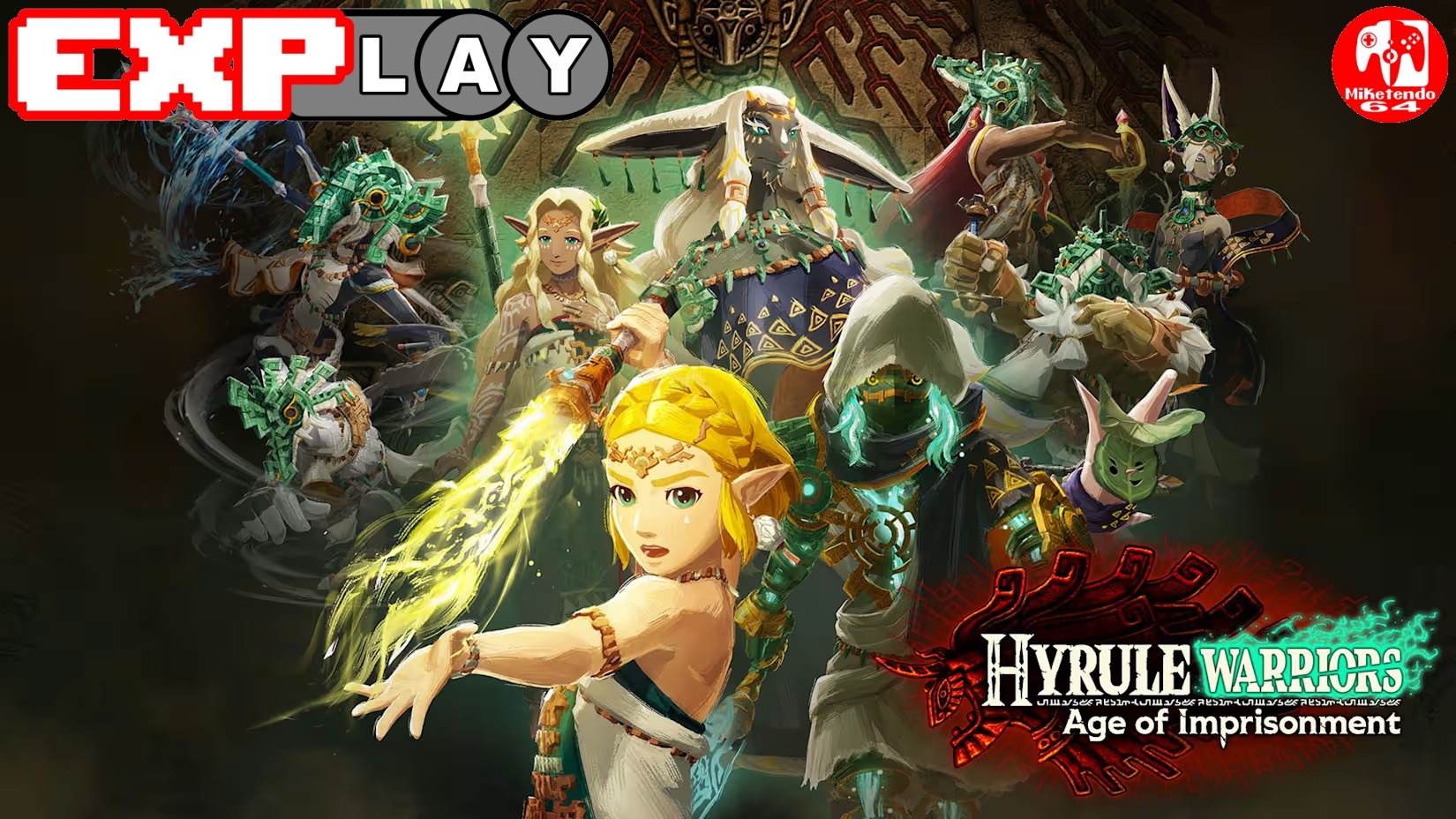
Welcome to EXPlay, (Explain & Play) the review series where we care not for scores, but tell it how it is when it comes to every game we get our hands on, all whilst including some lengthy gameplay, to give you, the reader, the chance to form your own impressions and views while reading and watching.
In this explanatory review, we’re covering Hyrule Warriors: Age of Imprisonment by developer, AAA Games Studio:

Hyrule Warriors: Age of Imprisonment (Nintendo Switch 2)
Developed by KOEI TECMO’s AAA Games Studio, which was founded in 2024, Hyrule Warriors: Age of Imprisonment is the third Hyrule Warriors title. Originally intended as a Nintendo Switch game, Age of Imprisonment ultimately became a Nintendo Switch 2 exclusive and launched worldwide on November 6, 2025.
As a hack-and-slash musou, with musou being the Japanese word for unrivaled and unparalleled, a reference to a character’s unrivaled power when taking on hordes of enemies, Hyrule Warriors: Age of Imprisonment mirrors that of the game that came before it, Age of Calamity, by serving as a continuation to the lore established in a main series The Legend of Zelda game. However, while Hyrule Warriors: Age of Calamity served as a prequel to The Legend of Zelda: Breath of the Wild, only to have time travel shenanigans grant it an entirely different ending, Age of Imprisonment remains faithful to the events of The Legend of Zelda: Tears of the Kingdom.
While acting as a prequel/sequel, Age of Imprisonment is a Warriors game all about the Imprisonment War. Having seen so little of it during cutscenes in Tears of the Kingdom, now players get to experience firsthand the events Princess Zelda had to go through when she found herself transported into the past. Events such as meeting King Rauru and Queen Sonia of Hyrule, meeting their allies and fighting their enemies led by Ganondorf.
With civil war breaking out and Ganondorf hellbent on awakening as the Demon King and unleashing his monstrous army, led by his four Archfiends, the races of Hyrule have no other choice but to band together and do what needs to be done to ensure Hyrule still has a future. It is not completely necessary to have played The Legend of Zelda: Tears of the Kingdom before completely jumping into Age of Imprisonment, but it does help during the lengthy cutscenes, as some scenes are extended versions of the ones first seen in Tears of the Kingdom.
The interesting thing about Age of Imprisonment, however, is that Zelda takes a back seat so other characters can steal the limelight. She’s there, she’s present, and she fights, but she ends up feeling like a side character from the third chapter onwards. This move feels rather refreshing, especially when Age of Imprisonment features 19 playable characters, each one possessing their own unique move set, completely separating them from one another. Age of Imprisonment does a great job of making you care about the sages, and strongly encourages you to play as each one for beneficial reasons, but we’ll get into that a little later.
As a musou game, the majority of gameplay is exactly what you expect: story missions and challenges each take place on a stage. Goals are given, such as defeating specific enemy captains or capturing a predetermined number of outposts, until the ultimate objective of taking down a formidable enemy is achieved at the end of the stage. Combat consists of your typical guarding, dodges, weak attacks, strong attacks, special attacks and an even more powerful special attack, this time around called a Sync Strike.
Sync Strikes are a powerful attack performed by two characters who have successfully filled their sync gauges, with each Sync Strike differing based on which characters you pair up with. Additionally, not only can you perform a Sync Strike with two characters you are in control of, but with NPCs as well. Then there are Switch Attacks, which happen when allies call out to you, allowing you to swap out to them and interrupt an enemy’s Dangerous Attack.
Dangerous Attacks are something only powerful enemies can use. They are depicted via a red aura that radiates around them, but not only can Switch Attacks interrupt them, but so can Unique Skills and certain Zonai Devices. Unique Skills are powerful attacks exclusive to each character, with some geared towards countering an airborne enemy, a charging enemy, or an armoured enemy that needs their armour destroyed so that you can obliterate their weak point gauge and perform a weak point smash. Just keep in mind that once a Unique Skill has been used, the gauge will need to be replenished before another Unique Skill can be used again.
With regards to Zonai Devices, with these replacing the Wizzrobe rods from Age of Calamity, when used, these devices will deplete your energy gauge, but depending on which device is being used, allow your character to throw bombs, use a hydrant to wash sludge off sludge-covered enemies or just freeze certain foes. There are also Fuse Attacks, which are something only a select few characters can use, and see them using the materials you gather against enemy forces.
In short, there are plenty of creative ways to deal damage to powerful foes and since not every character starts as being all-powerful, when not embarking on story quests and challenges, players are free to complete character-specific missions by supplying the recommended materials, which are acquired by completing missions, purchasing from shops, or completing Aside quests, to strengthen them. New skills, bonus hearts can be awarded, and by completing all quests available on the map screen at any given time, you help liberate all of Hyrule from Ganondorf’s forces.
Doing this is not just a necessity in strengthening characters, but by completing every Aside Quest, challenge map, Bonus Conversation and story mission, you can gain access to a second credits scene for Age of Imprisonment, which expands on the first credit scene, which plays out upon beating the game’s six chapters.
Now, in addition to being a perfect way to say goodbye to the world and characters of Hyrule, the likes of Breath of the Wild introduced us to in 2017, and has since expanded into four games, this story-heavy button-mashing masterpiece is the perfect way of giving series fans the closure we need before we move on to the next true Zelda adventure. And we’re not going to lie, it was great to finally see the likes of Agraston the Goron Chief, Qia the Zora Queen, Raphica, leader of the Rito, and Ardi take their place as the sages that helped Rauru to halt Ganondorf.
- 2017 | The Legend of Zelda: Breath of the Wild (Wii U & NSW)
- 202o | Hyrule Warriors: Age of Calmity (NSW)
- 2023 | The Legend of Zelda: Tears of the Kingdom (NSW)
- 2025 | The Legend of Zelda: Breath of the Wild – Nintendo Switch 2 Edition (NS2)
- 2025 | The Legend of Zelda: Tears of the Kingdom – Nintendo Switch 2 Edition (NS2)
- 2025 | Hyrule Warriors: Age of Calmity (NS2)
Each one has their own personality and, spoiler alert, by beating the game’s main story, you get the option to change their attire, which in this case is removing their envoy masks while you finish off every other mission that needs doing. But there are other great characters to use as well, as Calamo the wandering Korok, looking for a place to lay down his roots, is a fantastic character to play as. Sure, his Mysterious Construct companion never utters a word, but Calamo says enough for the both of them.
But it is time to address the lingering questions with the answers you deserve. No, Age of Imprisonment should not have been a DLC for Age of Calamity. It totally holds up as its own game, with amiibo support and plenty to do. In terms of content, it personally took us 42 hours to complete everything, except fully levelling up each weapon and maximising each character’s level. (They are 80+, though with Ardi being the highest as she’s a delight to play as, thanks to her electrifying capabilities.) Koroks are also back, needing to be found once again and everything can be upgraded. From character skills to sensor upgrades, everything can be improved.
As for GameChat and GameShare, both features function exactly as they do with every other title that has come before it. However, performance does dip when using GameShare or playing local co-op. Not only is the screen split in half with player 1 on top and player 2 on the bottom, but gameplay is locked at 30 FPS. It’s still fun to play, however, and less noticeable in previous Warriors titles.
Furthermore, on the upside Age of Imprisonment is one of the best-performing games on the Nintendo Switch 2, as the main campaign runs at a mostly stable 60 FPS, with minor drops in performance, never going below 50 FPS. Dynamic resolution scaling is hard at work, with resolution varying between 720p–900p in docked mode and 468p–648p in handheld mode and fast loading times in both. The only weird thing, though, is that almost all cutscenes are pre-rendered and run at 30 FPS.
In conclusion, on top of being one of the best looking Musou games we have ever played, it’s also one of the most fun. It learned a lot from its predecessor and has surpassed it in almost every way. From its characters, move sets, UI menus, and graphics, it was a fantastic adaptation of Breath of the Wild to the Warriors formula, and we’re glad to say, Age of Imprisonment is even better. AAA Games Studio took the perfect Musou game and made it even better, all while remaining faithful to Tears of the Kingdom’s lore and creating a game that stays true to canon, instead of forging its own path.
Game Specifications:
Developer: AAA Games Studio
Publisher: Nintendo
Platform: Nintendo Switch 2 (Physical)
Genre: Action
No. of Players: 1 – 2 (Single System)
Release Date: November 6, 2025
Price: $69.99
File Size: 43.4 GB
Nintendo.com Listing
