

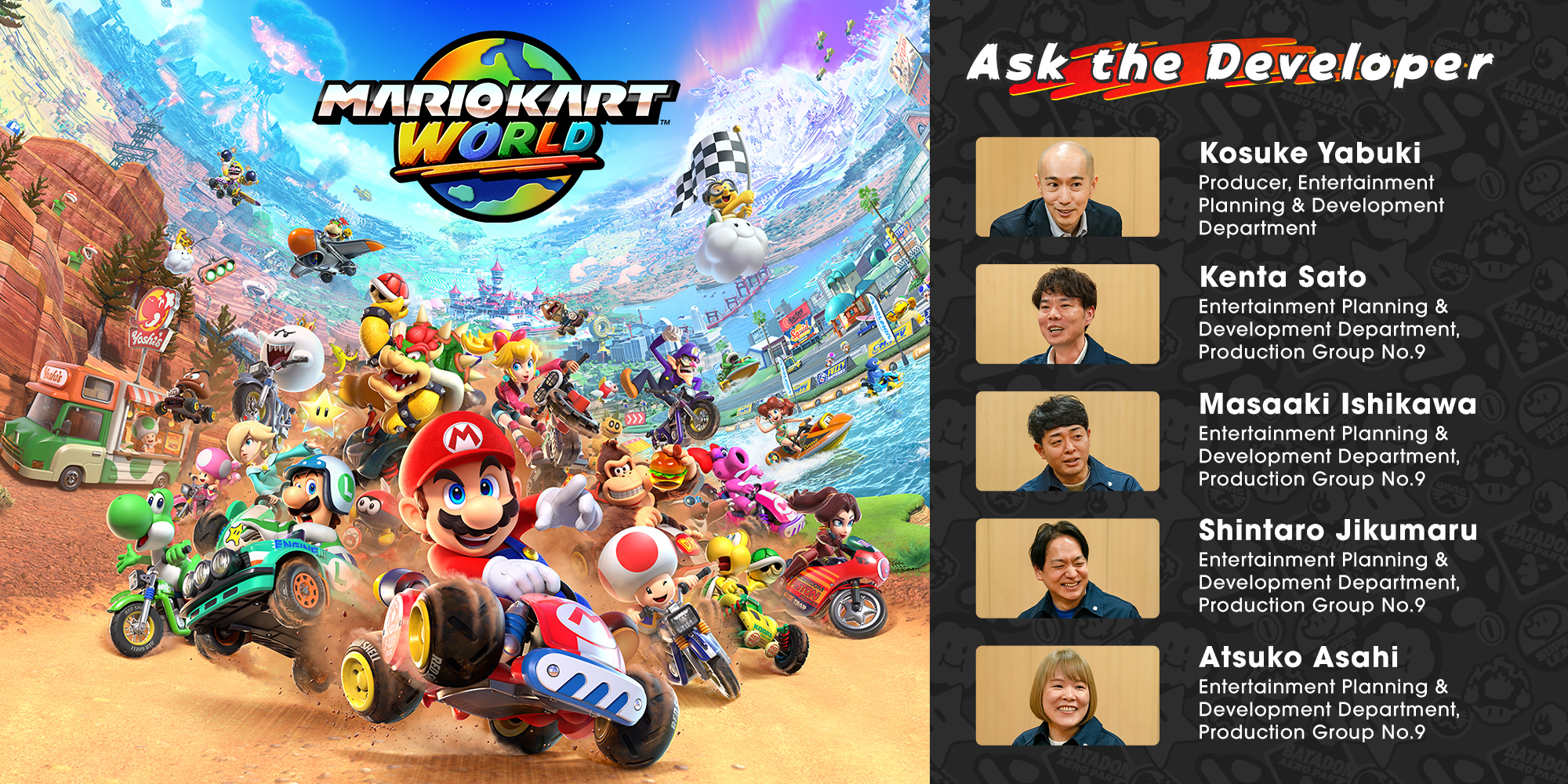
Asked and Answered with the Devs behind Mario Kart World.
With all of the Creator’s Voice interviews now concluded, Nintendo has opted to surprise us all with a brand-new Ask the Developer interview. This time around the focus is on Mario Kart World and five developers are on hand to answer questions covering how long the game has been in development, the fact it started off as a Switch 1 title and how its name was chosen. For every answer going, in this four-part long interview, we get to hear from the following developers:
- Kosuke Yabuki (Producer, Entertainment Planning & Development)
- Kenta Sato (Entertainment Planning & Development, Production Group No.9)
- Masaaki Ishikawa (Entertainment Planning & Development, Production Group No.9)
- Shintaro Jikumaru (Entertainment Planning & Development, Production Group No.9)
- Atsuko Asahi (Entertainment Planning & Development, Production Group No.9)
Chapter 1: Taking it to the next level

Nintendo: First, could you briefly introduce yourselves?
Kosuke Yabuki: Hello, I’m Kosuke Yabuki, the producer for Mario Kart World. I’ve been involved in the Mario Kart series since Mario Kart Wii. I was the director for Mario Kart 7 and Mario Kart 8, and have been working as a producer on the series since Mario Kart 8 Deluxe. I also worked on ARMS as a producer.
Kenta Sato: Hi, I’m Kenta Sato, the programming director. For this game, I mainly provided direction on technical matters. I’ve been involved as a programmer for the Mario Kart series since Mario Kart 8. Besides that, I also worked as a director for ARMS and was in charge of programming the Wii Sports series. I often work on games that are designed to be fun to play together with everyone.
Masaaki Ishikawa: Hello, I’m Masaaki Ishikawa, the art director. I was in charge of crafting the game’s visual direction. I also worked on Mario Kart DS and Mario Kart 7 as a character designer. I was the art director for Mario Kart 8 and ARMS.
Jikumaru: Hi, I’m Shintaro Jikumaru. Leading the planning team, I was responsible for the general gameplay design. I’ve been developing together with everyone here since Mario Kart 8 and ARMS.
Atsuko Asahi: Hi, I’m Atsuko Asahi. For this game, I was the music lead in charge of arranging tracks and working on various things related to the background music. I’ve been involved in the Mario Kart series since Mario Kart 8. Besides that, I also composed music for games such as Super Mario Maker 2, and worked on ARMS as the sound director.
Nintendo Switch game released in June 2019. In this 2D platformer, players can create their own courses by combining different parts.
Nintendo: Thank you very much. To begin with, could you tell us a little about this new game, Mario Kart World, Yabuki-san?
Kosuke Yabuki: Of course. Mario Kart World is the first new game in the series released on a home console since Mario Kart 8 Deluxe, which launched around eight years ago. The game is set in a large, seamlessly interconnected world. In addition to races as in previous games, where you complete three laps of a course, you can also race on the roads that connect different courses or even take part in Knockout Tour races that span the game’s world. In this world, you’ll also be able to experience changes to the environment. This includes the time shifting between day and night and weather changes, such as rain or snow. On top of races, there’s also a mode called Free Roam, where you can drive around the seamlessly interconnected world however you like.
Nintendo: So the various courses are interconnected. Could you tell us how development for this game got started?
Kosuke Yabuki: We were thinking about what to do for the next Mario Kart game even during the development of Mario Kart 8 Deluxe, and we began prototyping in March 2017. It was at the end of that year when we officially started work on it as a project. I felt that in Mario Kart 8 Deluxe, we were able to perfect the formula that we’d been following in the series up to that point, where players race on individual courses. That’s why, this time, we wanted the gameplay to involve players driving around a large world, and we began creating a world map like this.
Nintendo: Looking at this, it’s easy to understand how the world is connected. And on closer inspection, you can see the level of detail that’s gone into it.
Kosuke Yabuki: The higher-density areas correspond to courses like Mario Circuit and Bowser’s Castle in the previous Mario Kart games. Up to the previous game, we created each course separately as an independent element, but this time, we ended up with a map like this because all the courses are connected as part of the same world. In this game, rather than taking the approach of simply increasing the amount of content and adding more variations, such as the number of courses, we wanted to completely change the concept and make it playable in a larger world.
Nintendo: I’d like to ask about the title first. Was it always the plan to call it Mario Kart World, rather than Mario Kart 9?
Kosuke Yabuki: If the idea had just been to add more courses, then I think we would’ve called it Mario Kart 9. But, that wasn’t our approach this time. We wanted to take the series to the next level. So, we decided to drop the numbering this time and go with a completely new title, Mario Kart World. So we’d already added “MARIO KART WORLD” to the concept art from the early stages of development.

Nintendo: Ah, I can see it written there. You must’ve had a consistent vision from the very beginning if the name even shows up on the concept art. By the way, where did the idea of connecting the world come from?
Kosuke Yabuki: In previous Mario Kart games, after finishing a course, you’d move on to the next course. However, I thought that with modern technology, being able to seamlessly transition between courses and realise a single, vast world wasn’t beyond the realm of possibility. So with this in mind, we set out to create a new kind of Mario Kart. …And that’s when all our troubles began. (Laughs)
Nintendo: So that’s how you set out on your arduous journey. (Laughs) Speaking of which, what did everyone else think when you first heard about this concept?
Kenta Sato: I was involved from the start of the Mario Kart World project, and at the time, there were a lot of games out there set in vast worlds. I’ve seen and heard about the difficulty of developing such games, so I was feeling the pressure and wondering if we could really do that with Mario Kart too. Also, we’ve always considered it important for the Mario Kart series to run at 60 fps, and we believe split-screen multiplayer to be an essential element. I was excited, but at the same time, I felt like it would be tough.
Masaaki Ishikawa: I also led the art direction during the development of Mario Kart 8, and even then, the change to HD dramatically increased our capabilities to create some very distinctive courses and lots of characters. Also, we were able to implement visuals from The Legend of Zelda and Animal Crossing in the DLC, so I felt to a certain extent, like we’d achieved everything we wanted. And that’s when I heard from Yabuki-san that we’d be creating a single-world Mario Kart, which I thought sounded pretty interesting. Until now, we’ve only been able to express the world of Mario and other characters through different courses, so I thought this would give us a new way to portray the world and have a lot of potential. So, when I heard the concept, my excitement won out against my expectations of how challenging it would be. In a way, that was when all our troubles began. (Laughs)
Shintaro Jikumaru: I also felt that with Mario Kart 8 Deluxe, we’d pretty much perfected the formula of a Mario Kart game where each course is played separately. In that sense, I felt that a Mario Kart game where you play in an interconnected world would also be rewarding from a developer’s perspective. However, from a player’s perspective, it can sometimes feel particularly disappointing when a sequel changes too many things. So, as someone involved in game development, I felt that our first challenge was to figure out how to add new elements while still making it satisfying for those who’ve played previous Mario Kart games.
Nintendo: Asahi-san, you must’ve also had some thoughts from a sound perspective. What were your impressions?
Atsuko Asahi: “All the different landscapes are connected, and the world is expanding…what am I going to do?!”. That was my first thought. Until then, I’d been composing custom-made tracks for each course based on the weather and time of day. But now, with everything being connected and with the ability to drive anywhere, there are so many more things you need to consider. We need lots of sounds to fill the gaps between courses, and because players take different routes and drive at different speeds, we have to assume that the timing of background music transitions will vary. I thought we’d never finish development if we approached sound creation the same way as before, and I was worried about whether we’d really be able to get it done.
Nintendo: I see. It seems like everyone felt that this was a major change of direction for Mario Kart. What kinds of things, in particular, did you keep in mind when planning and moving forward with this new title?
Kosuke Yabuki: We were careful not to change things that have been important to Mario Kart as a series purely because it’s now set in an interconnected world. As before, we needed to keep the fun of casually playing with family and friends, but also have depth, where players can hone their skills against the online competition.
Shintaro Jikumaru: I think people who’ve played the series up to now are looking for a Mario Kart game that feels familiar to them, so we wanted to make sure we preserved that. This game has some new features like Wall Ride and Rail Ride, but we made sure that you could still have fun playing with just the basic controls without using these new techniques. We implemented and adjusted features with the goal of gathering up all the best bits from past Mario Kart games. During development, Yabuki-san kept saying, “Well, that’s how we did it in the last game”, almost like it was his catchphrase. (Laughs)
Kosuke Yabuki: Due to it being an interconnected world, we had to remake all kinds of features, and we were often discussing whether features from the last game should stay the same or be changed.
Kenta Sato: This time, we refreshed the tools used to create the game, so everything, even the programming systems, has been rebuilt from scratch. …But Yabuki-san insisted that not only the programs and the tools be remade from scratch, but that they should be capable of producing the same level of quality seen in previous games.
Kosuke Yabuki: That’s no easy task, and I often ended up saying, “I don’t get the same feeling as before when I play it”.
Masaaki Ishikawa: On the other hand, the direction of the visual design changed drastically. For Mario Kart 8, based on the concept of vehicles transforming to be like hovercraft, we opted for a futuristic and sophisticated design. Whereas in this game, since you’re driving through all kinds of locations in the world, we wanted to convey the feeling of adventure. We also wanted to create a lively, bustling atmosphere even in a vast world, and we were talking about how we wanted to recapture that feeling from Super Mario Kart, the first title in the series. During those discussions, someone on the team mentioned the key phrase “playfulness”.
From there, we focused on creating a chaotic vibe where anything could happen, like the lively and bustling atmosphere where lots of characters are in a pack, jostling for position.
Nintendo: Indeed, Super Mario Kart gave the impression of drivers being crammed into a narrow course. Looking at it from that perspective, this game does have rounded edges to its visual design, like in the original game.

Masaaki Ishikawa: The characters in the Super Mario series have a rounded look, so we wanted to give the vehicles a rounded design too, to match their appearance. We also wanted to give the characters a livelier look even while they’re in their vehicles, so we put everything together in a way that gives off a sense of playfulness through the combination of the characters’ rounded designs, soft facial expressions, and rich movements.
Atsuko Asahi: The sound was also created based on the theme of playfulness. We revised the audio systems of the in-game space so that the sound effects convey the vast world while maintaining the lively, bustling atmosphere that Mario Kart is known for. The background music features a harmonica with a powerful tone that aligns with the idea of playfulness. It’s featured in various tracks, including the main theme.
The sound also took on a cool, futuristic direction in the previous game, but this time, we increased the proportion of live instruments for a more energetic sound in an attempt to match the brighter atmosphere of the world.
Nintendo: Going back to the lively, bustling atmosphere you mentioned earlier, this game lets up to 24 players race each other. That’s a big increase over the last game. Was this number decided at a relatively early stage?
Kosuke Yabuki: Yes, the previous game was for up to 12 players, and we decided fairly early on that this game would be for up to 24 players. By creating long routes in a vast world, you could end up with players spread out in various places, which could diminish the sense that they’re racing against each other. So we figured that by increasing the number of racers, you’d be sure to see some competitive action here and there. Maybe that’s a bit simplistic. (Laughs)
Kenta Sato: At the time, we were developing Mario Kart World for Nintendo Switch, and we were analysing from a calm and collected programming perspective whether it would be possible to accommodate 24 players. In game development, you first finish making all the different elements and then optimise them to run on the system. But when trying to accommodate 24 players, we had to make all kinds of processing optimisations right from the start as we were making it.
Nintendo: I’m sure you’d already been making huge efforts just to create 12-player races, but suddenly being told you had to double that… If it were me, I’d be at a loss.
Masaaki Ishikawa: But I was happy in terms of the visual design because it would give off more of the lively, bustling feeling. I felt like the 12 players we had previously was a lot, but as Yabuki-san said, once players spread out, the course starts to look sparse, and the visuals give off a sort of lonely feel. So, I thought that 24 players would be better because there’d be more interaction between various players. That said, it was quite challenging once we got going and the volume of design work increased. But it was worth it. (Laughs)
Kenta Sato: When we were developing for Nintendo Switch, it was difficult for us to incorporate everything we wanted, so we were always conscious of what we were giving up in return. We discussed things like toning down the visuals, lowering the resolution, and we even considered dropping the frame rate to 30 fps in some cases. It was a tough situation.
Nintendo: What did you decide to give up on in the end?
Kenta Sato: Well…
Shintaro Jikumaru: …We couldn’t give up on anything. (Laughs)
Everyone: (Laughs)
Kosuke Yabuki: We worked on it while kicking the can down the road in terms of deciding what to give up on, so at some point, we knew it was going to get messy. But as we’d decided to release the Mario Kart 8 Deluxe – Booster Course Pass, we thought that would give us a bit more time to continue development. That’s when the conversation of moving it to Nintendo Switch 2 came up, and this suddenly opened up a bunch of possibilities on what we could do. It was truly a ray of hope.
Chapter 2: A lasting impression

Nintendo: When did you decide to move development of this game to Nintendo Switch 2?
Kenta Sato: Yabuki-san first brought it up around 2020. Back then, we already had an idea of the next console’s expected specs, but it wasn’t until a bit later that we actually received working development units. Until then, we just had to proceed with development based on provisional estimates.
Nintendo: I see, so you had to use your imagination while developing the game.
Kenta Sato: When we were developing for Nintendo Switch, we often worried whether we could find the right balance between planning and performance. Of course, the Switch console’s performance is sufficient for developing different kinds of games, but if we had included everything we wanted to in this game’s vast world, then it wouldn’t have run at 60 fps and would have suffered from constant framerate drops. I think there were a lot of people on the team who were worried about whether we could really manage it. But once we decided to release this game on Switch 2, we expected our worries to evaporate all at once. I remember being overjoyed when I discovered we could express even more than we’d originally set out to.
Nintendo: With the move to Nintendo Switch 2, you were able to implement things you couldn’t previously. On the other hand, didn’t that mean you needed to do a lot more than before?
Masaaki Ishikawa: That’s right. Of course, the graphics needed to be more detailed. But like Sato-san, I also felt like it was outweighed by the sense of relief. From the beginning, the designers were saying they wanted to make the art richer, so I thought we could achieve that now. For example, team members who were creating the terrain in the scenery were really happy because they could now place more trees, which were key to giving the world a more natural look.
Nintendo: Indeed, having trees around makes your surroundings feel more realistic. By the way, the courses in this game are spread across different parts of the world. How did you determine their placement and design the surrounding scenery?
Masaaki Ishikawa: Jikumaru-san drew up a rough map for us to start discussing where to place them. We first placed the existing courses in the world based on the directions of the compass and created a setting for them. For example, the climate gets drier as you go west, so we thought we could place the Shy Guy Bazaar course from previous games with its palace in this area, and perhaps place the Desert Hills course nearby. Going northeast, we thought we could make this region colder with a steep, snowy mountain as a landmark, and have a course where you can race at its peak. When designing courses based on the climate, we also tried to be creative so that the routes that connect courses are seamless and that the scenery around you changes before you know it.
Shintaro Jikumaru: Each individual course has its own distinct characteristics, so connecting them all was pretty tricky. We had to place existing courses in a way that fits the context of the world without losing what makes them special.
Masaaki Ishikawa: I recall the team lead for terrain telling us that we need to keep context in mind. Each course was built around its own unique and distinctive concept, so if the landscape between the courses was barren, then it would feel like the world was just divided into chunks. That’s why it’s important to establish a context that connects them in a way that feels natural while making use of contrast to create surprises. For example, we thought it would be good if, from Mario Bros. Circuit, you could keep driving down a wide road like Route 66. The scenery would gradually thin out, while up ahead you’d see a landmark that resembles Monument Valley, and the road would ultimately connect to a big city.

We wanted players to experience being in the next area before they knew it, so we had to work out where to put impactful changes in scenery like landmarks so that we could realise that while still making it seamless.
Nintendo: I see. That’s the challenge of putting existing courses into a new world, isn’t it? Incidentally, how did you go about crafting background music that would raise the excitement further?
Atsuko Asahi: First we created music for the courses like we’ve always done before and then thought about what to do for the roads outside the courses. We decided to have two different kinds of music depending on how you’re playing. For the Knockout Tour mode, we started off by simply trying to connect the course themes. But that approach didn’t work well. It ended up sounding weird because the tracks have different tempos and beats. So we decided to find a way to end each of the course themes, even though they’re connected by the route. Video game music often plays on a loop, and in this game too, the same music keeps playing if you’re driving laps around a course. But for Knockout Tour, as you get closer to the next course, the music transitions to the outro, so the theme ends nicely. We also created a new intro for each course theme which starts to play shortly before you reach the gate, building excitement. Then, as you actually pass through the gate, it changes to the theme of the course you’ve entered. By repeating this, it feels like a medley is playing along to you live, creating a sense of immersion.
Nintendo: So, what did you do with the music for modes like Free Roam, where the route isn’t fixed?
Atsuko Asahi: For other modes like Free Roam, we prepared lots of music in addition to course themes and made it so the game would automatically select the right track depending on the situation. During development, we called this the “jukebox”. For this, we created lots of arrangements of music composed for past Super Mario and Mario Kart games.
Nintendo: You’re not only rearranging the music but also revamping the mechanism for how the music is selected and played, right? You said you created a lot of musical tracks, but how many pieces did you end up with?
Atsuko Asahi: Altogether, over 200 for the “jukebox”. These are all brand-new arrangements, and we also did live recordings. We prepared pieces from quite a wide variety of musical genres. I believe those who are well-versed in video game music, as well as those who aren’t, will enjoy listening to them.
Nintendo: In this game, not only are all the courses interconnected in a single world, but the weather and time of day also change, right
Masaaki Ishikawa: Exactly. Whenever designers get the chance to create such a vast world, they tend to become bold and adventurous, fully aware that it means a much higher volume of content that they need to work on. What if we could make the scenery in this interconnected world change with the time of day… What if we could create a world that looks as if people actually live there… We thought this would be so nice and make the game so full of emotion, that it led to the creation of sketches like these.

Shintaro Jikumaru: But we spent a long time discussing within the team whether we could really implement time and weather changes.
Masaaki Ishikawa: Right, the sheer volume of work required to prepare all the art needed to show time and weather changes in a seamless world… We were under no illusion. (Laughs) We were even on the verge of giving up on it at one point.
Kenta Sato: But the appeal of having time and weather changes won out. So we decided to try and find a way to implement this feature that we’d initially considered giving up.
Kosuke Yabuki: Also, in terms of course design, if the time of day and weather are fixed, then it’s easier to create the clearest path under those conditions. But even just with changes in brightness or the angle of the light, we have to check multiple variations and adjust them accordingly. In that sense, everyone was happy that they could achieve more things, but I’m sure they also ran into a lot of difficulties when it came to actually making it.
Masaaki Ishikawa: Yup, it was even worse than we imagined. (Laughs) But the graphics programmers were also determined to create something good and worked ambitiously to make it happen, rallying support from various people.
Kenta Sato: The programmers were also worried about how they were going to work together to handle this volume of content. We knew what we wanted to do, but the big challenge was working out how we could actually complete it. That said, we thought it might be possible if we could change our development approach in a way that reduces the workload.
Nintendo: I see. So you altered your programming workflow to overcome the unprecedented volume of content. All thanks to that, you can now really sense the flow of time when you’re driving around and the scenery and weather change naturally.
Shintaro Jikumaru: We designed it so that a day in the game passes in around 24 minutes. You easily get a sense of how time passes in the game, since it happens faster than in real life. But the time doesn’t progress evenly, does it?
Masaaki Ishikawa: At first, we made the colour of the sky gradually change over time, but in many cases, we considered the time and scenery together. For example, we wanted players to be able to experience the desert at night. In this case, when there’s a particular scene we really want players to see, we didn’t think such a feature would work, as players might drive through that location at the rather bland time between evening and night. So I discussed this issue with the programmers, and we decided to focus on the most appealing times of day and dramatically shorten the transitions between day and night.
Kosuke Yabuki: Rather than having the time change in accordance with the real world, we prioritised it working well with the gameplay. Besides that, in terms of weather changes, sometimes it will rain or snow, or there might be a flash from the Lightning power-up followed by a sudden change in weather. For these kinds of things as well, we were thinking about how we could make a lasting impression on players and what kinds of effects would be fun for them as they drive around. For the background music, we took songs from a variety of previous Super Mario games and arranged them into fun driving tunes, which I think will add an extra layer of enjoyment for players.
Atsuko Asahi: The “jukebox” feature will have you racing towards Bowser’s Castle while listening to Bowser’s Road from Super Mario 64 or going for a nighttime spin while soaking in the Rainbow Road theme from Super Mario Kart. During the daytime, various bright and cheerful tracks play. In the evening and at night, the arrangements are more chilled. We recorded a band arrangement for the Staff Credits theme from Mario Kart DS in a style that fits this new game, and I personally was really moved when I listened to it driving around during the game’s evening scenes. You can enjoy it even without knowing the original tracks, but I think someone with fond memories of playing various Super Mario games will feel a wave of nostalgia listening to these tunes as they drive around.
Nintendo: I see. So you had to get creative in order to put together this interconnected world. On the other hand, I’m sure you’ve included lots of new gameplay elements in this game. Can you tell us how you went about making those?
Shintaro Jikumaru: Mario Kart is a series of racing games that has placed a lot of emphasis on “drifting” over the years, so the courses were designed with lots of bends. But in this game, since you’re driving around an interconnected world, we needed to make it fun to drive not only around corners, but also in a straight line.

Nintendo: Make it fun to drive in a straight line? How did you approach that?
Shintaro Jikumaru: For example, when going from point A to point B, we tried placing lots of bends along the way like we always do. But with too many bends, you lose sight of your destination. Then your goal of travelling from point A to point B becomes more difficult. That said, driving for ages down a straight road isn’t much fun either. So we figured what we were lacking was some kind of gameplay mechanic for straight roads, and that’s where the idea for some of the game’s new elements, such as Rail Ride and Wall Ride, came from. The development team collectively referred to these new features as “tricks”.
Kosuke Yabuki: If everywhere’s just straight roads, it’s going to feel the same no matter where you drive.
Shintaro Jikumaru: With such a vast world, we thought it’d be a shame if you were just driving in a straight line the whole time. Then, we found a hint from a book that said, “Skateboards create infinite possibilities in a city with just a single piece of wood”. Tricks can open up a multitude of driving possibilities for just a single wall or dirt track. We thought it would be fun to be able to drive in completely different ways just based on the player’s imagination, so we made the gameplay more varied. For tricks like Rail Ride and the Wall Ride, we referenced extreme sports like skateboarding, snowboarding, and BMX.
Kosuke Yabuki: I think these tricks will really give players a chance to use their imagination as they come up with ideas like “I’m gonna drive up that wall”, “Let me use that pillar”, or “Can I ride that guard rail or power line?”.
Nintendo: I see. But if you give players more moves, then you also need to design courses that account for them, right? How many courses are in the game?
Kosuke Yabuki: In this game, you don’t just race on the courses. The areas between courses are also used for racing. So it’s as if there are courses spread out all over the world, and if you were to add up all the possible variations, it would easily exceed 100.
Nintendo: Hang on, Yabuki-san, didn’t you say earlier that it wasn’t about increasing the amount of content?
Everyone: (Laughs)
Kosuke Yabuki: Since it’s now a single, interconnected world, it’s hard to do a direct comparison with the last game, but in the pursuit of approachability and fun in this new, vast world, the volume of content we had to create in terms of visual design, programming, and audio increased dramatically. And as a result, the gameplay is more varied than ever before.
Chapter 3: An interconnected world

Nintendo: You mentioned that the amount of content ended up increasing. You also drew a lot of concept art for this game.
Masaaki Ishikawa: The designers came up with various ideas, thinking that if the theme was a vast world, they could show things other than racing. There were sketches of characters, scenery, costumes that matched the various landscapes, characters eating… We had a vast, interconnected world in mind, so a good deal of the concept art depicted scenes of people’s lives there. We designed the costumes and vehicles as a set and created these poster-style designs.
Nintendo: Oh, even though it’s Mario Kart, there are some that show the characters eating food instead of driving a kart.
Kosuke Yabuki: The idea of showing characters eating a variety of foods came up early on in development.
Shintaro Jikumaru: If you’re travelling through a vast and diverse world, you can’t leave out the local food that’s unique to each place. But actually, we did consider removing the food feature at one point. Incorporating it into the game means adding not only the food itself, but also the stores that sell it and the staff that work there, which would mean even more content.
Nintendo: But you came back to this idea later?
Shintaro Jikumaru: Yes, while development was ongoing, about two years after the idea came up, I thought to myself, “You know what? I need food!”. (Laughs) Unable to let it go, I asked the programmers to implement a hamburger model I’d created and make it so that the characters could eat it. It was well received within the team, and the designer started to churn out different kinds of food. Before we knew it, the number of variations had exploded.
Masaaki Ishikawa: The designer in charge was really pumped up about creating them. We’ve incorporated lots of Mario-inspired twists and titbits to create a wide variety of designs. I also had a lot of fun looking at those designs.

Kenta Sato: Food is sold at “Yoshi’s”, fictional drive-thru restaurants located all over the game’s world. Yoshi and his friends make food inspired by each area.
Nintendo: So, “Yoshi’s” is a chain of drive-thrus that’s expanded across the world.
Masaaki Ishikawa: Exactly. For example, a Yoshi’s drive-thru located in a volcanic region would look like a volcano and sell piping-hot soup inspired by Bowser. (Laughs)
Shintaro Jikumaru: As we were making these various concepts, Yabuki-san comes marching up to me and says, “When Mario eats something, he transforms”. He sounded pretty serious about it. (Laughs)
Kosuke Yabuki: Originally, we were creating the various outfits separately from the foods. So, we wondered if we could combine those two elements.
Nintendo: Oh, so the foods and outfits were unrelated at first?
Kosuke Yabuki: Yes, they were two completely separate elements. We discussed the idea of using coins to buy clothes from clothing stores, but that would have meant stopping at stores to shop, which would have disrupted the flow, given that this is a world where you can keep driving. That’s when the idea of food came up. We thought, why don’t we have a drive-thru system where characters eat while driving, and eating makes them change outfits or transform into a different character? Though, it’s utterly ridiculous. (Laughs)
Nintendo: But in the world of Mario, it probably doesn’t feel so strange.
Kosuke Yabuki: Then, the question came up: “Does Mario, in fact, eat mushrooms?”. (Laughs)
Jikumaru: So in the midst of development, we went up to Tezuka-san and asked him to confirm, “Is Mario actually eating those mushrooms?”.
Kosuke Yabuki: That’s right. And Tezuka-san answers, “Yeah, he is”.
Everyone: (Laughs)
Shintaro Jikumaru: Plus, the idea of eating food from a particular region and then changing into an outfit associated with that region fits the game perfectly. As you’re racing, it’s a real delight to see players changing one by one into the local outfit for that area.
Kosuke Yabuki: Not all characters have outfits that change by eating food, but some have a variety that you can pick up while driving around and eating, so we hope this will be a good incentive for players to try out different characters.
Nintendo: Now that you mention it, some of the new characters in this game seem like unlikely picks. I was surprised to see Cow as one of the playable characters.

Kosuke Yabuki: That’s right. In previous games in the series, Cow was part of the scenery or an obstacle on one of the courses. But when we were working on an early version of a course in this game set on a ranch that players can drive through, this sketch came up. (Laughs)
Nintendo: Oh, I thought Cow was just on the back of the truck, but she’s actually driving it. (Laughs)
Masaaki Ishikawa: Each new Mario Kart game features new characters to race with, but since we added so many to the previous game, we wondered where we could go from there. And then one of the designers came up with that silly sketch of Cow cruising along, and I thought to myself, “This is it!”. (Laughs) So that’s when we realised the course surroundings actually contained a lot of untapped resources.
The character designer quickly put together a prototype of Cow that could race, and surprisingly it didn’t feel out of place at all. So we thought maybe we could include other obstacle characters, and decided to add Cheep Cheep and Pokey as racers. As a result, the idea of taking obstacle characters, usually found in courses in past games, and having them participate in races made sense to me in terms of an interconnected world.
Kenta Sato: We called these types of characters “NPC drivers”. In other words, non-player character drivers.
Kosuke Yabuki: So it was like, “They’re NPCs, but they’re playable? Which is it?”. (Laughs) It’s pretty funny to see a four-legged Cow holding onto motorcycle handlebars with her front hooves.
Masaaki Ishikawa: But when she jumps, she strikes a proper quadrupedal pose. So I’m pretty sure Cow is still in touch with her animal nature. (Laughs)
Shintaro Jikumaru: It was thanks to the introduction of various “NPC drivers” that the idea to have Kamek appear as an item was born. When Kamek casts a spell, the racers are transformed into playable NPCs, so one by one they might all turn into Cow mid-race. I think it turned out to be a unique item that has never been seen before. In fact, Cow is a character who’s inspired a lot of different ideas, including obstacle characters like Camel and Giraffe.
Massaki Ishikawa: Cow is actually a pivotal character in the Mario Kart series. (Laughs)
Atsuko Asahi: On the other hand, when previously non-playable characters like Cow become playable, it means giving them new ways to express emotion, which must have been difficult for the voice lead. We were conscious of depicting the personalities and characteristics of “NPC drivers” in a way that doesn’t look inferior to classic characters like Mario. The voice team members went through a lot of trial and error in the pursuit of the ideal sound. In addition to more characters, this game also has a wider selection of vehicles for characters to drive, so it was a huge task to create engine sounds that matched the characteristics, such as the appearance and structure, of each vehicle. We tried out a lot of different sounds in our search for something ideal – we even used croaking frogs and beating drums. (Laughs)
Kenta Sato: There are a lot of vehicles in this game, too. Since the game is about racing around the world, we’ve included not only race karts, but also everyday vehicles. It must have been tough for the designers, as they had to not only design the body of the vehicle, but also consider how the tyres would transform when drifting and how the vehicle would move when jumping.
Nintendo: I see. Because players are driving in a vast, interconnected world, you designed vehicles that can handle a variety of driving styles and circumstances.
Masaaki Ishikawa: That’s right. For example, the Standard Kart has a higher ride height in this game, and suspension movement has been added so that when you drive it, the tyres move in accordance with the unevenness of the surface and your actions.
Since players are driving in a vast world, we wanted them to enjoy racing not only on asphalt, like on a racetrack, but also on rough, off-road surfaces. This was made possible thanks to the programmers’ careful attention to the vehicle movements. We also wanted it to be fun to choose a vehicle based on the world’s different locations and situations, so we tried to make the lineup as varied and distinct as possible.
Nintendo: In terms of the design, in the previous game, Mario Kart 8 Deluxe, you drove underwater, but in this game, you can drive on water, right?

Kenta Sato: Yes. Since you drive on water, we put a lot of effort into the wave graphics, too. Not just how they look – our up-and-coming programmers also implemented simulations, such as ripples spreading when something drops in the water, or waves appearing after a vehicle passes through. They made it possible to create waves on demand. This game has enemy characters that create waves when they attack, so we were able to incorporate players jumping on those waves into the gameplay.
Shintaro Jikumaru: Racing on water is something this game has in common with Wave Race 64.
Masaaki Ishikawa: That’s right – when it came to the jumping action, Jikumaru-san, you were very particular about the whitecaps of the waves, right?
Shintaro Jikumaru: Ah, you noticed that. (Laughs) If you want an exhilarating jump on a wave, you need to be able to see the crest of the wave to gauge the timing of your jump. But with regular wave visuals, it’s hard to tell where the crest of the wave is. That’s why I asked for white foam, or whitecaps, to be added to the crests. I was like, “Hmm, I don’t see any whitecaps on the waves…”. Then the programmers would say, “How about now, Jikumaru-san?”. And I’d be like, “I still can’t see it! Just a little more!”. We went back and forth like this for a while before the job was done. The programmers really worked hard. Thanks to that, I think jumping on waves has turned into a nice little gameplay element.
Nintendo: Was that also part of your commitment to user-friendliness?
Shintaro Jikumaru: Yes. But while we continued to work on this, the designers started to request different ways to express water, not just from a gameplay perspective, but also in terms of the visual portrayal of beaches and shoals.
Masaaki Ishikawa: I wanted to show the shoal floor through the crystal-clear water. At first, we were worried that we wouldn’t be able to show the shoal floor because it was demanding on the processor. But our programmers made improvements here and there, and we were able to make it happen. Even with the familiar Koopa Troopa Beach course, we were able to create the visuals we wanted to show… Thank you for that, Sato-san.
Kenta Sato: Because we were so particular about this, the designers needed to toil away to make the shoal floor visible. (Laughs) But thanks to their efforts, it improved the quality of the graphics.
Masaaki Ishikawa: You must’ve also worked hard to create the sound you hear when driving on water, right, Asahi-san?
Atsuko Asahi: That’s right. Unlike driving on land, when driving on water, the vehicle bobs up and down along with the movement of the water. The sound is designed to correspond to the vehicle’s movement and orientation. It was created with great attention paid to even the most delicate sounds, so please listen out for it when you’re driving on water.
Chapter 4: A new generation of Mario Kart

Nintendo: We talked earlier about approachability. The Mario Kart series has also been enjoyed by those who are less familiar with video games. Is there anything you’ve paid attention to in terms of making this game approachable?
Masaaki Ishikawa: This extends beyond those who aren’t very familiar with video games, but we’re making a conscious effort to create courses that are comfortable and satisfying to play. We sprinkled the terrain with what our team has been calling “landmarks”, such as mushroom-shaped mountains. These are designed to be easily recognisable and intriguing, so that players’ eyes are naturally pulled towards their destination. We could just have used arrows to point players in the right direction, but that would have just made the world feel cramped. We felt it was important for players to be able to sense which direction they should be heading while racing so that they’d think to themselves, “Looks like a right turn is coming up”.
Kosuke Yabuki: Everyone kept saying, “We’ll put up signs later”. (Laughs)
Shintaro Jikumaru: But since players are driving around a vast world, we needed a style of signpost that suited the game. Sometimes we needed to clearly indicate the route, for example, “This is a crossroad, but in this race, you turn right”, to ensure players wouldn’t get lost. In such cases, we made efforts to vary up the terrain, such as by placing what we call “banked parts” to guide players so they intuitively understand which way to go.
Players will be racing each other at high speed, so we don’t want to add in the distraction of, “Which way am I supposed to go now?”. It’s something that’s been fundamental to the Mario Kart series to date.
Nintendo: Right. So, rather than explicitly showing the way with arrows alone, you designed courses to be intuitive, creating a sense of continuity while still making the driving experience pleasant. But isn’t there a difference between where beginners get stuck versus where advanced players get stuck?
Shintaro Jikumaru: I’ve been working on the Mario Kart franchise for a long time, so I think I’ve got a good sense for how advanced players think. But newcomers to the series or those less familiar with video games might get stuck in places that we as developers didn’t expect. So, when designing gameplay in any game, not just this game, it’s important to have less experienced players test it out. Some members of our development team aren’t that good at Mario Kart, so we’ve marked them out as our “favourites”. (Laughs) We handed the game to a developer with just the right degree of unfamiliarity and said, “Off you go!”. We had them play next to us, and we were like, “Oh, so you don’t get that. Interesting!”. (Laughs)
Kenta Sato: Wait… Are you talking about me?
Everyone: (Laughs)
Shintaro Jikumaru: It’s true, Sato-san is one of my “favourites”. (Laughs) In particular, we felt we needed to see people like him play the P Switch Missions that come up in this game’s Free Roam mode. Unlike traditional courses, where we’ve accumulated a lot of know-how, the P Switch Missions were our first attempt in this game at something like this, so we particularly valued the feedback we got from those who played them. We got people who aren’t good at Mario Kart to actually play it, and we were like, “Yep, we thought that part might be challenging!”. (Laughs) By repeating this process, we made improvements so that even those less familiar with games can enjoy this title.
A challenge that begins when you drive over one of the P Switches scattered around the world in Free Roam mode. There are various missions, such as driving through a row of gates within the time limit and collecting coins.
Atsuko Asahi: P Switch Missions involve going to places you normally wouldn’t, or repeating actions you wouldn’t often perform. But when you go back to racing after completing a mission in Free Roam, you’ll realise, “Hey, I know another route here!” and feel like you’ve improved a bit.
Shintaro Jikumaru: In Mario Kart, we think it’s best for players to discover different ways to play as they drive around, so one of our goals was for players to naturally pick up skills as they play through the missions.
Kosuke Yabuki: Our commitment to approachability extends beyond the gameplay itself. The Mario Kart series often brings people together during the holiday season who wouldn’t usually play games. So, we’ve designed the menu screen so that you can select the number of players and get started right away. The world’s much bigger in this game and there are loads more things you can do, but we didn’t want it to become so complicated that it takes ages just to start a game.
Kenta Sato: The Smart Steering assist feature from Mario Kart 8 Deluxe has also been improved. When it’s activated, you won’t fall off the course or get lost, so even small children or those less familiar with video games can make it to the finish line.

Kosuke Yabuki: We’ve also created a Joy-Con 2 wheel accessory for Nintendo Switch 2. So it’s intuitive even for those who aren’t used to steering with a control stick, and they can enjoy the feeling of driving a kart. The colours are also specifically designed for Switch 2, and the magnets make it easier to attach the Joy-Con 2 controllers.
Nintendo: I see you’ve added lots of thoughtful touches to make it distinctively Mario Kart. By the way, as a Switch 2 game, it supports GameChat, one of the console’s features. How does GameChat add to the gameplay experience?
Kosuke Yabuki: In this game, you can go for a drive with friends in Free Roam mode or take pictures together in Photo Mode, and I think the addition of GameChat offers you even more possibilities. Other players can share their screens with you, so you can say things like, “I see you’re in the desert, I’ll swing by”.
Kenta Sato: Also, in previous Mario Kart games, you could see your opponents’ names above their vehicle, but if you’re using a camera for GameChat, they can see your face in real time. If everyone uses a camera, it makes it easier to see who’s playing as each character, but it’s also fun to see the other person’s expression when you hit them with an item. (Laughs)
Masaaki Ishikawa: That look of mild despair. (Laughs)
Kosuke Yabuki: Since the very beginning, Mario Kart has been a game you can enjoy with others in split screen. Then, online and local wireless play were added. Now, with GameChat, you can even chat with other players and see their faces online, so I think it’s taken its next evolutionary step.
Nintendo: That does sound pretty interesting. Finally, could you each say a few words to everyone who’ll be playing this game?
Atsuko Asahi: Earlier we talked about the large amount of content in this game, but more importantly, I think it’s shaped up to be a game that can be played for a really long time. What I personally like about the game is that you can experience something new each time you play, mixing up your choice of characters, vehicles, and where you drive in the vast world. I encourage players to snap lots of pictures in Photo Mode and create lots of memories.
This game has more music tracks than any other game in the series. We want players to stay engaged with this vast world for a long time without getting bored and hope the soundtrack will support those efforts. We poured a lot of effort into each and every song. Our goal was to create distinctive music that’s fun just to listen to while driving around. We also worked hard on the sound effects so that you can hear the changing scenery. So if you can, we’d love for you to turn up the volume on your TV or console while you play.
Shintaro Jikumaru: In addition to the vast world, we’ve added new elements such as Rail Ride and Wall Ride to allow for even more diverse driving styles. Players can discover various ways to play with these new elements, but it means they might find routes or techniques that we developers didn’t expect, which is quite terrifying… (Laughs) I think it’ll be fun not just for newcomers, but also for advanced Mario Kart players who’re into Time Trials. We’ve also added new modes and missions, so we hope you’ll experiment with various ways of driving in this vast world and continue enjoying the game for a long time to come.
Masaaki Ishikawa: As a designer, I started this project wondering, “Can we really make all of this?!”. But looking back on it, this huge challenge allowed us to have fun creating lots of different things with close attention to detail. In previous Mario Kart games, the courses were separate and could only be viewed one by one. But now they look different depending on the angle, time of day, and mode you’re playing. We’ve packed a lot of details into them. In fact, even for a single roadside sign, there’s a relationship between that sign and another sign a little further away. Lots of elements went into creating a continuous world, so we hope you’ll enjoy taking a breather between races and partake in some Free Roam to discover new things. By the way, this game’s road sign designs are also available as stickers you can stick onto your vehicle, so be sure to collect your favourites and have fun equipping them for races and Free Roam mode.

Kenta Sato: Even when driving along the same road, the scenery changes depending on the weather and time of day, so it feels like you’re heading somewhere new every time. So no matter how many times you play, it never feels like you’ve experienced everything the game has to offer. We hope you continue playing for a long time and experience new moments on every drive. One more thing I’d like to highlight is the replay feature. Once the race is over, you can rewind and fast forward to review your performance. We hope you’ll replay your funniest and best moments when playing with friends, and take some beautiful snaps in Photo Mode.
Nintendo: Now, Yabuki-san, please could you share some closing remarks?
Kosuke Yabuki: Mario Kart is a game where anything can happen. We developed this game hoping for players to experience those moments where they think to themselves, “I can’t believe what just happened!” and I believe we’ve achieved just that. Even if it’s been a while since you last played a Mario Kart game, I hope you’ll be motivated to come back to the series and re-experience such moments. I’m sure some of you reading this right now have played Mario Kart 8. It’s been over 10 years since that game was originally released. We’d like to thank everyone who’s played it or Mario Kart 8 Deluxe. We believe that Mario Kart World marks the dawn of a new generation for the series, so we hope you’ll give it a try.
Nintendo: So you also felt a sense of accomplishment, Yabuki-san.
Kosuke Yabuki: That’s right. This game will lead the new generation!
Everyone: Woah!
Kosuke Yabuki: …Or so I’d like to think. (Laughs)
Everyone: (Laughs)
Nintendo: In this new game, Mario Kart World, players can race around a vast, interconnected world. I’m looking forward to seeing what experiences await us there. Thank you very much.
End of Interview
Are you looking forwards to the release of the Nintendo Switch 2 and Mario Kart World on June 5, 2025? Did you have any luck ordering your preferred version of the console? Let us know!
